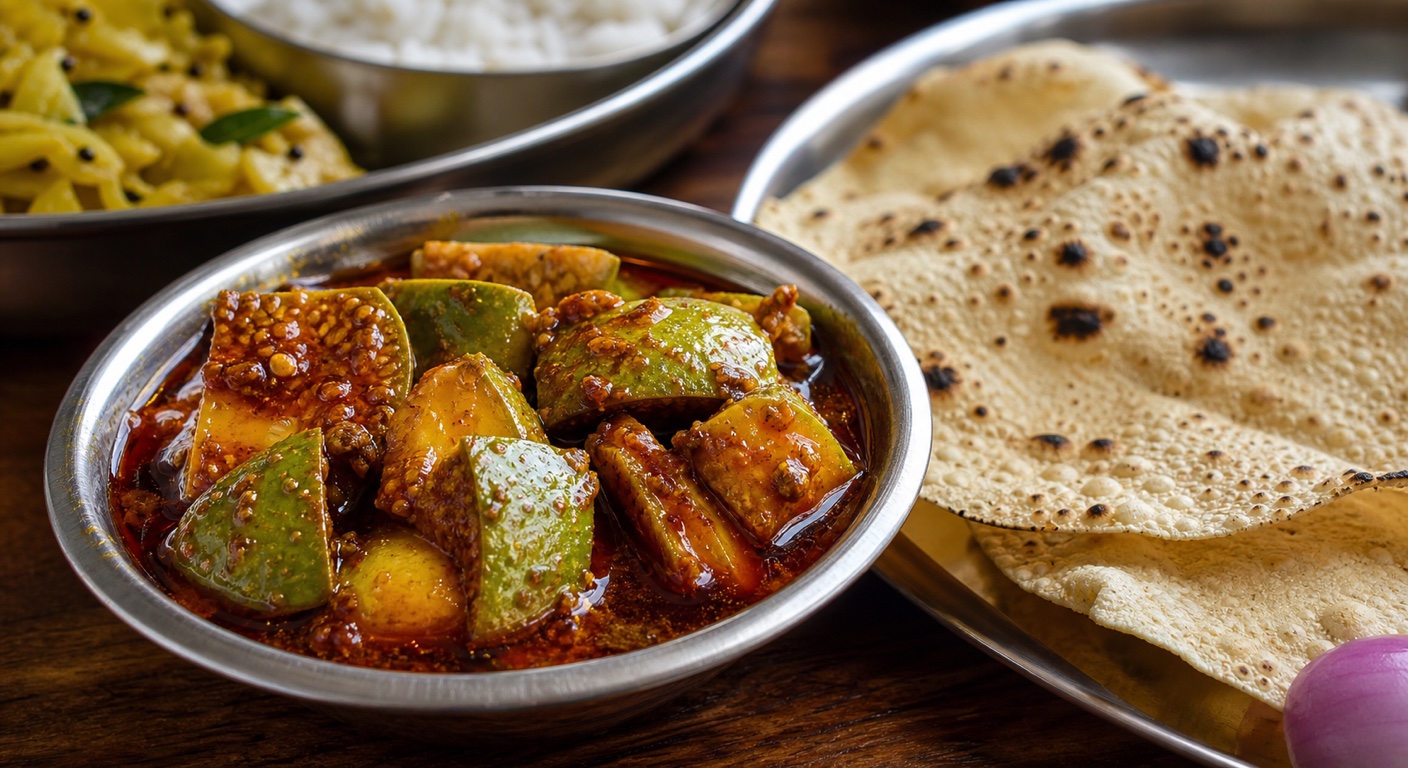
I love achar and papad with my thali - are they secretly adding up?
Achar and papad don't feel like 'food' - they feel like garnish. But a fried papad and a spoon of oil-packed pickle together run about 125 kcal, and the oil is doing almost all of the work. Roasting the papad and picking a lighter pickle barely changes how the meal feels.
Nobody sits down and 'has' papad and achar the way they have dal or rice - they're just there, on the side of every thali. But a fried papad and a spoonful of pickle both carry real calories, almost entirely from oil, and it's easy to have two or three helpings without ever noticing. Every figure here comes from a real nutrition source, rounded and given as honest ranges.
Your thali's papad and achar
One fried papad (about 15 g) and one tablespoon of a regular oil-packed pickle come to roughly 125 kcal together - a number most people never count because neither item feels like a real part of the meal.
Assumptions: 1 fried papad, ~15 g, estimated at ~79 kcal by scaling a verified fried-papad rate of 500-550 kcal/100 g (midpoint ~525 kcal/100 g) down to a 15 g piece + 1 tbsp regular mango pickle in oil, ~45 kcal.
Ask for it roasted (bhuna), not fried
A roasted papad has the same crunch and spice without the oil bath. It comes in at about 56 kcal against roughly 79 kcal for a fried one of the same size.
One papad is a garnish; two is a side dish
It's easy to take a second papad because it's thin and feels weightless. A second fried papad adds another ~79 kcal on top of the first.
Delta compares 1 fried papad (~79 kcal) against 2 fried papad (~158 kcal).
Pick a zero-oil pickle over an oil-packed one, spoon for spoon
Some pickles, like an instant zero-oil lemon pickle, skip the oil almost entirely. A tablespoon comes in at about 7 kcal, against roughly 45 kcal for the same spoon of a regular oil-packed mango pickle.
Achar is a condiment, not a side - one spoon, not a heap
Because a tablespoon of pickle looks small next to a full thali, it's easy to take two. Sticking to one level spoon keeps it at about 45 kcal instead of 90.
Delta compares 1 tbsp of regular oil-packed pickle (~45 kcal) against a heaped 2 tbsp serving (~90 kcal).
Small tips that add up
- The oil is doing almost all of the work in both papad and achar - the papad itself or the fruit barely counts.
- Don't stack every change - a roasted papad plus one modest spoon of achar already covers most of it.
- If you love the oil-packed pickle, treat it like a condiment: a teaspoon of the oil-and-spice paste is enough to flavour a whole bite of rice.
- A thali without papad or achar isn't more virtuous - these are small numbers next to the meal itself. The point is just not to double them without noticing.
The bottom line
A fried papad and a spoon of oil-packed pickle together run about 125 kcal - almost entirely from the oil, not the papad or the fruit itself. Roasting the papad and choosing a lighter, lower-oil pickle can bring that down to well under half, without changing what's actually on your thali.
Best-case recipe, computed independently: One roasted papad (~56 kcal), computed independently, with a single tablespoon of a zero-oil lemon pickle (~7 kcal) instead of a heaped spoon of oil-packed achar.