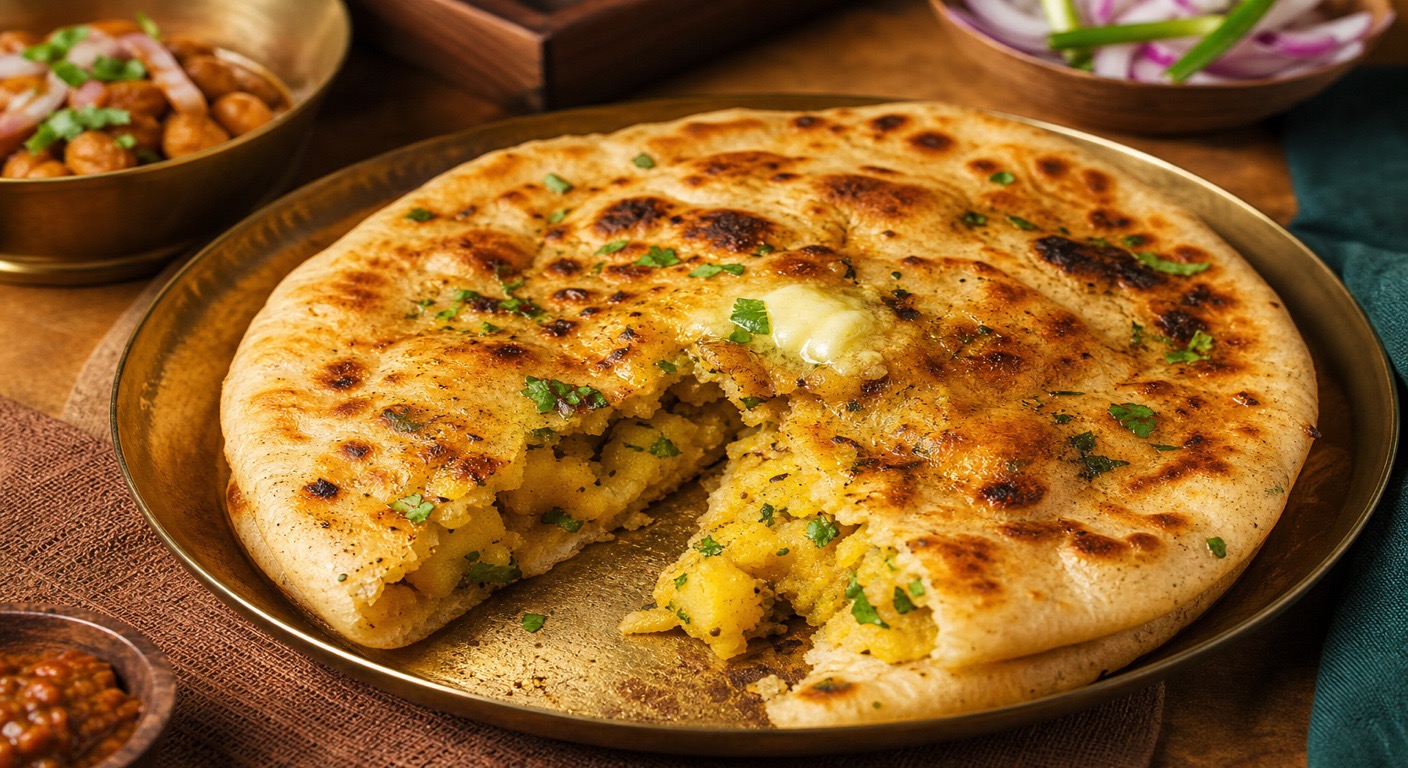
Stuffed kulcha - is it bread or a full meal?
One loaded Amritsari kulcha is about 480 kcal - that is more than a plate of two rotis and a katori of sabzi, so it is not just a piece of bread. The flour shell, the potato stuffing, and the butter on top together turn it into a full meal.
A kulcha is just bread, like a big roti - so it should count as one roti on my plate.
mostly falseMostly false. A plain roti is only flour and water. A loaded Amritsari kulcha is a flour shell PLUS a potato-onion stuffing PLUS a butter finish. Per 100 g, maida (364 kcal) is almost the same as whole-wheat atta (370 kcal) - so the flour itself is not the villain. The kulcha is heavier because it uses more flour than a roti, then adds stuffing, then adds butter. That stack is what turns one kulcha into a full meal, not a piece of bread.
One loaded Amritsari kulcha
A single stuffed kulcha from a dhaba is bigger than a roti and loaded with extras. Split it open and you see a thick maida shell, a spiced potato-onion filling, and a shiny butter brush on top. Add the oil it cooks in, and one kulcha lands around 480 kcal - about the same as a full plate of food.
Assumptions: Flour shell: ~75 g maida at 364 kcal/100 g = ~273 kcal. Potato-onion-spice stuffing: ~60 g boiled potato at 86 kcal/100 g = ~52 kcal (onion and spices negligible). Butter brushed on top: ~15 g at 717 kcal/100 g = ~108 kcal. Oil used to cook on the tava: ~5 g sunflower oil at 884 kcal/100 g = ~44 kcal. Total = ~477 kcal, rounded to 480. A dhaba kulcha with a heavier butter hand (25 g) and more oil can reach ~540-560; a lighter home version closer to ~420.
Kulcha vs a normal roti-sabzi plate vs plain bread
See how one loaded kulcha stacks up against a normal meal plate and a plain piece of bread. The kulcha sits above the meal plate, because the extra flour and the butter add on top of the potato.
Ask for half the butter
The butter brush is the easiest lever. A dhaba kulcha gets a generous 15 g swipe - ask for a light brush (about 5 g) instead. You keep the crisp top and lose most of the fat.
Assumptions: Same kulcha shell + potato + cooking oil (~369 kcal) but only 5 g butter instead of 15 g: 5 g at 717 kcal/100 g = ~36 kcal. Total = ~405 kcal, rounded to 408.
Share one kulcha with a friend
A loaded kulcha is a meal for one. Split it in two and you get all the flavour for half the calories - then fill your plate with a lighter side like salad or a small katori of dal.
Assumptions: Half of the baseline loaded kulcha (~480 kcal) = ~240 kcal. Range is half of the baseline range (420-560 split in two = 210-280).
Smart ways to enjoy kulcha
- Treat one loaded kulcha as your whole meal, not a side - do not pair it with more rotis or rice.
- The potato filling is the lightest part. The heavy calories are the big maida shell and the butter, not the aloo.
- Per 100 g, maida (364 kcal) is almost the same as atta (370 kcal) - so it is the quantity of flour plus the butter, not the flour type alone, that loads a kulcha.
- If you love the dhaba version, ask for less butter and split one kulcha - you save over 250 kcal without giving up the taste.
The bottom line
One loaded Amritsari kulcha is about 480 kcal - more than a full plate of two rotis and a katori of sabzi, and far more than a plain piece of bread. It is not 'just bread': the big flour shell, the potato stuffing, and the butter finish make it a complete meal. Ask for half the butter and share one kulcha, and the same treat drops to about 240 kcal.