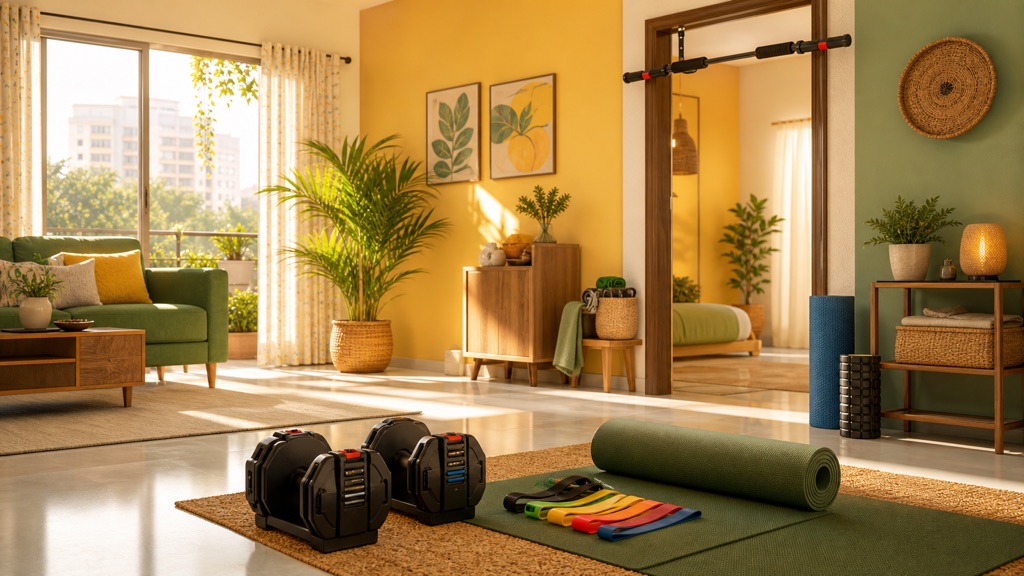
Space-saving home gym for an Indian apartment
You do not need a spare room or a power rack to train your full body in a 1BHK or 2BHK flat. One pair of adjustable dumbbells, a set of resistance bands, a doorway pull-up bar, and a yoga mat cover almost every compound lift in a 2 by 2 metre corner. Here is the honest kit, the floor math, and the apartment rules for noise, floor protection, and storage.
A flat is not a gym, people say. You have one bedroom, a hall, a kitchen, and a shared wall with a neighbour who hears every drop. So a power rack is out. A treadmill is out. A multi-gym station is out. But strength training is not out. You can train your whole body in a 2 by 2 metre corner of your living room or bedroom with gear that folds, rolls, or hangs on a door. This article is for the Indian apartment dweller who wants a real home gym without knocking down a wall. We keep it honest: what to buy, what to skip, how much floor you really need, and how to keep the neighbour below happy.
The baseline: a 2-sqm corner, five pieces of kit
A full-body session needs five things, and all five fit in a 2 by 2 metre corner or a cupboard. Adjustable dumbbells: one pair, a dial or pin changes the weight, so it replaces a whole rack of fixed dumbbells. Wikipedia describes selectorized dumbbells as ones that 'allow you to easily alter the weight or number of plates while the dumbbells are resting in the stand', by 'turning a dial or sliding a selector pin, rather than physically adding or removing plates.' Resistance bands: flat elastic bands that pack into a pouch and train push, pull, and leg patterns. A doorway pull-up bar: it hooks onto your door frame and trains the back and arms. A foldable bench: flat for presses, upright for seated rows, folds slim after use. A yoga mat: rolls up, protects the floor, and gives grip for floor work. That is the kit. The reason this matters for your body, not just your floor: resistance training builds lean mass, and lean mass raises the calories you burn at rest. A review of 22 studies found that 'resistance exercise increased RMR compared to controls (MD: 96.17 kCal/day, 95% CI: 45.17, 147.16, P = 0.0002).' So the gear that fits in your cupboard also helps preserve your BMR while you are in a calorie deficit.
Assumptions: Meta-analysis estimate of resting metabolic rate change from resistance training versus control. Individual results depend on training volume, lean mass gained, and diet.
You cannot build a real home gym in an apartment.
falseFalse. A real home gym is not defined by a power rack or a treadmill. It is defined by whether you can train the big compound patterns: push, pull, squat, hinge, and carry. Adjustable dumbbells cover presses, rows, squats, and lunges. Resistance bands cover pull-aparts, face pulls, and glute work, and a study found that 'the bench press and the resistance band push-up, at similar stress levels, produced similar strength gains.' A doorway bar covers pull-ups, which 'build up several muscles of the upper body, including the latissimus dorsi, trapezius, and biceps brachii.' Bodyweight work covers push-ups, squats, and dips, where 'the exerciser supports themselves on a dip bar' with their own body weight. All of this fits in a 2 by 2 metre corner. What you cannot do in an apartment is drop a loaded barbell, store a 2-metre rig, or run indoors. None of those are required for strength or for preserving lean mass. The honest line: adjustable dumbbells plus bands plus a pull-up bar cover most compound lifts in about 2 square metres.
Apartment rules: noise, floor, storage, ceiling
- Protect the floor first. A rolled yoga mat under a dumbbell stand stops scratches on tile or marble and softens the odd dropped rep. If you train heavy, add a cheap rubber doormat under the mat.
- No bar drops. A loaded barbell dropped on a slab is loud and cracks grout. Adjustable dumbbells let you set the weight down gently. If a rep fails, lower it with two hands.
- Check your ceiling height. Overhead press needs about 2.1 metres of clear vertical space. Most Indian flats have 2.7 to 3 metres, but a ceiling fan or a low beam can sneak into your press path. Press outside the fan sweep.
- Mind the neighbour below. Train in shoes or barefoot on a mat, not in hard-soled slats. Skip jumping movements like burpees or box jumps if you live above someone. Step-ups on a low bench are quieter.
- Store after every session. Dumbbells go back in the stand, bench folds and slides under the bed, bands go in their pouch, bar comes off the door. A 2-sqm gym only works if it stops being a gym when you are done.
- Ventilate. A closed 1BHK gets humid fast. Open a window or run the fan during a session, and wipe the mat and bench with a dry cloth after use, especially in monsoon.
- Pick one door for the pull-up bar. Use a sturdy, non-glass door frame, and check the bar's grip pads sit flat before each set. A doorway bar that slips is the one real injury risk in this kit.
The bottom line
You can build a real home gym in a 1BHK or 2BHK flat. The honest kit is one pair of adjustable dumbbells, a set of resistance bands, a doorway pull-up bar, a foldable bench, and a yoga mat. Together they cover presses, rows, squats, pull-ups, dips, and core work in a 2 by 2 metre corner, and they store out of sight after the session. Skip the power rack, the treadmill, and the multi-gym: they cost more, need drilling or a spare room, and do not train anything the small kit cannot. The deeper win is that resistance training builds lean mass, and a meta-analysis found resistance exercise raised resting metabolic rate by about 96 kcal per day versus controls. That helps preserve your BMR while you are in a deficit. Log your food in Burnie, train three days a week in your corner, and let the deficit and the dumbbells do their work together. That is the whole plan.