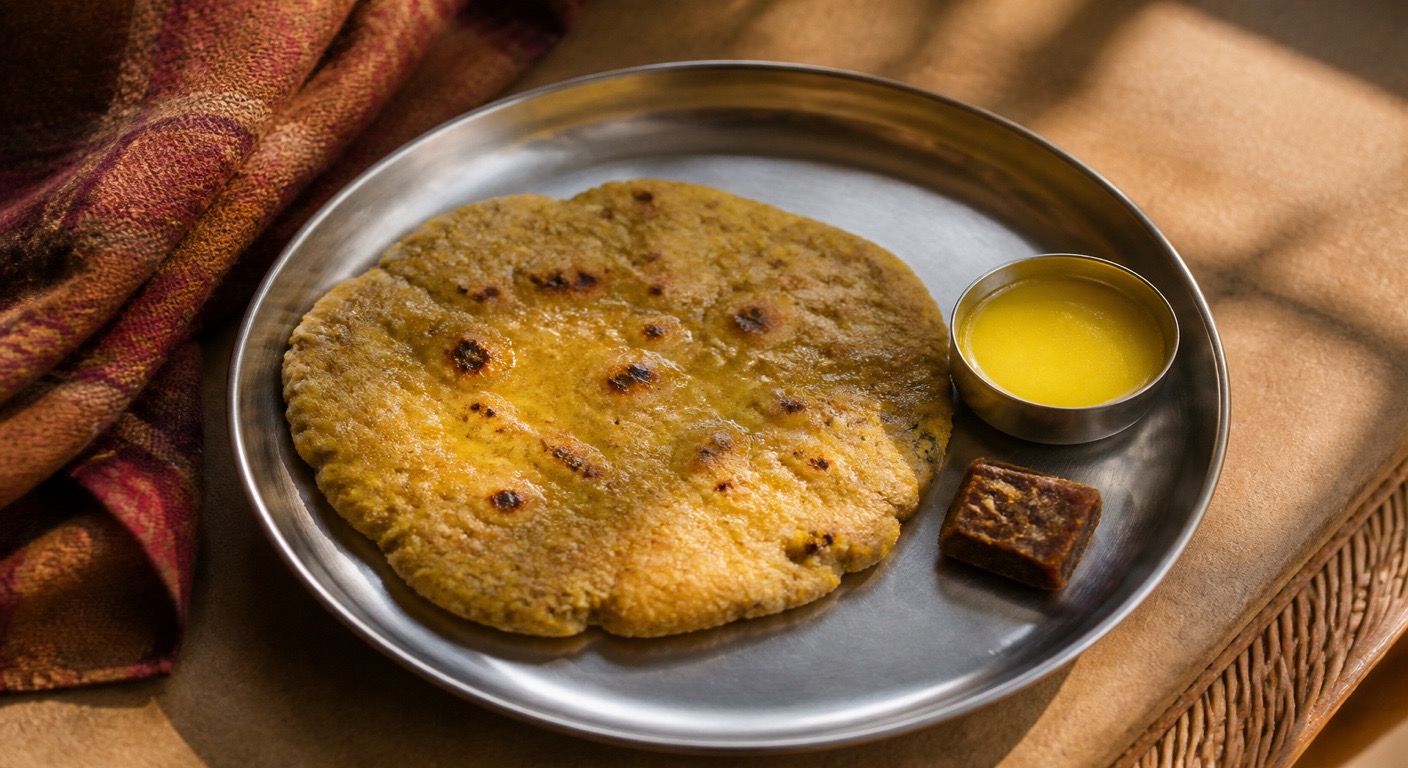
Bajra roti in winter - friend or trap?
A plain bajra roti is only about 145 kcal and its fibre keeps you full, but the ghee and jaggery you pair it with in winter can quietly double that. The millet is your friend - the toppings are the trap.
Bajra roti is a weight-loss food, so you can eat more of it in winter.
it dependsIt depends - and mostly it leans false. Bajra flour is about 362 kcal per 100 g, almost the same as whole-wheat atta at 370 kcal per 100 g. The grain is not magically lower in calories. What bajra does have is more fibre, and fibre helps you feel full sooner. The real trap is not the roti - it is the ghee you spread on it and the jaggery you eat alongside, which can double the calories of one roti without you noticing.
One plain home bajra roti
A normal home bajra roti is rolled from about 40 g of flour. Water binds it but adds no calories. So one plain roti, with nothing on top, lands near 145 kcal. That is honest and light - about the same as a plain wheat roti.
Assumptions: One roti uses ~40 g bajra flour at ~362 kcal/100 g = 145 kcal. A smaller roti from ~33 g flour is ~120 kcal; a thicker one from ~50 g is ~180 kcal. No ghee, no oil, no jaggery.
Plain vs ghee-loaded vs ghee + jaggery
Use one teaspoon of ghee, not two
Ghee is almost pure fat at 897 kcal per 100 g, so each teaspoon (5 g) carries about 45 kcal. Two teaspoons double that to 90 kcal. One teaspoon gives you the flavour and the winter warmth without the extra half-roti worth of calories.
Assumptions: Plain roti 145 kcal + 1 tsp ghee (5 g x 8.97 = ~45 kcal) = ~190 kcal. Compared to the dhaba-style 2-tsp version (235 kcal), this saves ~45 kcal per roti.
Keep the jaggery piece small - about 10 g
Jaggery is nearly the same calories as sugar - 383 kcal per 100 g. A big 25 g chunk after the roti adds about 96 kcal. A small 10 g piece still gives you the winter taste for only about 38 kcal. Pair it with the roti, not as an extra sweet on top of a full meal.
Assumptions: Plain roti 145 kcal + 10 g jaggery (10 x 3.83 = ~38 kcal) = ~183 kcal. This swaps the 15 g jaggery (~58 kcal) in the classic pairing for a smaller 10 g piece, saving ~20 kcal, and leaves the ghee out.
Smart winter bajra habits
- Bajra's fibre fills you up - so one roti with a bowl of kadhi or sarson saag is often enough. Going back for a third roti is where winter calories hide.
- If you love the ghee flavour, spread it thin with the back of a spoon instead of pouring. A thin wipe can be under 3 g, about 27 kcal.
- Jaggery is not a 'free' healthy sweet - it is almost sugar in calories. Treat a piece like a small dessert, not a free top-up.
- Pair bajra roti with a protein side - paneer, dal, or curd - so the meal keeps you full longer than the roti alone would.
The bottom line
The bajra itself is not the trap - one plain roti is about 145 kcal, close to a wheat roti. The trap is the winter ritual of ghee and jaggery on top, which can push one roti past 240 kcal. Keep one teaspoon of ghee and a small 10 g piece of jaggery, and your winter bajra roti stays near 190 kcal with all the flavour.