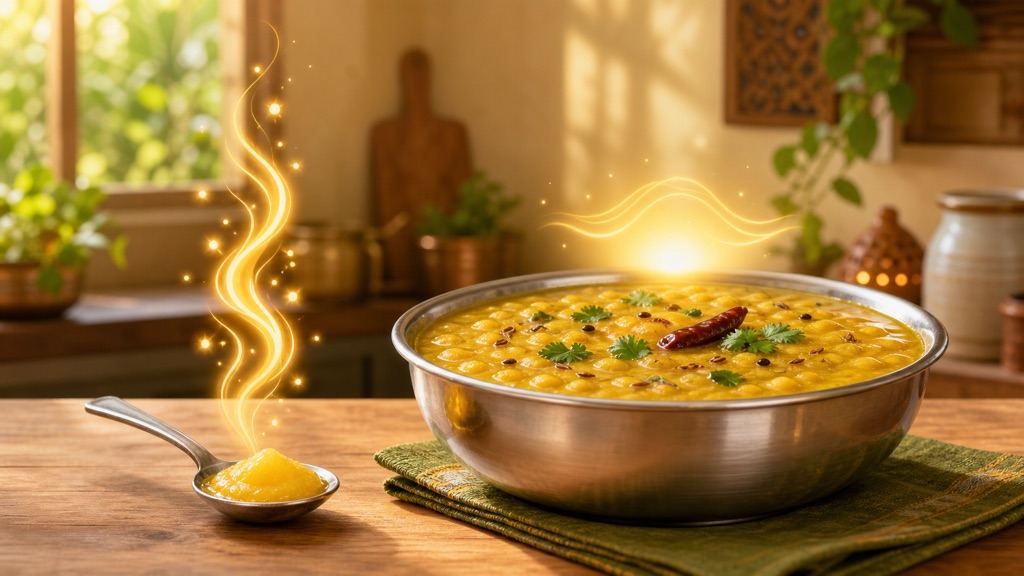
Why a spoon of ghee beats a bowl of dal in calories
Fat gives 9 calories per gram, but protein and carbs give only 4. So a small spoon of ghee carries more calories than a big bowl of dal. Knowing this one number helps you eat more food for fewer calories.
Take one small spoon of ghee. Take one big katori of plain dal. They look so different in size. But here is the surprise: that tiny spoon of ghee can carry almost as many calories as the whole bowl of dal. Why? Because fat packs more than twice the calories of protein or carbs in every single gram. This one fact explains why oily foods feel light in your hand but heavy in your calorie log. It also explains why watery, fibre-rich foods fill your stomach for very few calories. Let us see the numbers behind this, and how to use them without giving up the foods you love.
The base numbers: fat 9, protein and carbs 4, alcohol 7, fibre 2
Scientists measure food energy using the Atwater system. It gives each macro a fixed number of calories per gram. Fat gives 9 calories per gram. Protein gives 4. Carbohydrate gives 4. Alcohol gives 7 (we will not focus on alcohol here). Dietary fibre gives about 2, because your body does not absorb all of it. So fat is the heaviest macro by a long way. One gram of ghee has more than twice the calories of one gram of rice or dal. This is not an opinion. It is a measured fact scientists use to label every food packet in the world.
Assumptions: Atwater general factors. These are averages. Real foods vary a little because of fibre digestibility and cooking, but the 9-4-4-7-2 pattern holds for everyday foods.
Calorie density of real Indian foods (calories per gram)
Calorie density is the calories in one gram of a FOOD, not a macro. It mixes water, fibre, fat, carbs and protein together. Foods with lots of water and fibre have low calorie density. Foods with lots of fat have high calorie density. Look at four Indian foods side by side. Ghee is almost pure fat, so it sits near the top of the scale at about 8.8 calories per gram. Almonds are about half fat, so they sit around 5.8. Plain cooked toor dal is mostly water and protein, so it is about 1.2. Raw cucumber is almost all water, so it is about 0.16. Same weight, very different calories. One spoon of ghee (about 14 g) gives about 123 calories. You would need about 100 grams of cucumber to match that, which is a huge plateful.
All foods fill you up the same if they have the same calories.
mostly falseMostly false. The calories may be equal, but the volume is not. A 200 calorie serving of cucumber is a mountain of food. A 200 calorie serving of ghee is less than two tablespoons. People tend to eat a similar WEIGHT of food to feel full, not a similar calorie count. So lower calorie-density foods let you eat more volume for the same calories. That is why a big bowl of dal and sabzi fills your stomach for fewer calories than a small handful of fried namkeen. The calories match, but the fullness does not.
Same snack time, two paths
It is 5 pm, you are hungry, and you want a snack. Here are two ways to spend about 170 calories. One gives you a small handful. The other gives you a big plateful plus protein. Neither is wrong. Pick the one that fits your day.
Use calorie density the easy way
You do not need to maths every meal. Just keep these four habits in mind. They let you eat a satisfying plate for fewer calories, without feeling hungry all day.
The bottom line
Fat gives 9 calories per gram. Protein and carbs give 4. So foods full of water and fibre fill you up for few calories, while oily and fatty foods carry many calories in a small weight. You do not have to fear ghee or nuts. Just measure them, and let watery vegetables and dal do the heavy lifting on your plate. Burnie helps you put this into practice. You type a meal in plain words, like 'one katori dal, two roti, one spoon ghee'. Burnie AI estimates the calories from that text. Then it works out your daily deficit as food calories minus (BMR plus active calories). The app is free, with no paid tier, and it never reads your heart rate, sleep, blood pressure, or location. For more on the fibre and alcohol numbers, see the sibling article fibre-alcohol-calorie-rules.