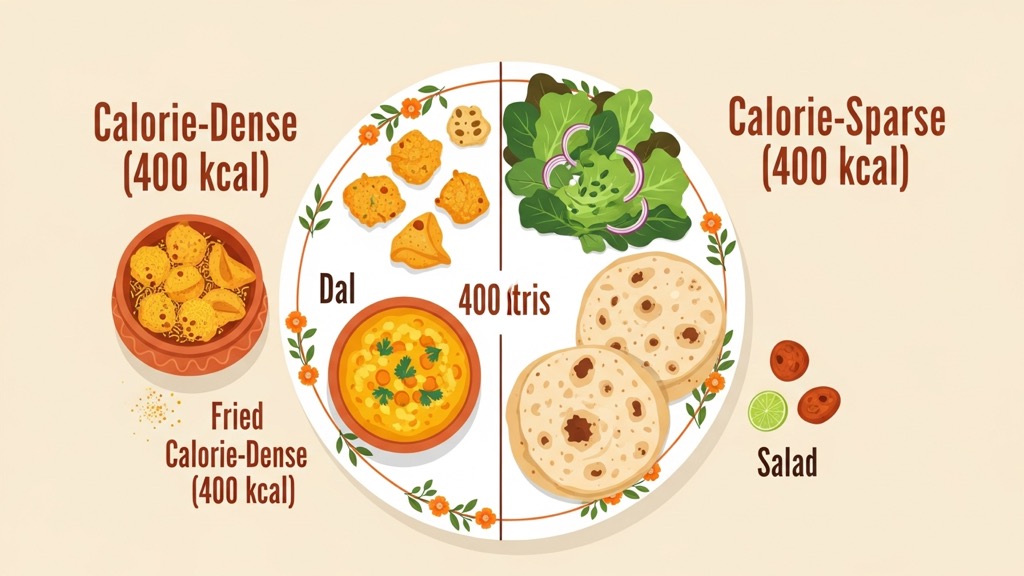
Calorie density vs count: why the same number feels different
Two meals can show the same calorie number in Burnie but fill your stomach very differently. Calorie density - the calories packed into each gram - explains why one leaves you hungry and one leaves you full.
You log your lunch in Burnie. The number shows 400 kcal. A friend logs lunch too. The same 400 kcal shows up. But your plate had a small handful of fried namkeen. Your friend had a big bowl of dal, two rotis, and salad. Same count. Very different fullness. The secret behind this is called calorie density. This short read shows why it matters.
What calorie density actually means
Calorie density is the calories in one gram of a food. Oil and fried foods cram many calories into a tiny weight. Water-rich foods, like cucumber and watermelon, spread very few calories over a big weight. So a small piece of fried food can match a huge bowl of watery food. Scientists tested this on real people. They served food at a lower density, about 1.1 kcal per gram. They served other food at 1.5 kcal per gram. People ate the same weight of food each day. But the lower-density group ate 223 fewer calories every day. That is like dropping about two rotis from your day, with no extra hunger.
A calorie is a calorie - only the total number matters.
it dependsit depends
For your weight maths, the total count is what moves the scale. Burnie's daily maths is food calories minus your BMR and active calories. That part is pure numbers. But for your hunger, the number alone is not enough. A 400-kcal log of oily food leaves your stomach early. A 400-kcal log of dal, roti, and salad keeps you full for hours. Same calories. Different fullness. One review put it simply. People felt just as full on lower-density food. They still ate fewer calories.
Four calorie-density bands (kcal per gram)
Foods fall into four density bands. The bands come from a research review on energy density. Look where your usual foods sit. Most of your plate should come from the first two bands.
Use calorie density with Burnie
The bottom line
Burnie counts the calories. You choose the density. Two meals can show the same number and fill you very differently. Drop the density of your day a little. You can eat about 223 fewer calories with no extra hunger. That is roughly two rotis gone, just by picking foods with more water and fibre. Log the count. Then lower the density.