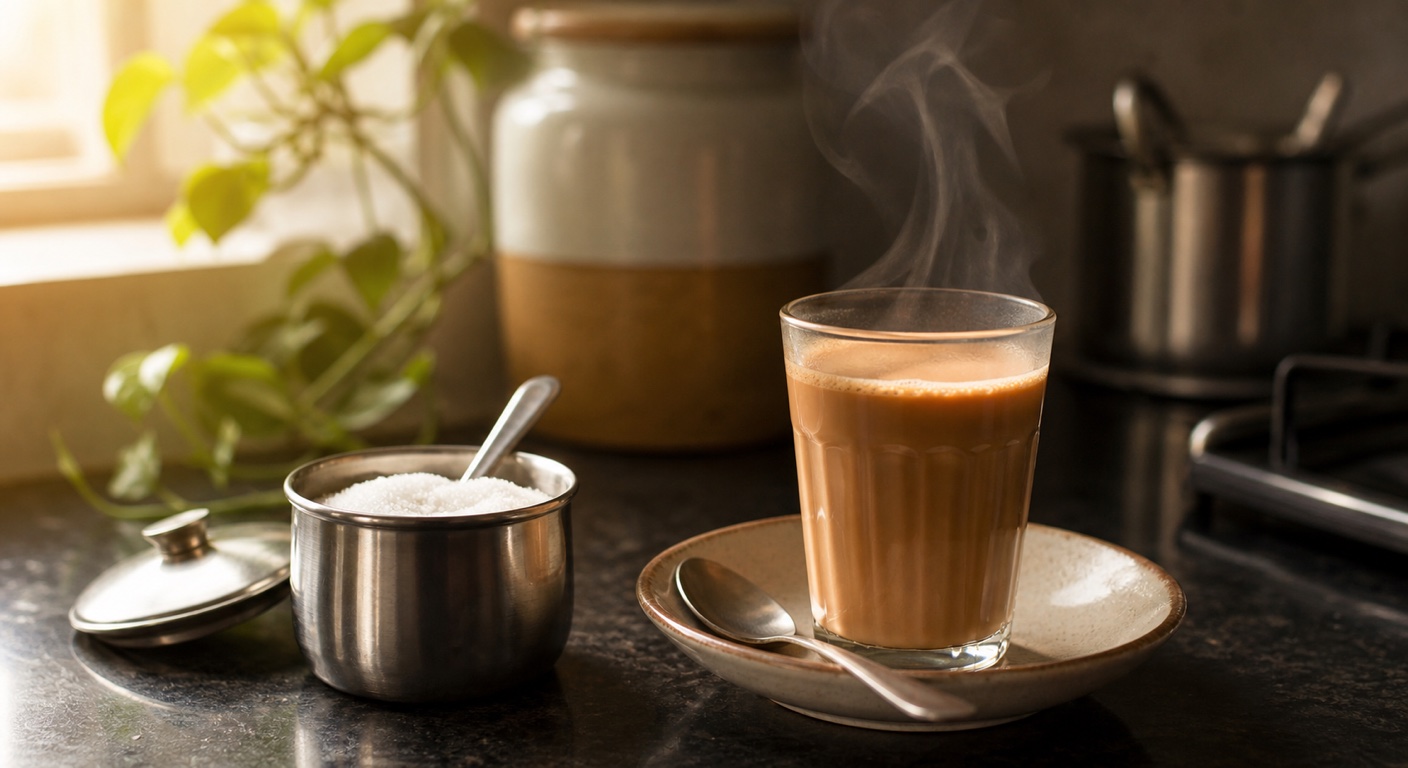
The truth about sugar in your chai (and whether jaggery or honey changes the math)
Two spoons, four cups, every single day - chai and filter coffee are where a lot of Indian sugar intake hides in plain sight. Here's the honest math, and what jaggery and honey actually do differently.
Chai and filter coffee are non-negotiable in most Indian homes - sometimes four, five, even six cups a day. Because each cup feels 'small', the sugar in it barely registers as a decision. This article does the actual math on how that sugar adds up over a day, and tests the common substitutes - jaggery, honey - against real evidence rather than tradition.
"It's just one small spoon of sugar in my chai, it doesn't matter."
mythMyth - not because one spoon is dangerous, but because it's never really just one spoon, once a day.
One rounded teaspoon of sugar is roughly 4-5g. Have chai four times a day with a spoon or two each time, and you're already at 25-40g of sugar before a single sweet, biscuit or soft drink touches your plate. WHO's 2015 sugars guideline sets the ceiling for free sugars - which explicitly includes sugar added to tea and coffee - at under 10% of daily energy, about 50g (12 teaspoons) on a 2,000 kcal diet, with additional benefits below 5% (roughly 25g/6 teaspoons). ICMR-NIN's 2024 Dietary Guidelines for Indians tightened the practical added-sugar ceiling to about 25g/day for exactly this reason. A tea-drinking household can spend its entire day's sugar budget on chai alone, leaving nothing for anything else.
"Jaggery (gur) in chai is a healthier sweetener than sugar."
mythMyth, as far as blood sugar is concerned - jaggery is still sugar, and Indian research says it behaves like it.
Jaggery retains trace minerals that refining strips from white sugar, but gram for gram it is still roughly 85-90% sucrose. A comparative study on glycaemic indices presented at the Research Society for the Study of Diabetes in India (RSSDI, 1987 proceedings) tested iso-caloric amounts of glucose, sucrose, honey and jaggery/gur in diabetic patients and found all four produced a similarly hyperglycaemic response - gur was not gentler on blood sugar than table sugar. Swapping sugar for jaggery in your chai changes the trace-mineral content slightly; it does not meaningfully change the sugar load or the calories going into your cup.
"Honey is a natural, healthier sweetener for tea and coffee."
partly truePartly true - but only when it replaces sugar within an otherwise moderate diet, not when it's added on top of your usual sugar.
A 2022 systematic review and meta-analysis in Nutrition Reviews (Ahmed, Khan, Sievenpiper and colleagues) pooled 18 controlled feeding trials in 1,105 people and found that honey, at a median dose of about 40g/day for 8 weeks, modestly improved fasting glucose, LDL cholesterol, triglycerides and HDL cholesterol compared with sucrose. But this benefit specifically showed up in trials where honey substituted for other sugars within diets that were already fairly controlled - and the same review found honey significantly raised inflammatory markers (IL-6, TNF-alpha). WHO's free-sugars definition explicitly counts the sugars naturally present in honey as free sugars too, so a spoon of honey in your coffee still counts against your daily sugar ceiling - it's a marginally better free sugar, not a free pass.
"The sugar in chai/coffee doesn't really count as 'added sugar' - it's not like eating sweets."
mythMyth - a gram of sugar stirred into a cup counts exactly the same as a gram of sugar eaten in a sweet.
WHO's guideline defines free sugars as sugars added by the cook or consumer to food and drink, plus sugars in honey and syrups - chai and coffee sugar is the textbook example, not an exception. ICMR-NIN's Dietary Guidelines for Indians treat beverage sugar identically to sweets and desserts when totalling the roughly 25g/day ceiling. Because it's stirred in rather than eaten as a solid, it's psychologically easy to forget - but metabolically it is indistinguishable from a spoon of sugar eaten with a spoon.
Small tips that add up
- Track cups, not spoons: count how many times a day you drink sweetened chai/coffee - that number matters more than how sweet each individual cup is.
- Cut sugar gradually (a quarter-spoon at a time) rather than switching to jaggery or honey and assuming the problem is solved - taste buds adjust in about 2-3 weeks.
- If you do prefer jaggery or honey for taste, still count it against your day's sugar budget - it isn't a 'free' swap.
- Try slightly less sugar plus more elaichi, ginger or cinnamon - the spice covers the reduction well.
- If you're diabetic or pre-diabetic, treat gur and honey with the same caution as sugar in chai - the RSSDI data above is specifically about diabetic blood-glucose response.
The bottom line
The honest bottom line: it's not the sugar in one cup that hurts you, it's the sugar in every cup, every single day, quietly adding up. Jaggery and honey are marginally different sweeteners, not fundamentally different ones.
Best-case recipe, computed independently: Not a literal recipe - the practical fix is to slowly halve your per-cup sugar over a few weeks, and to treat any gur or honey you use as counting toward the same daily budget rather than as a free replacement.