Chest Strap vs Optical HR: Which Sensor Is More Honest?
Two ways to read your heartbeat exist. One uses electrical signals, the other uses light. Here is what the science says about which is more accurate, and why it still only gives an indirect calorie guess. Burnie itself does not use heart rate at all.
You see two kinds of heart-rate gadgets in the gym. One is a strap around your chest. The other is a band on your wrist with a little light. Both show a heart number on your phone. But they work in totally different ways. This article is general science about how the two sensors compare. It is NOT a Burnie feature. Burnie never reads your heart rate. Burnie uses your phone or Android Health Connect (Samsung Health) active calories, or a number you type in yourself.
How each sensor reads your heart
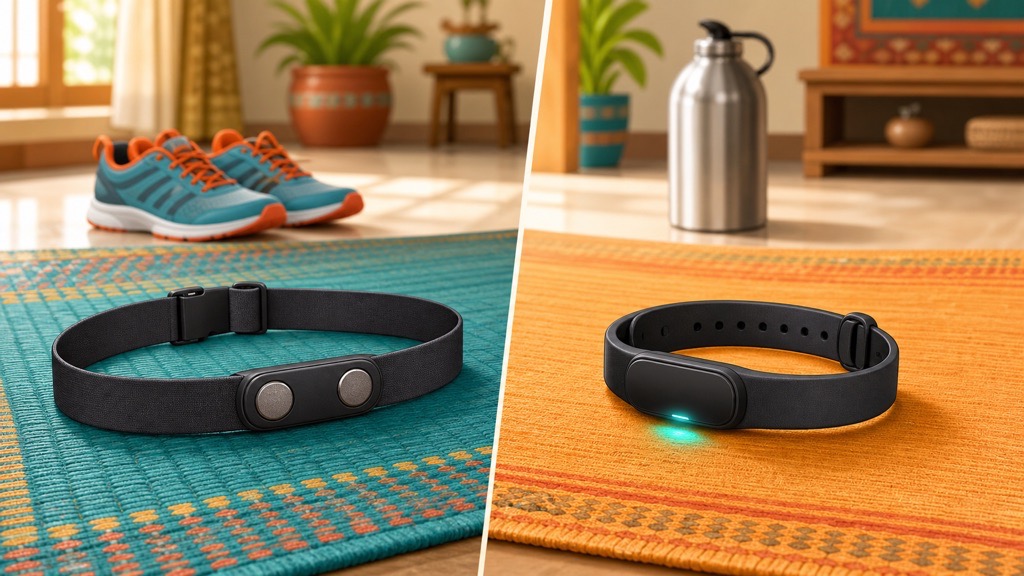
A chest strap is an ECG machine. ECG means electrocardiogram. It records the tiny electrical signals your heart makes each beat. The strap has two pads that touch your skin. As Wikipedia puts it, ECG is 'a graph of voltage versus time of the electrical activity of the heart using electrodes placed on the skin.' So a chest strap reads the heart's own electricity. A wrist sensor is different. It uses light. The technical name is photoplethysmography, or PPG. A small light shines through your skin. A detector measures how much light comes back. Each heartbeat pushes more blood into your skin, so the light changes a little. As Wikipedia says, PPG 'illuminates the skin and measures changes in light absorption.' So one sensor reads electricity. The other reads blood flow with light.
Chest strap vs wrist sensor side by side
Myth: An optical wrist sensor is just as accurate as a chest strap for heart rate.
it dependsIt depends - explained simply. When you sit, walk, or cycle, a good wrist sensor is close to a chest strap. One study of 199 people found the wrist optical monitor stayed within about 3 beats per minute of the chest strap on average, with a concordance correlation of 0.98. But when you run, jump, or lift weights, the wrist sensor struggles. Movement shakes the light sensor. In one running test, women's wristband error hit 13.35% during running, and the study warned of 'extreme errors' that mean 'caution in relying on such devices for exercise monitoring.' So for resting and steady cycling, a wrist sensor is fine. For hard or messy movement, a chest strap is more honest.
If you do use a heart-rate device, do these things
The bottom line
Chest straps read your heart's electricity, so they stay accurate even when you move hard. Wrist sensors read blood flow with light, so they are great at rest but shaky during messy movement. Either way, the heart number only feeds an indirect calorie guess - it is not a magic truth. And remember, Burnie does not use heart rate at all. Burnie uses your phone or Android Health Connect (Samsung Health) active calories, or a number you type in. That keeps it simple, free, and honest.