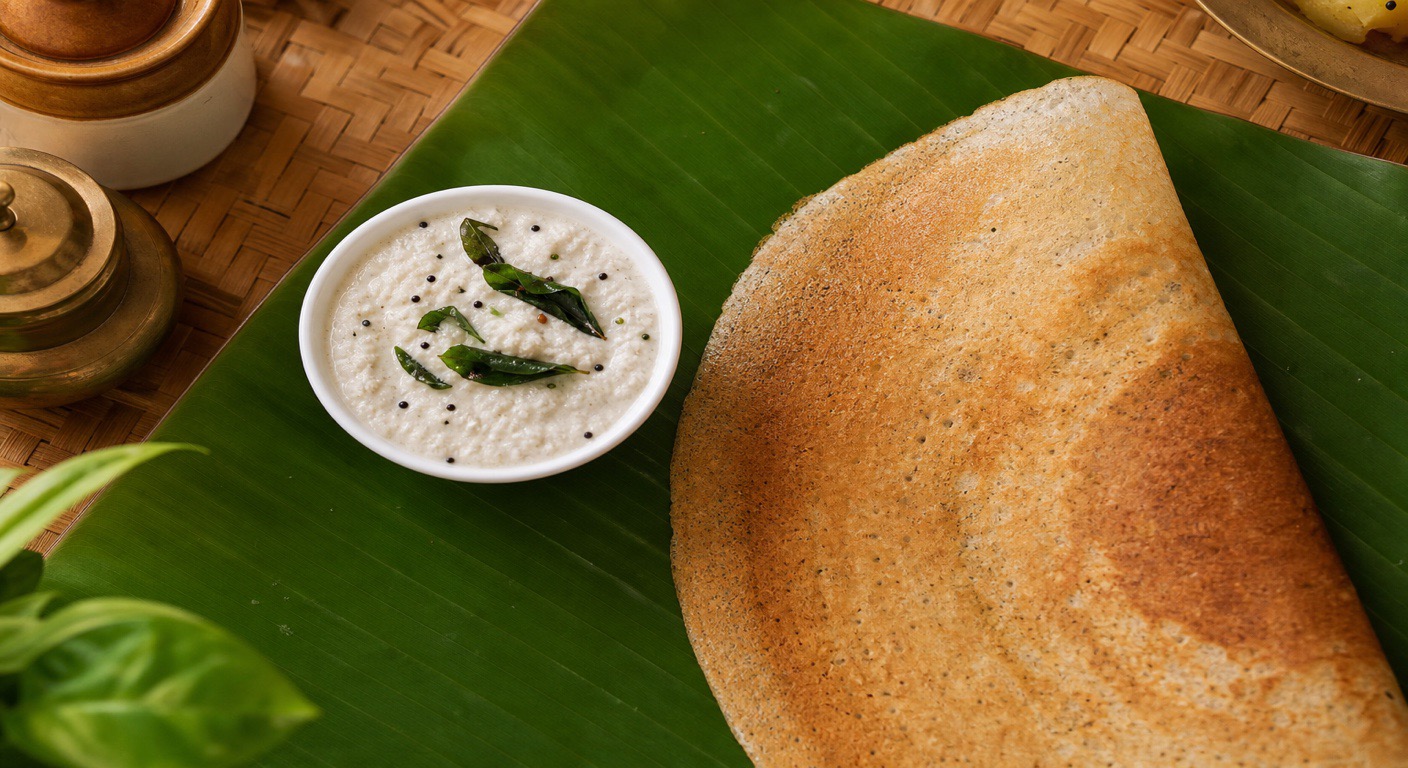
Coconut chutney - the quiet calorie side on your plate
One spoon of coconut chutney carries about 36 kcal, mostly from the coconut's fat. Three spoons with your dosa quietly add up to over 100 kcal, far more than tomato or mint chutney.
Coconut chutney looks so light and white. It sits quietly next to your idli or dosa. But fresh coconut is mostly fat, and a few spoons can carry more calories than you guess. Let us see where those calories really come from, spoon by spoon.
Coconut chutney is healthy, so its calories do not count.
mostly falseMostly false. The coconut in it does have fibre and some good fats, but it is still very high in calories. Fresh coconut meat has about 354 kcal and 33.5 g of fat in just 100 g. That fat is mostly saturated. Small amounts are fine, but the calories are real and they add up spoon by spoon.
Your katori of coconut chutney
A small katori of coconut chutney with your breakfast is about 3 tablespoons. One tablespoon is about 36 kcal, so that katori is roughly 108 kcal. Most of that comes straight from the fresh coconut, not the spices or the curd.
Assumptions: 1 tablespoon of coconut chutney = 36 kcal (Tarla Dalal recipe figure, which already includes the recipe's own tempering oil). Cross-check: the same recipe gives 501 kcal per cup and 14 tablespoons per cup, so 501 / 14 = 35.8, which rounds to 36 - the figure is consistent. A typical katori with dosa or idli holds about 3 tablespoons, so 36 x 3 = 108 kcal. A bigger roadside katori can hold 4 tablespoons (~144 kcal); a stingy one may hold 2 (~72 kcal), hence the range.
One spoon: coconut vs tomato vs mint chutney
Same spoon, very different calories. The difference is mostly water. Tomatoes and mint leaves are mostly water, while fresh coconut is mostly fat.
Take a smaller katori - 2 spoons, not 3
The easiest lever. You still get the coconut taste with your dosa. You just take a little less. Two spoons instead of three saves you about 36 kcal every breakfast.
Split it: half coconut, half tomato chutney
Ask for a mixed katori - half coconut chutney, half tomato chutney. The tomato chutney is light, so you keep the flavour variety but drop the calories. About 1.5 spoons of each in your katori.
Assumptions: A 3-tablespoon katori split evenly: 1.5 tablespoons coconut chutney (1.5 x 36 = 54 kcal) plus 1.5 tablespoons tomato chutney (1.5 x 14 = 21 kcal) = 75 kcal, versus 108 kcal for a full coconut katori.
Small habits for your chutney
- Fresh coconut is the calorie driver, not the green chilli or the salt - so watch the coconut amount, not the spice.
- Some tiffin centres pour an extra spoon of hot oil on top of the chutney as a tempering. One teaspoon (5 g) of oil is about 44 kcal - ask them to skip the extra oil spoon.
- Green mint-coriander chutney is almost calorie-free, so load up on it for flavour instead of extra coconut chutney.
- If you eat idli-dosa every day, even a 36 kcal saving per breakfast adds up - that is about 13,000 kcal across a year.
The bottom line
Coconut chutney is a quiet calorie side. One spoon is about 36 kcal, and a small katori of three spoons is about 108 kcal - far more than tomato (14 kcal) or mint (4 kcal) chutney per spoon. Take a smaller katori, split it with tomato chutney, and skip the extra oil spoon on top. You keep the South-Indian taste and quietly cut the calories.