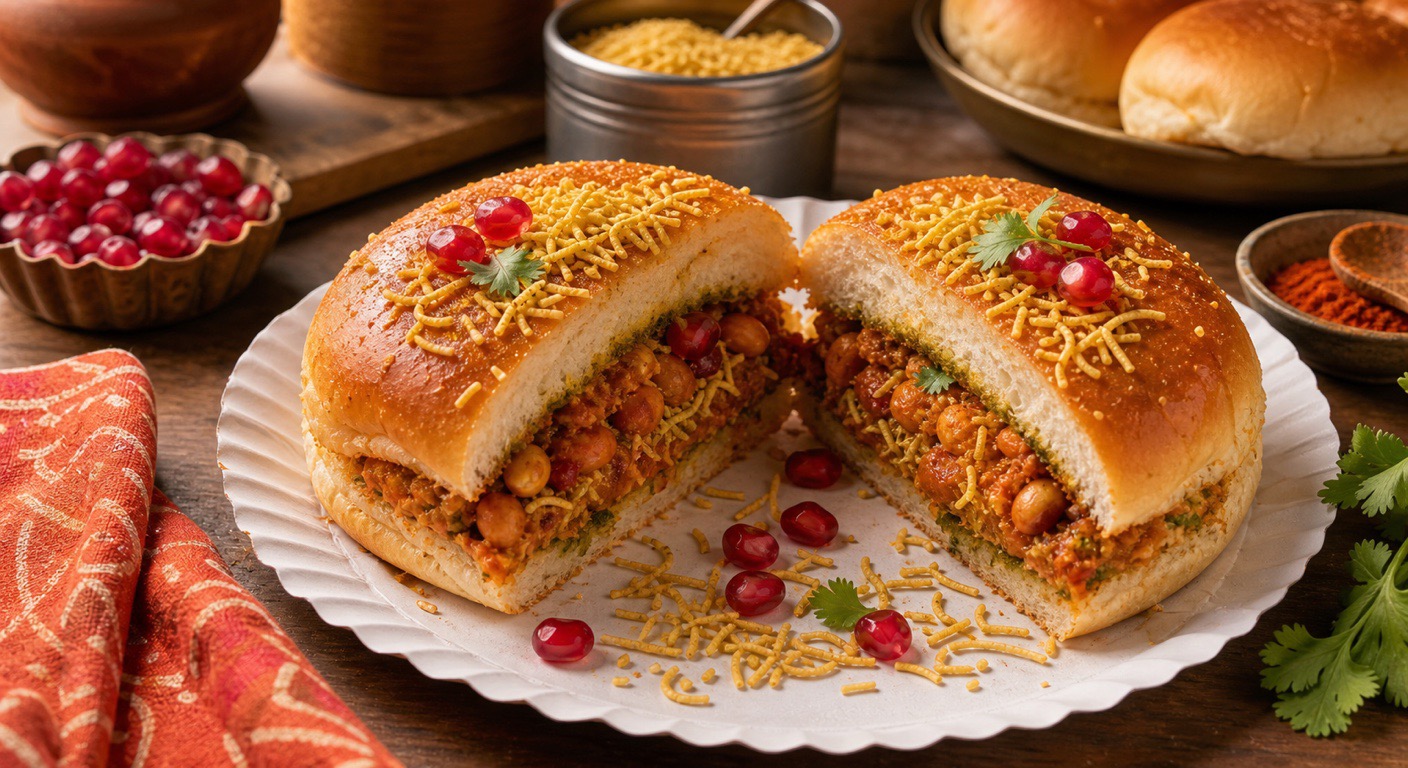
Dabeli - sweet, buttery, and how heavy?
One dabeli is not as heavy as you may think - real recipe calculators put a single street dabeli around 200-250 kcal. The butter on the pav and the sev on top are the parts you can easily trim to make it lighter.
Dabeli comes from Kutch in Gujarat. It is a soft pav bun, sliced and stuffed with a sweet-spicy mashed potato mix. Then it gets toasted with butter, topped with sev, peanuts, pomegranate, and chutneys. People call it a heavy snack. But one dabeli is smaller than you think. Let us look at the real number.
Dabeli is a very heavy, fattening snack you should avoid.
mostly falseMostly false for ONE dabeli. A single street dabeli is about 200-250 kcal on real recipe calculators - close to one samosa. It becomes heavy when you eat two or three, or when the bhaiya adds extra butter and a big mound of sev. The pav and potato are mostly carbs; the butter and sev are where the fat adds up.
One street dabeli: about 230 kcal
A single dabeli from a roadside stall lands around 230 kcal. That is less than two stuffed parathas. The pav bun is the biggest chunk, then the butter that toasts it, then the sev and peanuts on top. The sweet potato filling itself is light - potato is mostly water.
Assumptions: Two real recipe-calculator figures anchor this: the Tarla Dalal Mumbai roadside dabeli at 199 kcal and the homemade Kutchi dabeli at 250 kcal. A typical street dabeli sits between them, so 230 kcal is used as the working baseline with an honest range of 199-250. Component estimate (approximate, kitchen figures): 1 pav bun ~50 g (~144 kcal at 288 kcal/100 g), ~35 g sweet-spicy boiled-potato filling (~30 kcal), ~3 g butter for toasting (~22 kcal), ~8 g sev topping (~46 kcal), ~4 g roasted peanuts (~23 kcal), plus chutneys and a little sugar. Components vary by stall, which is why the published range is given.
Where the 230 kcal comes from
Ask for less butter and half the sev
This is your lighter fill. Tell the bhaiya 'thoda butter, thoda sev' - a light butter wipe instead of a big dab, and half the usual sev. Ask for extra pomegranate and chopped onion instead. You keep the sweet-spicy taste and the crunch, but drop the fattiest toppings.
Assumptions: Start from the ~230 kcal baseline. Cut butter from ~3 g to ~1 g (saves ~14 kcal). Cut sev from ~8 g to ~4 g (saves ~23 kcal). Add ~15 g pomegranate seeds (~6 kcal) and onion (~6 kcal) to replace the crunch. Net saving ~50 kcal, landing near ~180 kcal. These are kitchen estimates; the real recipe range stays 160-200.
Eat one dabeli, not two
The biggest lever of all. Two dabelis double everything - the pav, the butter, the sev, the peanuts. If you are hungry, pair one dabeli with a cup of chai or a small fruit instead of going for number two.
Assumptions: This is not a saving on a single dabeli - it is a cap on the order. One dabeli stays ~230 kcal; two would be ~460 kcal. The delta_vs_baseline is 0 because the unit is still one dabeli; the real saving versus a two-dabeli order is about 230 kcal.
Smart dabeli habits
- The sweet potato filling is the light part - do not worry about it. The butter and sev are the parts to trim.
- Pomegranate seeds give you the same sweet pops as extra chutney, but with far less sugar.
- If you make dabeli at home, toast the pav dry on a non-stick tava and brush just half a teaspoon of butter - you save about 20 kcal per dabeli.
- Pair one dabeli with a cup of unsweetened chai. The warmth fills you up so you do not reach for a second.
The bottom line
One dabeli is about 200-250 kcal - not a heavy snack by itself. The pav is the biggest chunk, and the butter and sev are the easy parts to cut. Ask for less butter, half the sev, and extra pomegranate, and your dabeli drops to around 180 kcal. Eat one, not two, and it stays a friendly evening treat.