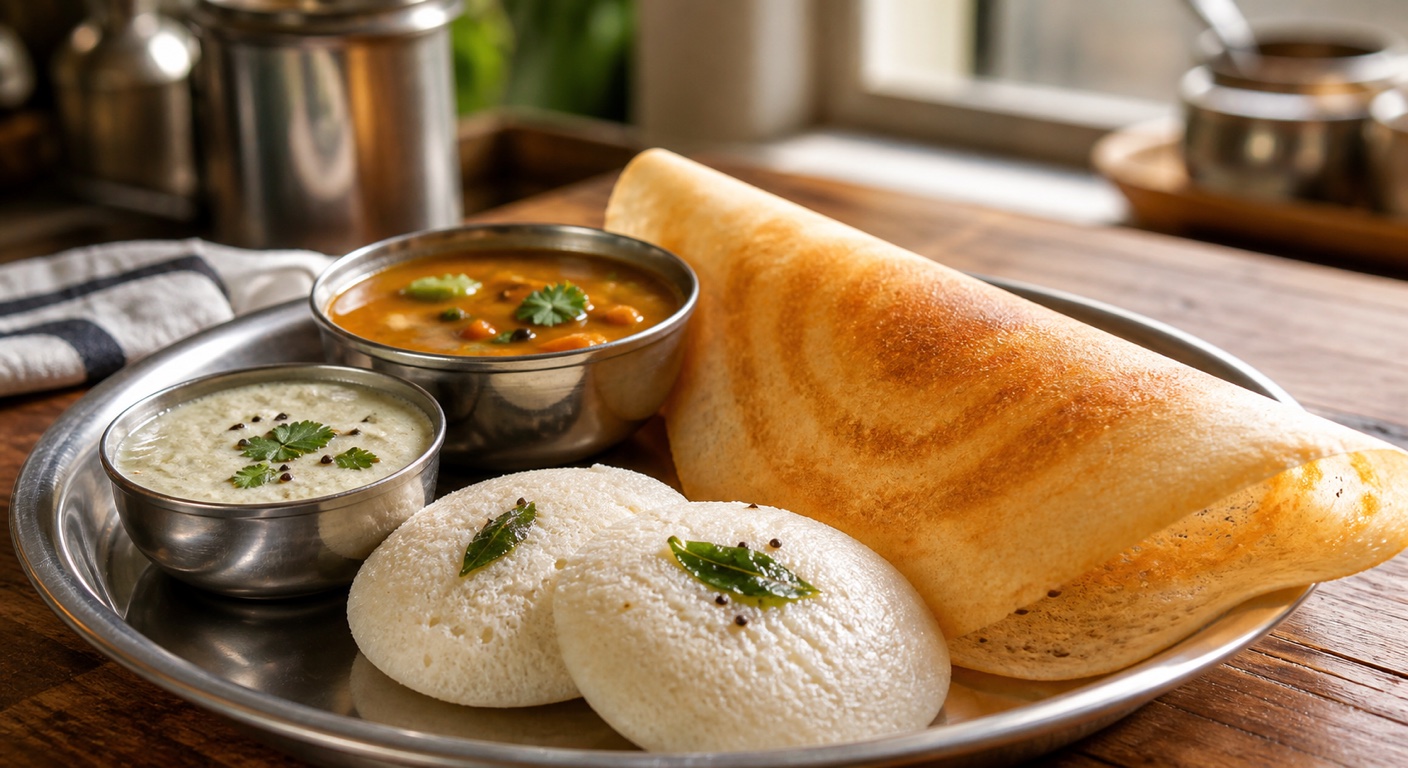
I love dosa and idli - how do I make my South Indian breakfast lighter?
Idli is genuinely light because it's steamed with zero oil - dosa needs a tawa's worth of oil to crisp up, and that's where most of the extra calories sit, not in the rice-lentil batter itself. A typical plate of 2 dosas with sambar and coconut chutney runs about 560 kcal; going easy on the tawa oil, swapping in a couple of idlis, and watching the ghee-roast and chutney oil can bring that down to roughly 380 kcal without changing what you're actually eating.
Idli and dosa come from the exact same fermented rice-and-urad-dal batter - the difference is entirely in how they're cooked. Steaming an idli adds no fat at all; crisping a dosa on a hot tawa always takes some oil. See where the calories in a typical plate actually sit, and you can keep ordering both without the number quietly creeping up.
Your typical plate: 2 dosas with sambar and coconut chutney
Two medium plain dosas cooked properly crisp (not the bare-minimum-oil version) with a bowl of sambar and a couple of spoons of coconut chutney comes to roughly 560 kcal. The dosa's rice-dal batter itself isn't heavy - it's the oil on the tawa and the coconut-and-tempering oil in the chutney doing most of the work.
Assumptions: 1 medium dosa (~40 g, cooked with only a trace of oil) is a real recipe figure of 104 kcal; a realistically-crisped restaurant/home dosa uses roughly 1.5 tsp (~7 g) of oil on the tawa, adding ~62 kcal, for ~166 kcal/dosa - two dosas ~332 kcal. Sambar bowl (~150 g) taken at a real recipe figure of ~85 kcal/100 g ~128 kcal. Coconut chutney (~30 g: ~20 g grated coconut plus a little roasted gram dal and tempering oil) ~100 kcal, estimated from coconut's real per-100 g rate. Total ~560 kcal.
Go easy on the tawa oil
A dosa doesn't need a pool of oil to crisp - a teaspoon spread thin with the back of a spoon (or a light spray) does the same job as one and a half. Ask for it 'kum oil' (less oil) if you're ordering out.
Swap one dosa's worth for idli instead
Idli and dosa are the same batter - idli just never touches oil, because it's steamed. Trading your 2 dosas for 3 medium idlis keeps the meal just as filling and removes the tawa oil from the equation entirely.
Assumptions: 3 medium idlis (~40 g each) at a real recipe figure of ~81 kcal each = ~243 kcal, plus the same sambar (~128 kcal) and chutney (~100 kcal) = ~471 kcal.
Pick a lighter chutney, or ease up on its tempering oil
Coconut chutney's calories come mostly from the coconut's natural fat plus the oil in its tempering (tadka) - not from anything unhealthy about coconut itself. A tomato or tamarind-based chutney, or the same coconut chutney with a lighter tempering, saves a real amount without touching the sambar.
Assumptions: A tomato/tamarind-based chutney or a lightly-tempered coconut chutney of the same size is estimated at roughly half the ~100 kcal baseline chutney, ~50 kcal - a transparent estimate based on removing most of the tempering oil and reducing the fat-dense coconut portion.
One dosa and a bigger bowl of sambar, instead of two dosas
If you're still hungry after one dosa, a second bowl of sambar (dal, vegetables, a little tamarind) fills you up with far fewer calories than a second fried dosa - and adds protein and fibre instead of more refined batter and oil.
This swaps the second dosa (~166 kcal) for a second sambar bowl (~128 kcal) rather than removing it outright - the saving is the difference between the two, not the full dosa.
Small tips that add up
- Idli's real advantage isn't a lighter batter - it's identical rice-and-dal batter to dosa. Its advantage is that steaming needs zero oil, while a tawa always needs some.
- A 'butter roast' or 'ghee roast' finish is a real add-on, not a garnish - a generous 1.5-2 tsp of ghee or butter on a dosa adds roughly 60-85 kcal on top of a plain oil-roast, based on real recipe figures. Ask for it dry or plain-oil roast if you want the crisp without the extra fat.
- The potato masala filling in a masala dosa barely moves the number - real recipe data puts it within a couple of kcal of a plain dosa of the same size. It's the oil and any ghee finish that matter, not the filling.
- 3 dosas or 5 idlis is easy to go for at a buffet-style breakfast because both feel 'light' - but the calories add up the same way any starch does. 2 dosas or 3-4 idlis is a full, satisfying plate.
The bottom line
Dosa and idli share the same rice-lentil batter - the calories that separate them come almost entirely from the tawa oil a dosa needs and steaming's total lack of it. A typical plate (2 dosas, sambar, coconut chutney) is about 560 kcal; going lighter on the tawa oil, swapping in a couple of idlis, and choosing a lighter chutney can bring the same meal down to roughly 380 kcal without changing what's actually on the plate.
Best-case recipe, computed independently: 3 medium idlis (steamed, no oil at all, ~243 kcal) with a lightly-tempered sambar (~95 kcal) and a tomato or tamarind chutney instead of coconut (~45 kcal) comes to about 383 kcal, computed independently (not a sum of the deltas above).