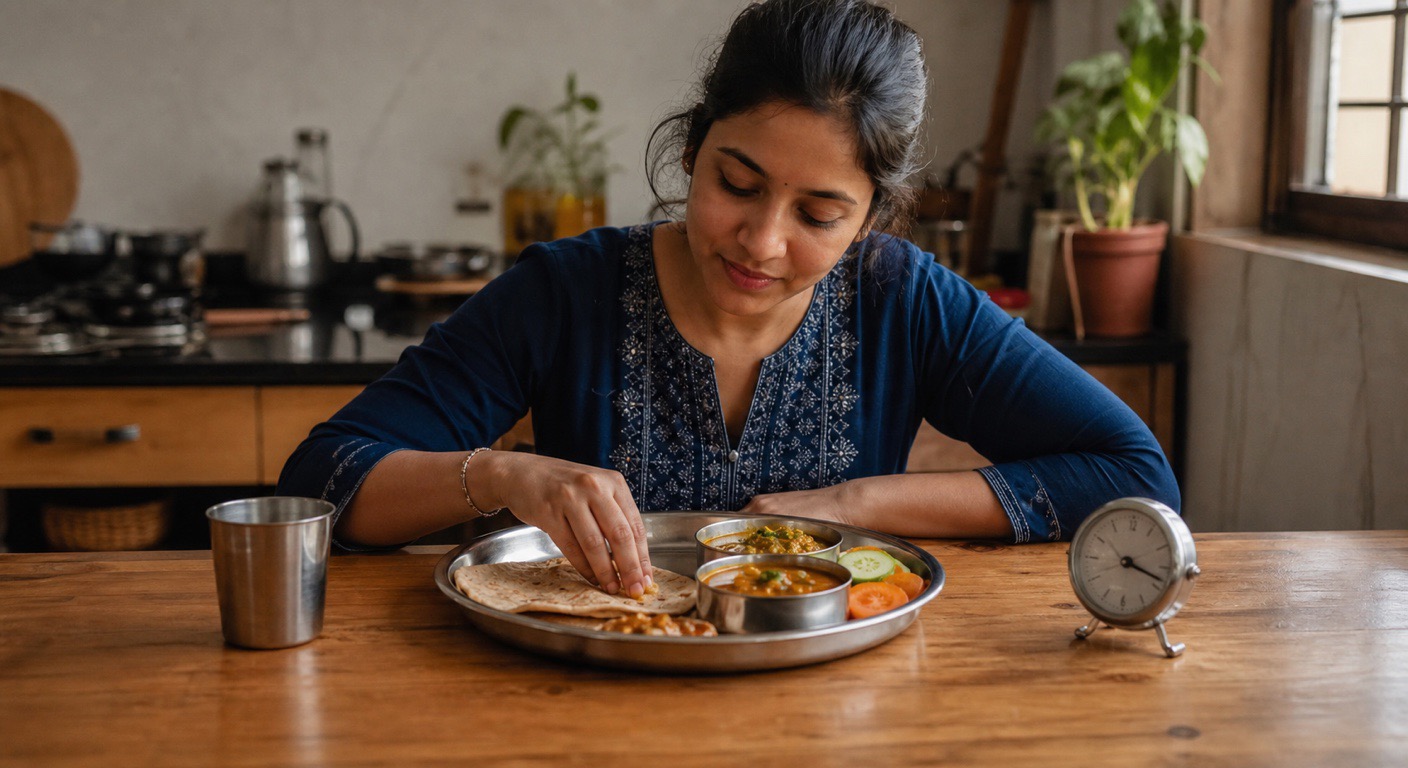
Why eating fast makes you eat more than you need
When you eat fast, your brain's fullness signal arrives too late, so you eat extra food you do not need. In real trials, slow eaters ate about 88 kcal less at one meal and up to 369 kcal less in a day.
It does not matter how fast you eat - only the food on your plate counts.
mostly falseMostly false. Your slow, hormonal fullness signal takes about 20 minutes or more to reach your brain. If you finish your thali in five minutes, that signal has not arrived yet, so you keep eating. In real trials, fast eaters took in about 88 extra kcal at one meal, slowing down cut about 369 kcal a day over two weeks, and slow eaters snacked about 25% less a few hours later.
You know the feeling. You finish lunch in five minutes, then feel stuffed ten minutes later. Your fullness signal was always coming - it just arrived after you had already eaten too much. That tiny timing gap is where the extra food slips in. Let's see how much it really costs you.
Your lunch when you rush it
Picture a normal Indian lunch - a couple of rotis, some dal, sabzi, and rice. When adults ate a meal as fast as they liked, the fast eaters averaged about 893 kcal. That is not a scary number on its own. The problem is the extra food you pile on top, before your brain has time to say 'enough'.
Assumptions: From Shah et al. 2014: normal-weight adults eating ad libitum (as much as they wanted) at a fast pace averaged 892.6 kcal per meal, rounded to 893 with an honest range of 860-920. This was a test meal, not a specific Indian thali, but the intake level is typical of a full lunch.
Slow that same lunch down
Take about 20 minutes for the meal. Put your spoon down between bites. Chew each mouthful, sip water, talk to whoever is at the table. Same food on the plate - just give the fullness signal time to arrive.
Assumptions: Same study, slow pace: 804.5 kcal averaged, about 88 kcal less than fast (P=0.04). Rounded to 805, honest range 770-840. The saving is roughly one home tandoori-style roti (~85 kcal) you would have eaten without noticing.
One meal vs a whole day
Honest ways to slow down
- Put your spoon down between bites. Pick it up only after you have chewed and swallowed.
- Take a sip of water between bites. It slows your rhythm without adding much.
- Chew each mouthful till it is almost liquid before the next one.
- Sit at a table, not standing over the kitchen counter or scrolling on your phone.
- Talk to the people eating with you. Chat is a natural brake.
- Serve yourself once, then wait before going back for seconds - your fullness signal needs time to land.
The bottom line
Eating fast is not about willpower - it is timing. Your fullness signal needs about 20 minutes, and a rushed lunch finishes before it arrives. Slow the same meal down and you eat about 88 kcal less at one sitting, up to about 369 kcal less over a whole day. Put the spoon down, chew, sip water, talk. Same food, less of it - no diet needed.