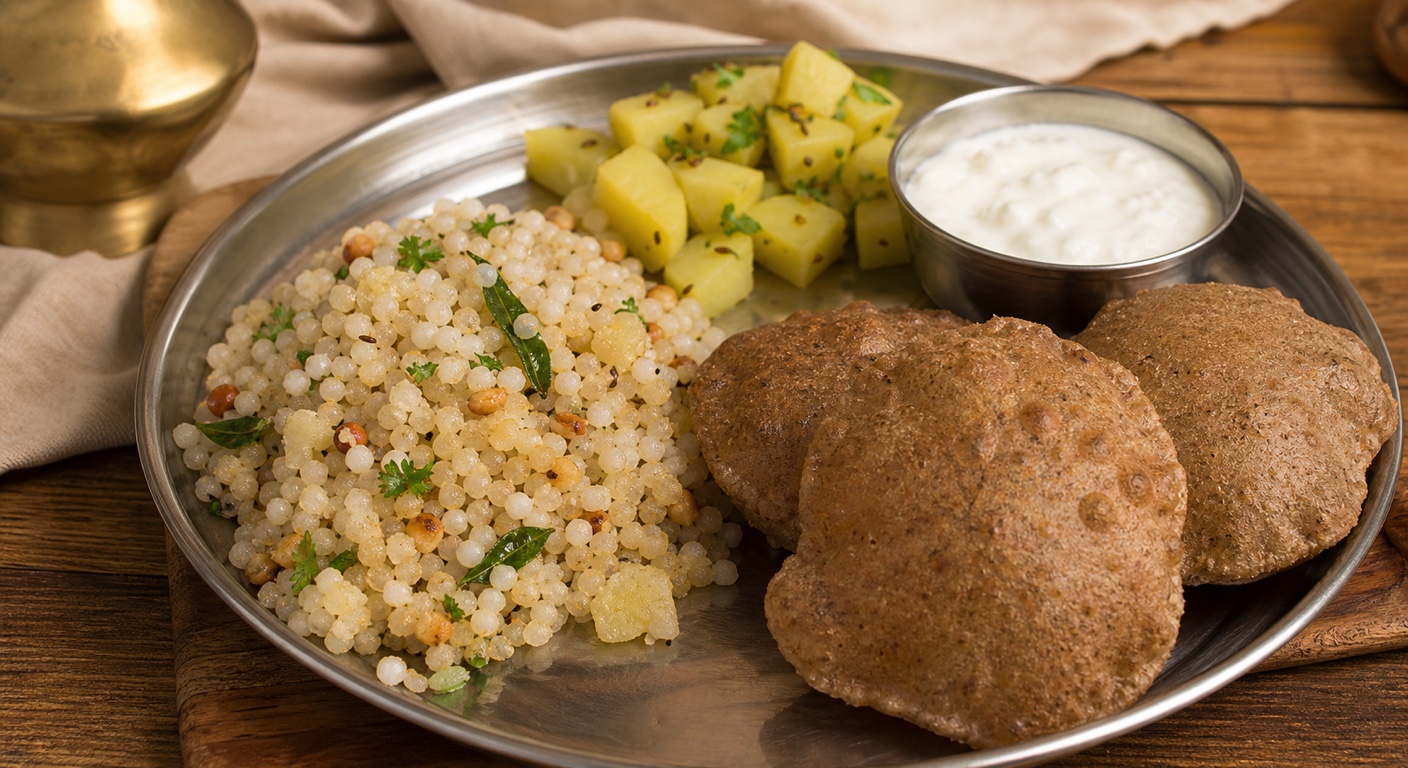
Navratri and Ekadashi fasting - the truth about the post-fast binge
You've fasted all day on fruit, sabudana and kuttu atta - so surely the samosas, sabudana kheer and puris at fast-break are 'earned', right? Here's what the real research on fasting physiology and post-fast eating actually says.
Navratri, Ekadashi and similar vrat fasts are less about starving and more about a shift in what's allowed - fruit, milk, sabudana, kuttu atta, singhare ka atta and potatoes stay on the table; grains, onion, garlic and certain pulses come off it. The physical fasting itself is rarely the problem. The problem is what happens at fast-break, when a day of 'virtuous' eating is used to justify a plate that erases the point of fasting altogether. This article goes through the actual evidence - not gym-folklore - on what a day of religious fasting does and doesn't do to your body, and why the fast-breaking meal deserves as much attention as the fast itself.
"Fasting resets your metabolism so you burn more fat."
partly truePartly true for a day or two - but not the fat-loss reset people imagine.
In a tightly controlled study, researchers put 11 healthy, lean adults through 84 hours (about 3.5 days) of total fasting and measured their resting energy expenditure directly. It didn't fall - it rose, climbing from about 3.97 to 4.53 kJ/min by day three, driven by a surge in norepinephrine (a stress hormone) released as blood glucose dropped. So a short fast genuinely does not shut your metabolism down; if anything, your body nudges its energy use up slightly in the first few days without food. But this is a small, temporary stress response, not a magic switch that 'resets' your metabolic rate or cancels out a large fast-breaking meal - and it was measured over multiple days of total fasting in a lab, not a single day of fruit-and-sabudana eating.
"A day of fasting creates such a big calorie deficit that you can eat anything once it breaks."
mythMyth - the deficit is smaller, and gets undone faster, than people assume.
Ramadan gives us the closest real-world data on dawn-to-dusk religious fasting, and it doesn't support this idea. A prospective study of adults in Jeddah found that, despite a shorter eating window, average daily calorie intake was actually higher during Ramadan than in the weeks before it (about 1,636 vs 1,483 kcal/day), largely from carbohydrate-heavy iftar spreads eaten to break the fast. And a 2019 meta-analysis of Ramadan-fasting studies found that the modest weight loss seen by the end of the fasting month (about 1.34 kg on average) had shrunk to just 0.59 kg within 2-5 weeks afterward, describing 'a return towards, or to, pre-Ramadan measurements' in weight. These are Ramadan fasters, not Navratri or Ekadashi fasters, but the mechanism is the same one at play at any fast-break: a shorter eating window doesn't automatically bank you a surplus to spend - it's the food you actually eat to break the fast that decides whether the day nets out as a deficit or a gain.
"Fasting flushes toxins out of your body, so you're 'starting clean' for the feast."
mythMyth.
This is one of the most common justifications for a big fast-breaking meal, but it doesn't hold up to scrutiny. A 2015 critical review of the detox-diet literature found no randomised controlled trials in humans supporting the claim that any diet or fasting protocol enhances the body's toxin-elimination processes - and most commercial 'detox' claims don't even specify which toxin is supposedly being removed, or how. Your liver and kidneys detoxify your blood continuously, whether or not you're fasting; a day without grains doesn't pause that system, and it doesn't give it a bonus shift either. There's no clean slate being earned here to justify a bigger plate - your body was working normally the whole time.
"Once you've had one gulab jamun, the fast - and the day - is already broken, so you might as well keep eating."
partly truePartly true as a mental trap - but not a rule your body enforces.
This is a textbook case of what researchers call the 'what-the-hell effect.' In the classic 1975 'milkshake study,' Herman and Mack found that restrained eaters given a milkshake before a taste test then ate about 66% more ice cream afterward than restrained eaters given no milkshake - as if permission to eat one thing became license to abandon control entirely. It's a real, well-documented pattern in controlled lab settings. But it isn't inevitable: a 2009 study that tracked real dieters in everyday life after they broke a diet rule found they did not go on to overeat for the rest of the day - many actually ate less afterward to compensate. So the 'the day is ruined' feeling is a thought, not a physiological fact, and you get to decide what the next bite is regardless of what the last one was.
Small tips that add up
- Break the fast with protein and fibre first - curd, roasted makhana, a fruit - before the fried sabudana vada or aloo chaat; it slows you down and blunts the 'eat fast because I'm starving' reflex.
- Decide the fast-breaking meal in advance, the same way you'd plan any other meal. A 'figure it out when I'm hungry' fast-break is when the biggest overeating happens.
- Watch the fried and sweet vrat staples specifically - sabudana vada, aloo chaat, kuttu puri, sabudana kheer. They're grain-free, but frying and sugar are exactly what make 'fasting-appropriate' food calorie-dense.
- If you slip on the fast's rules, treat it as one bite, not a verdict on the whole day - the 'what-the-hell effect' is a thought pattern you can choose not to follow, not a rule your body enforces.
The bottom line
Fasting for Navratri or Ekadashi doesn't damage your metabolism, and it doesn't earn you a reward meal to 'make up for it' either - both ideas overstate what a day off grains actually does to your body. The real risk was never the fast itself; it's the belief that the fast has earned you a blowout, which is what quietly turns one skipped meal into a net calorie surplus for the week.
Best-case recipe, computed independently: Fast as planned, then break it with a portion-controlled plate that leads with protein and fibre (curd, fruit, roasted makhana) before the fried items, and treat any slip on the fasting rules as a single bite - not permission for the whole day to become a binge.