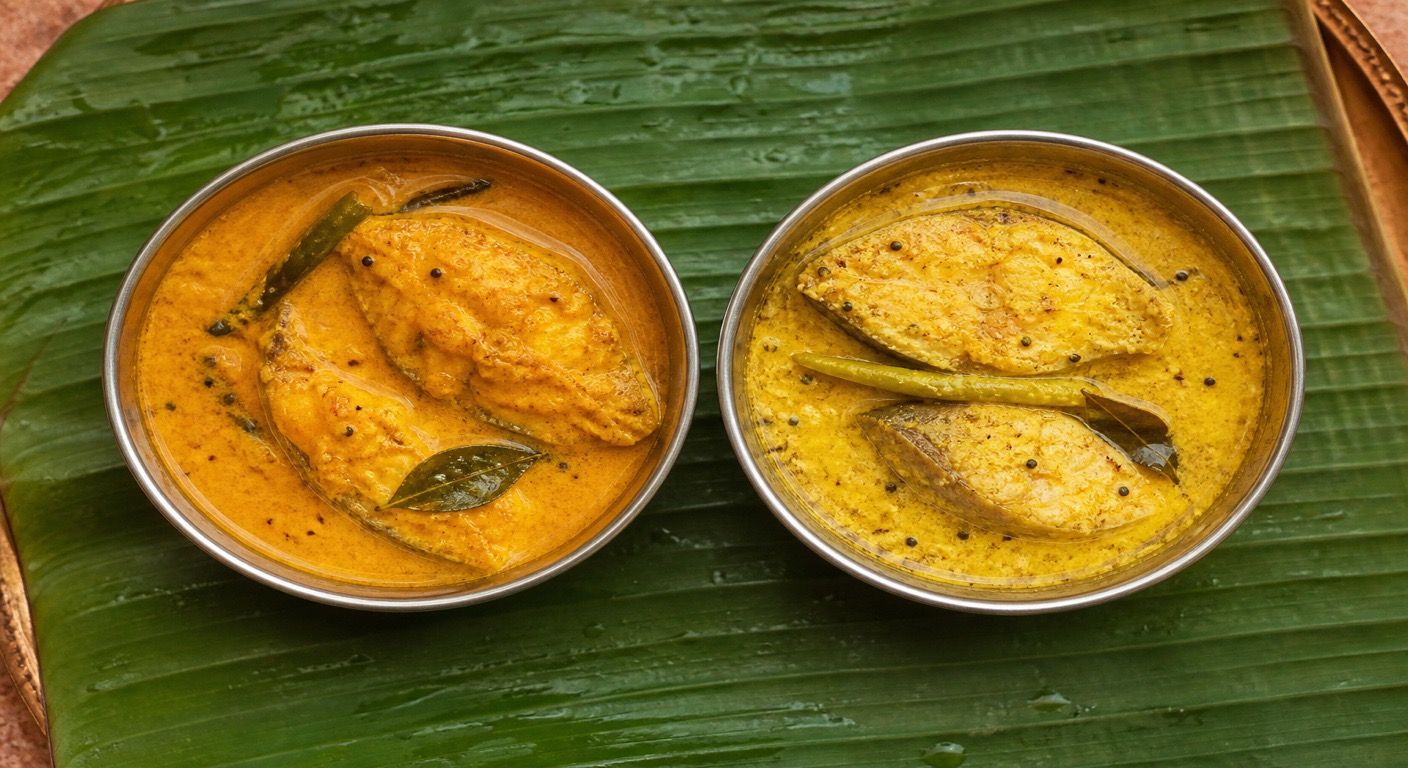
Fish curry - coconut or mustard, which is lighter?
Goan coconut fish curry and Bengali mustard fish curry both taste rich, but the coconut version hides far more fat in its gravy. A katori of mustard-style fish curry runs about 220 kcal, while the coconut one lands closer to 330 kcal.
Fish curry is a Sunday favourite in many Indian homes. Goan style swims in coconut. Bengali style sings with mustard. They taste nothing alike, and they load very different calories onto your plate. Let us see where the fat really hides.
Fish curry is healthy, so any fish curry must be light.
it dependsIt depends. The fish itself is lean and good for you, about 127 kcal per 100 g. But the gravy is where the calories live. Coconut milk and grated coconut carry a lot of fat, so a coconut gravy can add more than double the fish's calories. A mustard gravy uses far less fat, so it stays lighter.
Two famous fish curries, one medium katori each
Your usual Goan coconut fish curry, 1 medium katori
One katori of home-style Goan fish curry lands around 330 kcal. The fish piece is only about 100 kcal. The rest is the gravy. Grated coconut, a splash of coconut milk, and a spoon of cooking oil do almost all the work.
Assumptions: 1 medium katori (~225 g): one fish piece ~75 g cooked from ~80 g raw carp at 127 kcal/100 g = ~102 kcal. Gravy ~150 g built as: 35 g grated fresh coconut (354 kcal/100 g = ~124 kcal), 30 g canned coconut milk (197 kcal/100 g = ~59 kcal), 1 tsp cooking oil ~5 g (884 kcal/100 g = ~44 kcal), spices and water ~0. Gravy = ~227 kcal. Total = 102 + 227 = ~329, rounded to 330.
Swap to Bengali mustard fish curry (shorshe)
Same size katori, same fish piece, a very different gravy. Mustard paste plus a small spoon of mustard oil carries far less fat than coconut and coconut milk. This is the lighter pick if you enjoy the pungent mustard kick.
Assumptions: 1 medium katori (~225 g): one fish piece ~75 g cooked from ~80 g raw carp = ~102 kcal. Gravy ~150 g built as: mustard paste from 15 g ground mustard seed (508 kcal/100 g = ~76 kcal), 1 tsp mustard oil ~5 g (884 kcal/100 g = ~44 kcal), green chilli, turmeric, salt and water ~0. Gravy = ~120 kcal. Total = 102 + 120 = ~222, rounded to 220.
Lighter fish curry, your way
- The fish is the lean part, about 100 kcal for a 75 g piece. The gravy decides whether your katori is 220 or 330.
- Love Goan curry? Ask for less coconut milk and more ground-spice paste. That alone can trim a good chunk off a katori.
- Bengali shorshe fish curry uses mustard paste and just a spoon of mustard oil, so it lands around 220 kcal a katori.
- Eat it with one roti or a small mound of rice, not both. The gravy already carries a full meal's fat.
- Restaurant fish curries pour extra oil so the gravy shines, so a dhaba katori runs higher than the home math above.
The bottom line
Between the two famous styles, the Bengali mustard fish curry is the lighter pick. It runs about 220 kcal a katori against the Goan coconut version's ~330. The fish is nearly the same in both. The gravy is the whole story. Pick mustard when you want the lighter katori, or go easy on the coconut milk when you go Goan.