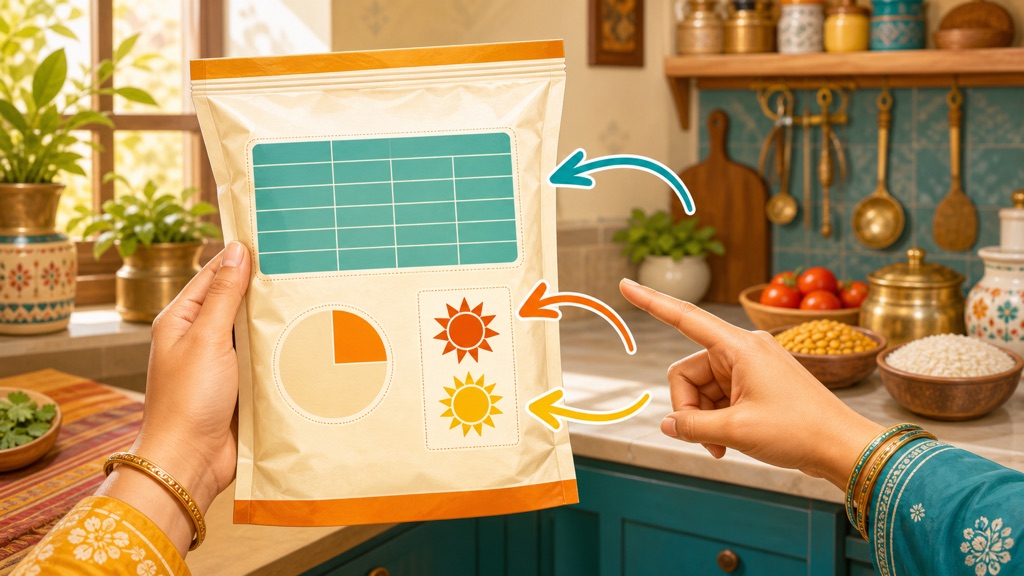
How to read the calorie line on a food label
The calorie number on a pack looks simple, but it hides behind three tricks: per-100g vs per-serving, kJ vs kcal, and a serving size that is often smaller than you eat. Learn to read it right so the number you log is the number you actually ate.
You flip a pack of noodles or biscuits to read the back. There it is, the calorie line. But the number you see is not always the number you eat. Packs play three quiet tricks. They show calories per 100g, or per serving, or for the whole pack. They show energy in kJ, in kcal, or both. And the serving size is often much smaller than what you actually eat. Read the line wrong, and you log a number that is half of what you really ate. That is the gap that quietly breaks a calorie deficit.
Two numbers live on one pack: per-100g and per-serving
Most packs give energy in two columns. One says 'per 100g' (or per 100ml). The other says 'per serving'. They are not the same number. Per-100g is a fair way to compare two foods, because 100g is 100g for everyone. Per-serving is what the maker says one serving is. The serving might be 30g, or half the pack, or one biscuit. Indian rules require this. The Food Safety and Standards (Packaging and Labelling) Regulations, 2011 say a label must give 'Nutritional information or nutritional facts per 100 gm or 100ml or per serving' and the very first item is '(i) energy value in kcal'. So the kcal number is your legal right on the back of the pack. The trick is knowing which column you are reading.
One pack of instant noodles, three different calorie numbers
The serving size on the pack is how much you should eat.
mostly falseMostly false. The serving size is a number the maker chooses, and it is often old and smaller than what people really eat. The US FDA, which sets the rules many countries copy, fixed its serving sizes in 1993 using food surveys from 1977-1988, and now admits 'there is evidence that the U.S. population is eating larger portion sizes than it did in the 1970s and 1980s'. So the serving on the pack is not a health goal. It is just the amount the maker used to do the maths. If you eat more than that one serving, you must multiply. One biscuit shown as 45 kcal is 45 kcal only if you stop at one.
kcal and Calories are different units, so kJ and kcal are easy to mix up.
it dependsIt depends, explained simply. On a food label, the word 'Calorie' with a capital C means exactly one kilocalorie (kcal). Years ago a scientist named Berthelot 'decided to define the lower-case calorie as a g-calorie and use the capitalized Calorie to refer to the kg-calorie'. So 'Calories 200' on a label means 200 kcal. The conversion to kilojoules is fixed: '1 kcal equals exactly 4.184 kJ'. So a pack that says 303 kcal also means about 1274 kJ (303 x 4.184). If your pack shows only kJ, divide by 4.184 to get kcal. In India, labels show kcal. In the EU and UK, both kJ and kcal are shown, with kJ first. Read the unit, not just the number.
A real Indian biscuit label: per-100g vs per-serving in action
Take a packet of Britannia Marie Gold biscuits, a common tea-time pack. The label gives 445 kcal per 100g. That is the per-100g number. Now look at the serving. The maker's serving is small, often about 15g, which is roughly one and a half biscuits. So one serving is about 67 kcal (445 x 15 / 100). But few people stop at one and a half biscuits with their chai. Eat six biscuits and you are near 267 kcal, four times the serving number. The per-100g line is the honest yardstick. The per-serving line is the maker's maths. Match the number to how much you actually eat.
Assumptions: Per-100g = 445 kcal (Britannia Marie Gold, FatSecret India). Maker serving ~15g gives ~67 kcal (445 x 15/100). Six biscuits (~60g) gives ~267 kcal. The full 100g gives 445 kcal.
Read the calorie line in five honest steps
The bottom line
The calorie line is honest only if you read it honestly. Check the unit (kcal or kJ), check the column (per 100g, per serving, or per pack), and check the serving size in grams against how much you actually eat. The maker's serving is old maths, not a health goal. In Burnie, log the calories for the real amount you ate, and your daily deficit = food_total_kcal minus (bmr plus active_calories). Read the back of the pack. Match the number. That is the Burnie way.