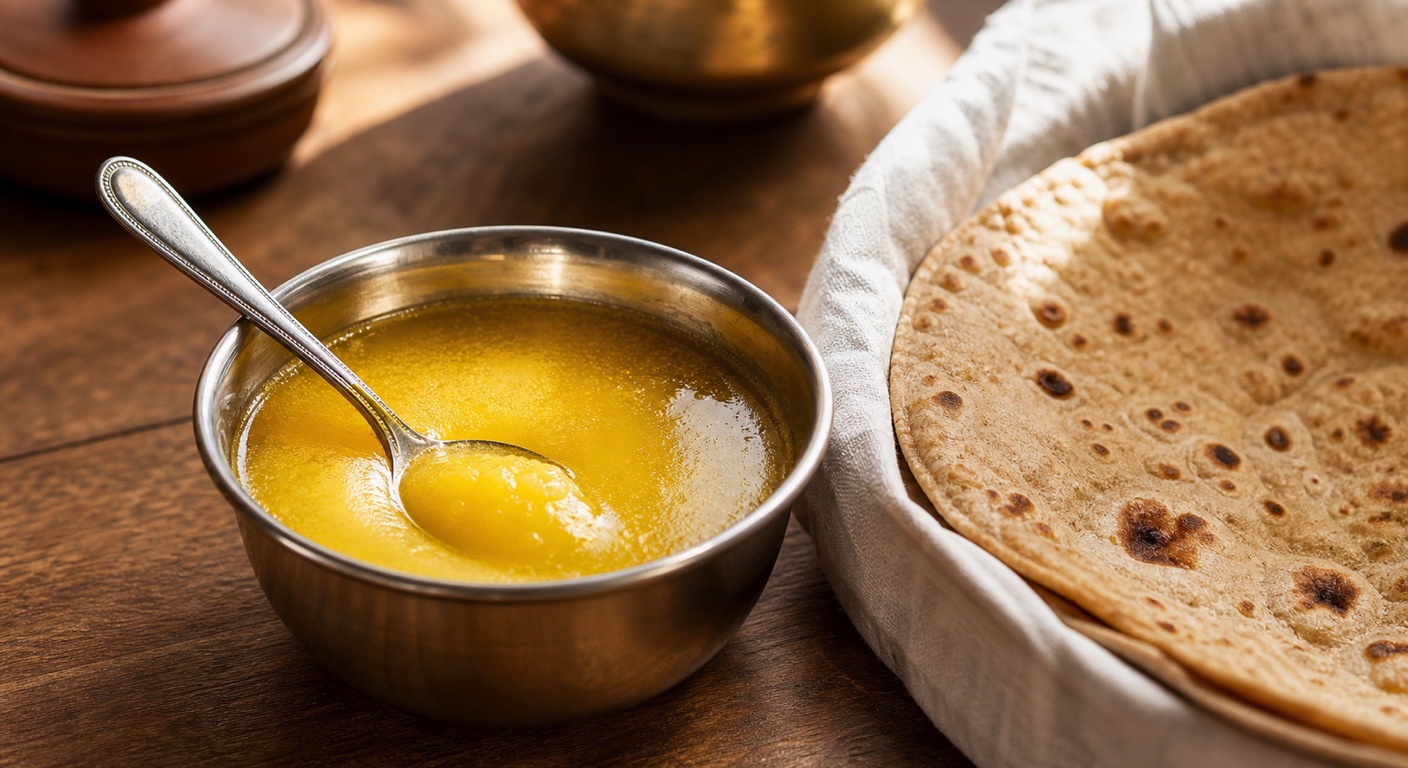
Ghee: how much is actually "healthy"?
Ghee carries huge cultural weight in Indian kitchens - which makes it easy to slide from 'ghee is a valued food' to 'ghee has no limit.' Here's what the actual clinical research says, kept separate from Ayurvedic tradition.
Ghee holds a special place in Indian households and Indian identity - dadi's ghee, pure desi ghee, ghee as prasad. That cultural weight makes it easy to slide from 'ghee is a valued food' to 'ghee has no calorie or health limit.' Here's what the actual clinical and epidemiological research says, kept deliberately separate from Ayurvedic tradition - which is a different, and valid, but different, kind of knowledge.
"Ghee doesn't make you fat - it's a 'good fat'."
mythMyth as stated - all fat, 'good' or not, is calorie-dense, and ghee is close to 100% fat.
Fat of any kind supplies about 9 kcal per gram, roughly double what carbohydrate or protein supply, and ghee - having had water and milk solids removed - is close to 99-100% fat by weight. A single tablespoon (about 13-15g) runs to roughly 110-130 kcal. ICMR-NIN's Dietary Guidelines for Indians (2024) cap total visible fat/oil intake - ghee, butter and cooking oil combined - at roughly 20-30g/day for women and 25-40g/day for men depending on activity level, precisely because visible fats are calorie-dense enough to tip a normal diet into surplus quickly. 'Good fat' affects your cholesterol profile differently from 'bad fat'; it does not exempt anyone from the basic calories-in-calories-out arithmetic of weight gain.
"Ghee burns fat / boosts your metabolism because of its CLA content."
mythMyth as commonly claimed - the CLA dose shown to do anything in humans is far higher than what's in a normal serving of ghee.
Ghee does contain small amounts of conjugated linoleic acid (CLA), a genuinely studied compound. Blankson and colleagues (2000, Journal of Nutrition) ran a randomised, double-blind trial giving overweight and obese adults isolated CLA supplements at 1.7 to 6.8 grams per day for 12 weeks, and found reductions in body fat mass only at those supplement-level doses. Ghee's naturally occurring CLA content is a small fraction of a gram per typical serving - nowhere close to the 3+ grams/day used in the trials that showed any effect. Eating ghee for its CLA is a bit like eating an orange expecting a vitamin-C-derived cure - the compound is real, the dose delivered by the food isn't.
"You can eat unlimited ghee if it's pure or homemade."
mythMyth - purity affects flavour, smoke point and adulteration risk, not the calorie count or fat composition.
'Pure' or homemade ghee is still essentially all fat, made of the same mix of saturated and monounsaturated fatty acids as any other ghee - clarifying butter at home removes water and milk solids the same way commercial processing does. There is no research showing homemade ghee is metabolised differently or is calorie-free; ICMR-NIN's visible-fat ceiling applies to ghee regardless of where it came from. The genuine benefit of home-clarifying your own ghee is quality control - no adulteration, no added flavouring - not a license to eat it by the spoon without counting it.
"Ghee is protective for the heart - Indian tradition proves it, this isn't just Ayurveda."
VerdictGenuinely mixed clinical evidence - and it's important to separate that from the cultural claim, because they don't say the same thing.
There is real, published epidemiological evidence pointing in ghee's favour: Gupta and Prakash (1997, Journal of the Indian Medical Association) surveyed 1,982 rural Rajasthani men and found significantly lower coronary heart disease prevalence in those eating more than 1kg of ghee a month (odds ratio 0.23) - though these higher-ghee-consuming men also ate more total calories and monounsaturated fat, and lived a different overall lifestyle, so ghee itself may not be the whole story. Pulling the wider evidence together, a systematic review and meta-analysis in Progress in Nutrition (Aulesa and Fernandez) combined 10 studies covering nearly 20,000 people and found ghee intake associated with a marginally higher coronary heart disease risk (OR 1.15, 95% CI 0.71-1.59) that was not statistically significant, while a separate pooled analysis of 8 studies found neutral-to-positive effects on lipid profile. The honest reading: clinical evidence on ghee and heart disease is genuinely mixed and mostly non-alarming in moderate amounts - a very different, more cautious claim than a confident 'ghee actively protects the heart', which leans closer to cultural belief than settled science.
Small tips that add up
- Measure ghee with a spoon, not by eye - a rounded tablespoon (~13-15g, ~110-130 kcal) is a realistic single serving, not a light drizzle.
- Count ghee against the same daily visible-fat budget as your cooking oil and butter (roughly 20-30g/day per ICMR-NIN) - it doesn't get its own separate allowance.
- Enjoy ghee for what it's genuinely good at - flavour, smoke point, satisfaction - rather than as a supplement for fat loss or heart protection.
- If heart health is the goal, the stronger evidence points to overall dietary pattern (vegetables, fibre, less refined carbohydrate, physical activity) mattering more than the ghee-vs-oil choice alone.
- 'Homemade' and 'pure' ghee are worth choosing for quality and lack of adulteration - not as a reason to stop measuring how much you eat.
The bottom line
Ghee is not the villain, and it's not a miracle either - it's a calorie-dense fat with genuinely mixed cardiovascular evidence, most of it non-alarming in moderate amounts, none of it supporting 'unlimited' as a serving size.
Best-case recipe, computed independently: Not a literal recipe - the practical best case is one measured spoon of ghee a day on dal, rice or roti for flavour, with the rest of your fat budget coming from cooking oil, and dropping the belief that 'pure' or 'homemade' changes the calorie math.