Does ghee make you fat? The honest answer
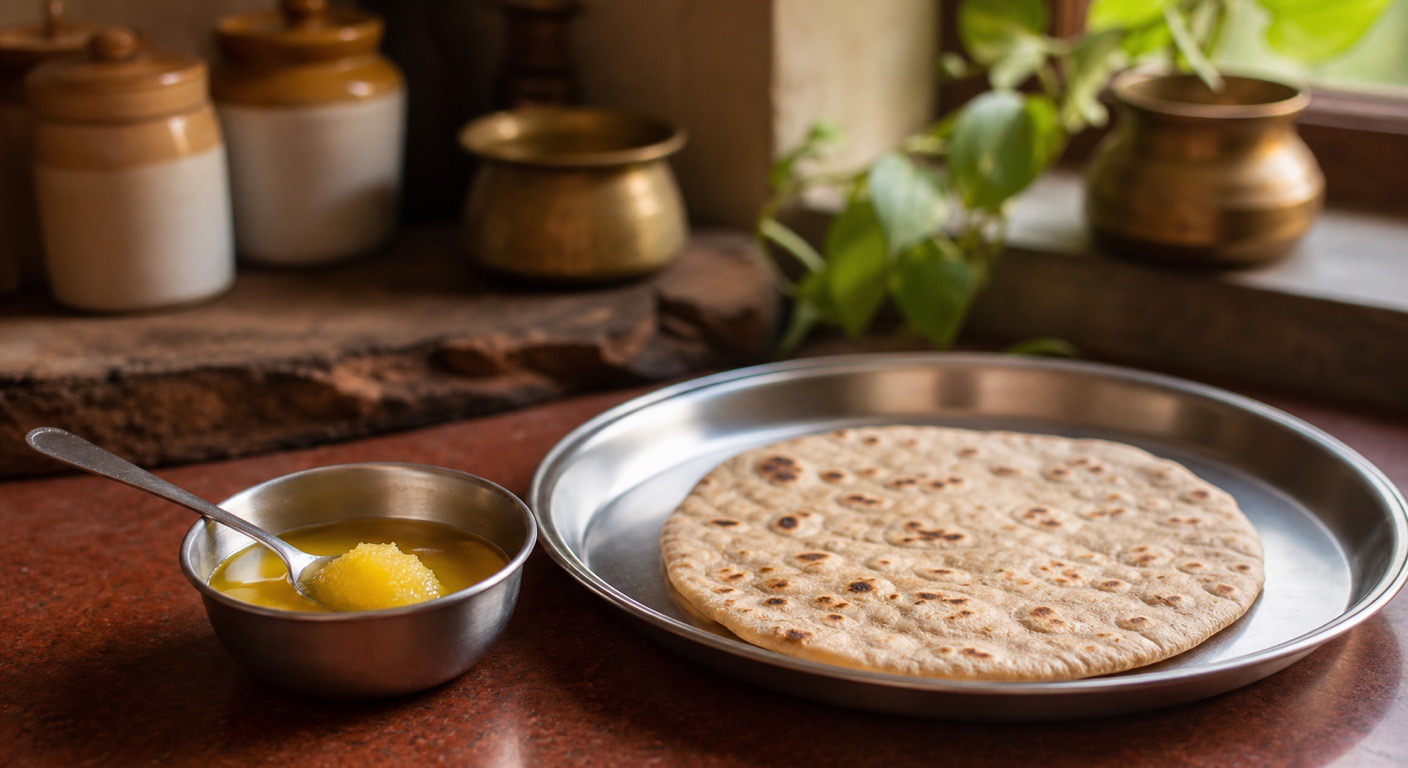
Ghee is almost pure fat at about 897 kcal per 100 g, but one small teaspoon on your roti is only about 45 kcal. It will not make you fat by itself — pouring it freely, day after day, is what quietly adds the calories.
Ghee makes you fat, so you must stop it completely to lose weight.
mostly falseMostly false. Ghee is almost pure fat, so a lot of it will add calories fast. But a single teaspoon on your roti is only about 45 kcal — that will not make you fat. The quantity is what matters, not the ghee itself.
Your grandma put a spoon of ghee on your roti and you grew up fine. Then someone told you ghee is 'pure fat' and you felt scared. Both things are true at once. Ghee is fat — but a little is fine and a lot is too much. Let us look at the honest numbers so you can enjoy your roti without fear.
A normal ghee day at home: about 3 teaspoons
On a normal Indian day you might use 1 teaspoon of ghee on your rotis, 1 teaspoon in the tadka for your dal, and 1 teaspoon on a paratha or in your khichdi. That is about 15 g of ghee, which comes to about 135 kcal. That is a small, honest number — not scary at all.
Assumptions: 1 teaspoon of ghee = ~5 g. At 897 kcal/100 g, 5 g = ~45 kcal. Three teaspoons (15 g) = 15 x 8.97 = ~135 kcal. This is a transparent kitchen estimate of a typical home day, not a lab measurement of a specific brand.
One teaspoon of common fats: ghee is not special
People act like ghee is worse than butter or oil. The numbers say they are all fat, all close in calories per spoon. So swapping ghee for oil does not save you much — the only win is using less of any of them.
Use one teaspoon on the roti, not two
A second spoon of ghee on each roti is a habit, not a need. One teaspoon gives the flavour and the smell. Dropping the second spoon saves about 45 kcal per roti, and over two rotis that is about 90 kcal a day.
Assumptions: Baseline 3 tsp/day (135 kcal). Cutting one extra spoon (5 g ghee = ~45 kcal) takes it to 2 tsp/day = ~90 kcal. Delta is -45 kcal from the baseline. At 897 kcal/100 g, 5 g = ~45 kcal.
Skip the free-pour ghee on festive sweets
A festive thali loves a big pour of ghee on halwa, moong dal payasam, or roti. One free pour can be 2-3 spoons, about 90-135 kcal, on top of an already rich sweet. Keep the sweet, skip the extra pour — that is where ghee quietly piles on.
Assumptions: A festive pour on top of the baseline: ~3 extra teaspoons (15 g) = ~135 kcal more, on top of the normal 3 tsp/day (~135 kcal). Total ~270 kcal of ghee that day. 15 g ghee at 897 kcal/100 g = ~135 kcal.
Honest ghee habits
- Measure ghee with a teaspoon, not a big serving spoon — your eyes usually count double what the spoon really holds.
- One teaspoon on hot roti gives the same smell and flavour as two, because the heat carries it.
- Ghee and oil are almost the same calories per spoon, so do not fool yourself that an oil pour is 'lighter'.
- If you love the taste, keep one teaspoon a day — that 45 kcal is easy to fit into any weight-loss plan.
- The real ghee problem is not the teaspoon on your roti — it is the free pour on sweets, parathas, and dal at festivals.
The bottom line
Ghee is fat — about 897 kcal per 100 g — but that does not make it evil. One teaspoon is about 45 kcal, which fits easily into your day. The myth is not that ghee has calories; the myth is that ghee is uniquely fattening. It is not — oil and butter are just as calorie-dense per spoon. Keep a small spoon of ghee on your roti and stop the free pours. That is the whole honest answer.