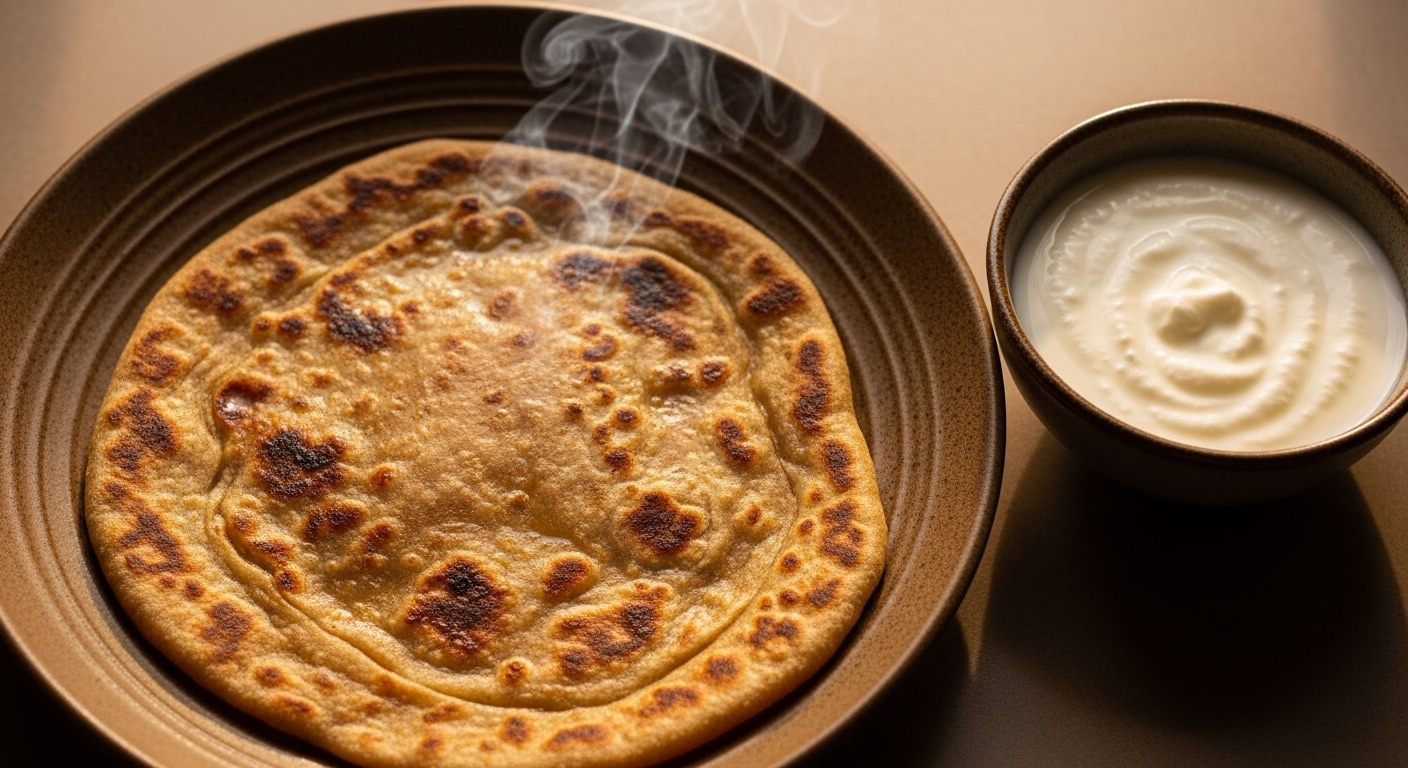
I love paratha - how do I make it healthier?
You don't have to give up parathas. A regular aloo paratha is about 250-300 kcal, and most of the extra calories come from the ghee it's cooked in and from eating two instead of one. With a few small swaps - less cooking fat, a thinner paratha, a vegetable stuffing, and a bowl of dahi on the side - you can roughly halve the plate without losing the paratha you love.
Paratha isn't the problem - a few habits around it are. See where the calories actually come from, and you can keep eating paratha while quietly bringing the number down. Every figure here comes from a real recipe and real food data, rounded and given as honest ranges.
Your regular paratha
One medium aloo paratha - 40 g atta, 70 g boiled potato, 2 tsp ghee - comes to about 270 kcal. Most people eat two, so the plate is often 540 kcal before any butter on top. The potato isn't the villain; the ghee is the biggest lever.
Assumptions: 1 medium aloo paratha ~110-120 g: 40 g atta (128 kcal) + 70 g boiled potato (49 kcal) + 2 tsp / 10 g ghee (90 kcal). Home-style; a dhaba paratha with lots of ghee and butter can reach 350-385 kcal.
Cook it with less ghee
Use 1 teaspoon of ghee instead of 2, spread thin with the back of a spoon - same flavour and golden spots, no puddle. The easiest change here.
Brush oil on a nonstick tawa instead of shallow-frying
On a nonstick tawa, brush on just 2-3 g of oil with a silicone brush or folded tissue instead of pouring ghee around the edges. This replaces the tip above - the same lever taken further, not an extra saving.
Same lever as 'less ghee' - the low end of the cooking-fat spectrum, not an additional saving.
Whole wheat (atta) instead of refined flour (maida)
Stick with atta over maida - though the calorie gap is tiny (~320 vs ~352 kcal/100 g, so only 10-15 kcal per paratha). The real win is fibre: atta has ~11 g per 100 g vs under 3 g in maida, so it keeps you full longer and cuts the urge for a second paratha.
This is about fibre and staying full, NOT about calories. The calorie saving is small and honest.
Swap the stuffing: mooli, gobi or methi instead of aloo (and know that paneer is the richest)
Mooli, gobi or methi add bulk and fibre for almost no calories - swap 70 g potato for 70 g grated mooli or gobi and save ~30 kcal, still full and stuffed. Paneer stuffing is the richest choice (~100 kcal from just 40 g) - a treat, not an everyday lighter option.
Eat one paratha with a bowl of dahi or chaas, not two parathas
The biggest lever of all - and it's about the plate, not the paratha. Two parathas is ~540 kcal; swap the second for a bowl of dahi (~90 kcal) or a glass of chaas and you land around 360 kcal, still full, plus some protein. One paratha with something cooling beats two parathas almost every time.
Delta is measured against a typical TWO-paratha meal (540 kcal), because that's what this swap replaces - not against the single-paratha baseline.
Make it smaller and thinner
Roll it thinner - 30 g atta instead of 40 g, with a lighter hand on the ghee - and it naturally uses less flour and fat. Cooks faster too. Still a full paratha, just not an extra-large one.
Small tips that add up
- Don't stack the same lever twice. 'Less ghee' and 'brush instead of fry' are the same idea - pick where you land on the cooking-fat scale, don't count both savings.
- The two changes that matter most are the cooking fat and the number of parathas - fix those first, the rest is fine-tuning.
- Serve dahi, chaas or a big salad on the side. It fills the plate and the stomach without filling the calorie count.
- Whole wheat is about fibre and staying full, not about calories - don't expect a big calorie drop from atta alone.
- A paneer paratha is a treat, not a 'healthy' swap - enjoy it, just know it's the richest one.
The bottom line
A regular aloo paratha is ~250-300 kcal. Thinner (30 g atta), whole wheat, brushed oil instead of frying, mooli or gobi instead of potato - and one paratha drops to ~135-175 kcal. The change that matters most: eat one paratha with dahi instead of two, and the whole meal drops from ~540 to ~225-310 kcal - less than half, still a filling meal with something cooling on the side. You're not giving up paratha - just making a few small swaps, starting with less ghee.
Best-case recipe, computed independently: One thin whole-wheat paratha from 30 g atta (96 kcal) + 60 g mooli/gobi filling (~18 kcal) + ~2 g brushed oil (~18 kcal) = ~132 kcal, computed independently (not a sum of the deltas above). Paired with a 150 g bowl of dahi (~90 kcal) for a full, satisfying plate.