A budget home gym in India: what to buy, what to skip
You do not need a fancy treadmill or big machines to get fit at home. For a few thousand rupees, two dumbbells, a mat, some resistance bands, and a doorway pull-up bar cover about 90% of what a gym does. This kit builds muscle, raises your resting burn, and fits in a corner of a small Indian home.
Many Indians think a home gym means a treadmill that costs as much as a fridge, or a shiny multi-gym that eats half a room. That idea keeps people from starting. The truth is simpler and far cheaper. With two dumbbells, a mat, a set of resistance bands, and a doorway pull-up bar, you can train almost every muscle in your body inside a 6-by-6 corner of your bedroom. This article tells you what to buy first, what each piece is for, what to skip, and why this small kit beats a treadmill for long-term fat loss. The short answer: resistance gear builds and protects your muscle, and muscle is what keeps your daily burn high. A treadmill only adds burn while you walk.
The starter kit: mat, dumbbells, bands, and a pull-up bar
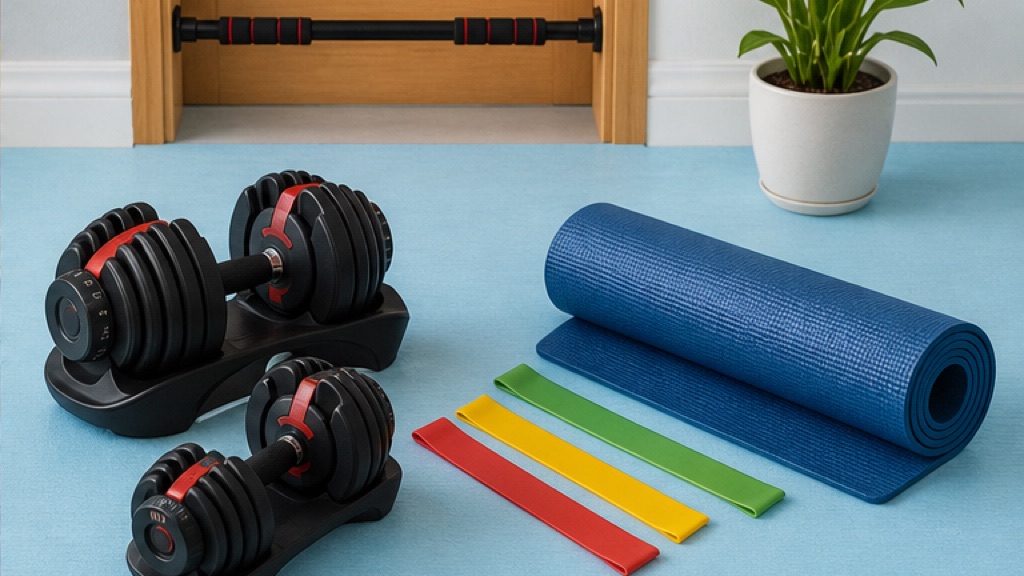
Your first home gym is just four things. A yoga or exercise mat gives you a clean, non-slip surface for floor work, stretches, and core exercises; it costs the least and you use it every session. Two dumbbells, either a fixed pair or adjustable ones where you slide weight plates on and off, are your main strength tool; you press, curl, row, squat, and lunge with them. A set of resistance bands adds light, portable resistance for warm-ups, mobility, and extra angles a dumbbell cannot reach; they fold into a drawer and cost very little. A doorway pull-up bar trains your back, arms, and grip using your own body weight, and it stays out of the way when not in use. Together these four pieces let you train your whole body for a few thousand rupees. You can add a foldable weight bench later, once you outgrow the basics, but it is not needed to start.
You need expensive equipment to get fit at home.
falseFalse. A pair of dumbbells, a mat, some resistance bands, and a doorway pull-up bar cover about 90% of the exercises you would do in a commercial gym, for a few thousand rupees total. The bigger win is what resistance gear does to your body over time. Resistance training is the exercise method that reliably builds lean muscle, and that extra muscle raises your resting metabolic rate, the calories you burn even while sitting. One review found resistance exercise alone raised resting metabolic rate by about 96 kcal per day compared to controls, while aerobic exercise alone had no such effect. So a cheap set of dumbbells and bands does more for your daily burn than a costly treadmill, because it builds the muscle that keeps burning calories all day, not only while you work out.
Buying order and living with a home gym in a small home
- Buy in this order: mat and dumbbells first, then bands, then a pull-up bar. Add a foldable bench only after floor presses feel too easy. This spreads cost and each piece is useful on its own.
- Pick the cheapest that is sturdy. Cast-iron fixed dumbbells last decades. Adjustable spin-lock dumbbells save space and money if you want to add weight later. Skip shiny chrome and brand tax.
- Try used gear first. Many people sell barely-used dumbbells and benches online when they stop working out. You can get them for half price, and iron does not expire.
- Store smart in a small home. A mat rolls up, bands fit in a shoe box, and a pull-up bar lives in the doorway. Keep dumbbells under the bed or a corner shelf. The whole kit needs less space than a single suitcase.
- Skip fancy machines, ab belts, and vibrating plates. They cost more, take more room, and do less than a pair of dumbbells. The claims are mostly marketing, not muscle.
- Use your body weight too. Push-ups, squats, lunges, and planks are free, need no gear, and build real strength. Pair them with dumbbells and bands for a full plan.
- Train two to three days a week, about 30 minutes each. That is enough to build and keep muscle, raise your daily burn, and still leave time for the rest of your life.
The bottom line
A good home gym in India costs a few thousand rupees, not lakhs. A mat, two dumbbells, a set of resistance bands, and a doorway pull-up bar cover about 90% of a commercial gym's exercises, and they fit in a corner of a small home. Buy in that order, pick the cheapest that is sturdy, and try used gear first. Skip the treadmill, the multi-gym, the ab belts, and the vibrating plates; they cost more and do less. The real reason this kit beats a treadmill is that resistance training builds lean muscle, and that muscle raises your resting burn all day, not only while you exercise. One review found resistance training alone raised resting metabolic rate by about 96 kcal per day, while aerobic exercise alone did not. Log your food in Burnie, train two to three days a week with this small kit, and let the muscle you build widen your deficit quietly, every single day. That is the whole plan.