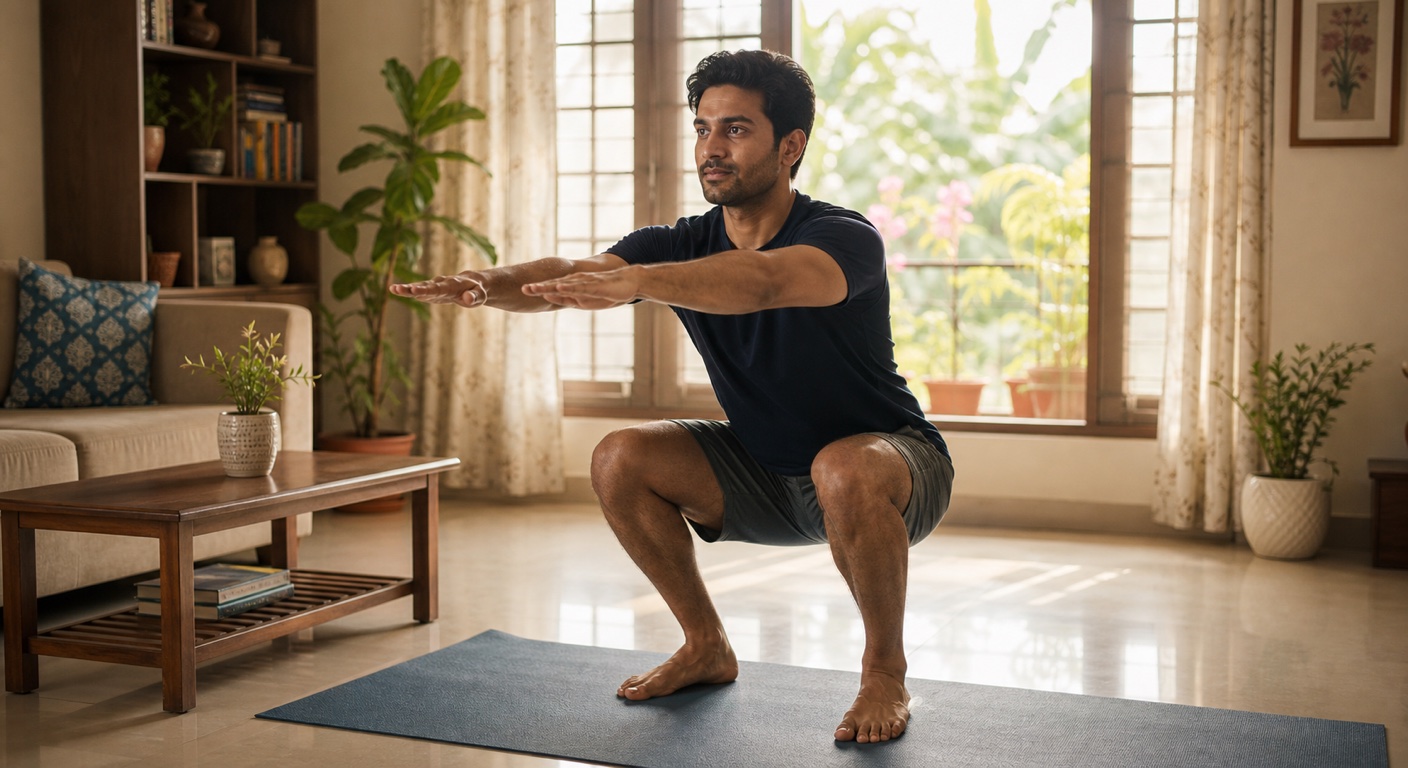
No gym, no problem? The truth about home workouts vs the gym
Small flat, no gym nearby, or just done with the membership guilt? Here's what the actual training research says about bodyweight workouts vs the gym.
Between long commutes, expensive memberships, and apartments where 'home gym' means a mat squeezed between the bed and the wall, most Indians train (or want to train) at home at some point. But is a bodyweight routine actually as good as a gym, or just a compromise you settle for? Claim by claim, here's the honest answer from real exercise-science research.
"You need weights or machines to build real muscle - bodyweight exercise doesn't count."
mythMyth.
A 2015 randomized trial by Schoenfeld and colleagues in the Journal of Strength and Conditioning Research put well-trained men through either a low-load routine (25-35 reps a set) or a high-load routine (8-12 reps a set), both taken close to failure, and found essentially identical increases in muscle thickness in the biceps, triceps, and quadriceps - high loads only won on maximum strength, not muscle size. A 2023 meta-analysis of 13 trials and over 1,000 people by Haugen and colleagues found the same pattern comparing free weights to machines: no difference in hypertrophy either way. What builds muscle is pushing a set close to failure with enough volume - a barbell, a resistance band, or your own bodyweight can all provide that stimulus.
"A gym membership is necessary to get real fat-loss or fitness results."
mythMyth.
A 2022 meta-analysis in Obesity Reviews by Lopez and colleagues, pooling 114 trials and over 4,000 participants, found that resistance training combined with a calorie deficit was the most effective combination for cutting body fat percentage and fat mass - and nothing about that combination requires gym-specific equipment. A separate small randomized pilot trial from Glasgow found that people doing home-based resistance training during a diet gained real improvements in muscle strength and physical function, even though that particular trial didn't detect an extra fat-loss edge from adding the home training on top of diet alone. The active ingredient for fat loss is a calorie deficit plus consistent resistance training of some kind, not the postcode or equipment it happens with.
"Resistance bands are a gimmick, not real training."
mythMyth.
A 2019 systematic review and meta-analysis in SAGE Open Medicine by Lopes and colleagues found elastic resistance training produced statistically equivalent strength gains to conventional free-weight training, for both upper- and lower-body exercises. Bands are genuinely awkward for a handful of movements - they don't load a heavy back squat well - but for most home exercises like rows, presses, curls, and leg work, they can create the same mechanical tension a dumbbell rack would.
"For fat loss, cardio machines matter more than home strength work - lifting or bodyweight training doesn't 'burn fat' the way a treadmill does."
partly truePartly true.
In the STRRIDE-AT/RT randomized trial (Willis and colleagues, 2012, Journal of Applied Physiology), sedentary overweight adults assigned to aerobic training, or to combined aerobic-plus-resistance training, lost more total body mass and fat mass over 8 months than a group doing resistance training alone - so if fat loss is the only goal, walking or cycling does have a real per-session edge. But the same body of evidence, including Lopez and colleagues' 2022 meta-analysis, shows resistance training (bodyweight and band work included) protects and builds lean muscle in a way cardio alone doesn't, and that resistance training plus a calorie deficit was the single most effective combination for fat-loss outcomes overall. A small-space routine of bodyweight strength work plus brisk walking covers both bases without a single machine.
Small tips that add up
- Pick 6-8 bodyweight or band exercises covering push, pull, squat, hinge, and core, and train them 3-4x/week close to failure - the 'close to failure' part matters more than the equipment.
- Add progression even at home: slower reps, single-limb variations, a loaded backpack, or a resistance band are all valid ways to make a bodyweight move harder over time.
- Pair your strength days with brisk walks or stair climbs for the cardio side of fat loss - you don't need a treadmill for that either.
- If cost rather than space is the real barrier, two or three resistance bands (a few hundred rupees) cover most of what a gym's cable machines do.
The bottom line
The honest bottom line: your muscles can't tell the difference between a barbell and a well-designed bodyweight or band routine - what matters is training hard and consistently, something a small room in Mumbai or Bengaluru can absolutely deliver.
Best-case recipe, computed independently: Not a literal recipe: the practical best case is a home circuit of squats, push-ups, rows (with a band or a sturdy dupatta over a door), glute bridges, and planks, done close to failure 3-4x a week, plus 20-30 minutes of brisk walking most days - a combination the evidence says rivals a full gym membership for anyone not chasing competitive powerlifting numbers.