How Does a Food Label Get Its Calorie Number?
That calorie number on a food packet is not guessed. It comes from burning food in a lab, then fixing the number for what your body actually absorbs.
You pick up a packet of biscuits. The label says 480 kcal. But where did that number come from? Did someone guess it? No. Scientists measured it in a lab. Then they fixed it for what your body really absorbs. Let us follow the number step by step.
Step 1: Burn the food in a bomb calorimeter
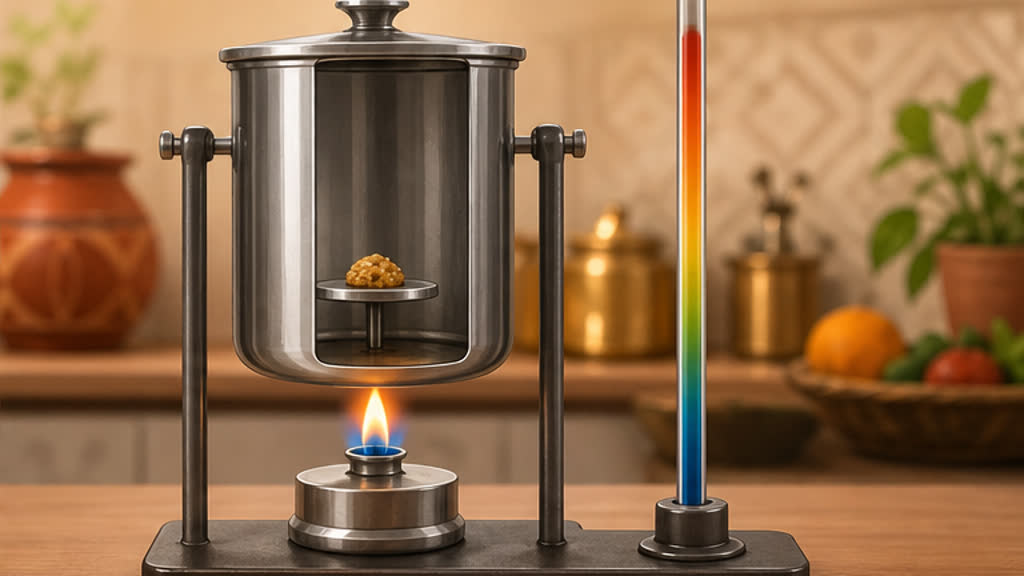
Scientists put a tiny piece of food inside a strong steel box. It is called a bomb calorimeter. They fill the box with oxygen. Then they spark it. The food burns fully. The heat that comes out is measured. This heat is called the gross energy. It is the total energy locked inside the food. The FAO explains it plainly: 'The gross energy is the energy released as heat when the particular food is completely combusted in a bomb calorimeter.' Each macro has its own gross energy. The FAO lists them: carbohydrate about 4.1 kcal/g, fat about 9.3 kcal/g, and protein about 5.4 kcal/g. So gross energy is all the heat the food can give if it burns perfectly. But your body is not a bomb. You do not burn food perfectly. Some energy is lost.
Gross energy vs what your body can use
Step 2: The Atwater factors fix the number
A scientist named W.O. Atwater measured these losses long ago. He found how much energy from each macro your body really keeps. These are called the Atwater factors. The FAO states them clearly: 'The Atwater factors for available energy—4.0 kcalth (17 kJ) per g for protein, 4.0 kcalth (17 kJ) for carbohydrate, and 9.0 kcalth (38 kJ) for fat—were determined from the average values for these losses on habitual American diets.' So the label number is gross energy minus losses. That is why fat shows 9 kcal/g, not 9.3. Protein shows 4, not 5.4. The full 5.4 never reaches your cells. A newer FAO report keeps the same general factors: protein 4, fat 9, available carbohydrate 4 kcal/g. These are averages. Real foods vary a little. But for a label, the average works well enough.
The calorie number on the label is exactly what my body will absorb.
mostly falsemostly false — explained simply. The label shows metabolisable energy using average Atwater factors. Your real digestion differs. The FAO notes Atwater himself wanted specific factors per food, not one average. Cooking, your gut bacteria, and how the food is prepared change real absorption. The label number is a close estimate, not an exact count for your body.
In India: FSSR 2011 rules the label
Indian packaged food follows the Food Safety and Standards (Packaging and Labelling) Regulations, 2011. Regulation 2.2.2(3) says: 'Nutritional Information or nutritional facts per 100 gm or 100ml or per serving of the product shall be given on the label containing the following:— (i) energy value in kcal.' So every packet must show energy in kcal per 100 g or per serving. The number is usually calculated from the macronutrient amounts times the Atwater factors. Food is not burned fresh in a bomb calorimeter for every batch. That would be too slow and costly. The FSSAI guidance note on menu labelling uses the same Atwater factors (protein 4, fat 9, carb 4, fibre 2) with the NIN-ICMR Indian Food Composition Tables. So your khari biscuit number comes from fat times 9, plus carb times 4, plus protein times 4, then rounded.
How Burnie uses these same factors
The bottom line
The calorie number on a food label is not magic. First the food is burned in a bomb calorimeter to find the gross energy. Then the Atwater factors subtract what your body loses in poo and urine. What remains is the metabolisable energy on the label. Indian labels follow FSSR 2011 and use the same factors. Burnie uses the same kind of factors to estimate your meal from a text description. Log what you eat, and the daily deficit math does the rest.