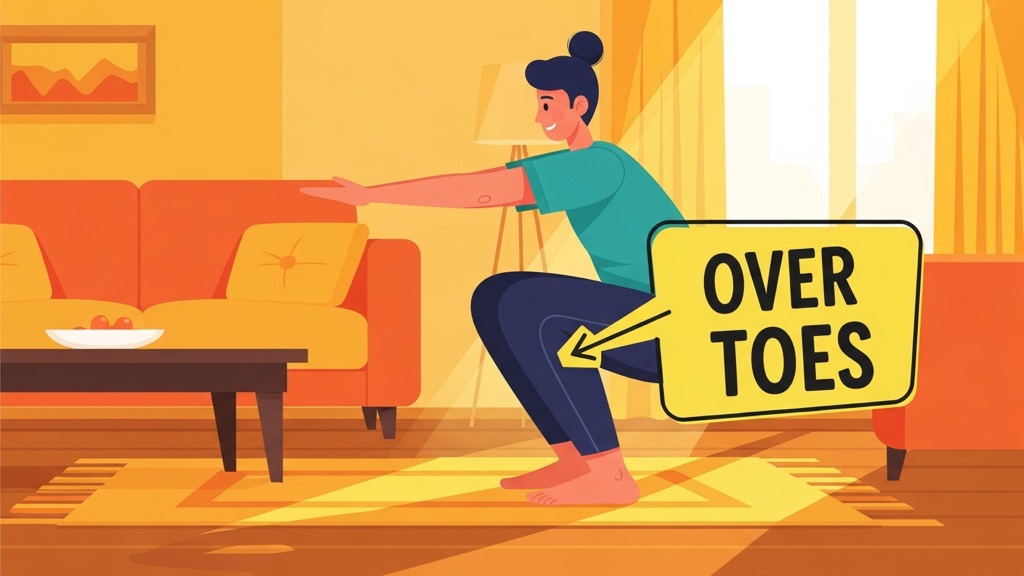
How to do a perfect bodyweight squat
The squat is the king of home leg moves, but only clean form keeps your knees safe. Learn the four cues and the honest truth: a few sets burn little, yet the muscle they build helps your weight-loss maths.
You decide to try squats at home. You stand, you bend, and your knees cave in. Your back rounds like a question mark. The first rep feels wrong. That is normal. A clean squat has only four moving parts. Learn them, and your legs will thank you.
Squats burn so many calories that they cancel out the evening snack you ate.
mostly falsemostly false
Here is the honest maths. Thirty minutes of bodyweight moves, like squats and push-ups, burns about 135 to 189 kilocalories for most adults. That is less than a typical Indian evening snack. Three sets of ten squats takes only a few minutes, so it burns even less. The squat's real gift is not the calories it burns in those minutes. It is the muscle it builds.
What a bodyweight session actually burns
Bodyweight moves count as moderate exercise. A 70 kilogram adult burns about 162 kilocalories in thirty minutes of moderate calisthenics. But three sets of ten squats is only a few minutes of real work, so the squat portion burns much less. So why squat at all? The muscle you build keeps your metabolism — your body's engine — running higher, even when you rest. That helps the maths side of weight loss. The food side still does the heavy lifting.
The four cues for a clean squat
Clean squat vs common mistakes
You should squat every single day to see results.
mostly falsemostly false
Muscle needs rest to grow back stronger. The US CDC says adults need muscle-strengthening activity on at least two days a week. For a beginner, two or three squat sessions a week, with a rest day between, is plenty. Your muscles do the building during the rest, not during the work.
The bottom line
The squat is one of the best home moves you can learn. Four cues keep it safe: set your feet, send your hips back, keep your chest up, then breathe out and squeeze. Three sets of ten, two or three days a week, is a fine place to start. Squat for the muscle, not for the calories. Your food log in Burnie — free, always — still owns the deficit maths. And if a squat hurts your knees or back, stop and check with a doctor or a physiotherapist.