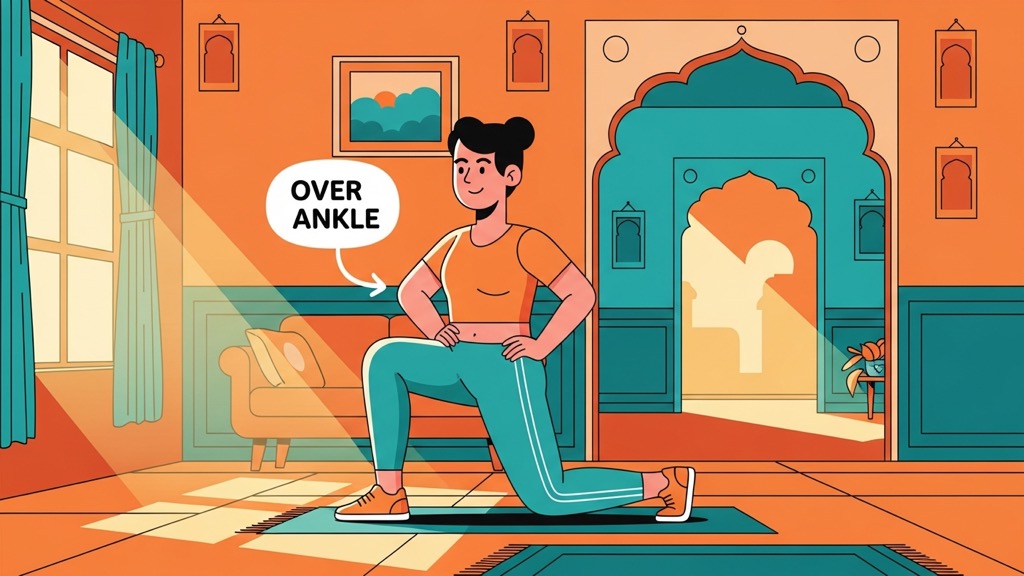
How to do a lunge without hurting your knees
Lunges build strong legs and burn real calories, but bad form hurts your knees. A longer step, an upright torso and the reverse lunge make this move safe and kind.
You tried lunges. Your knee did not say thank you. So you stopped. That is a shame, because the lunge is one of the best home moves for strong legs and a higher burn. The fix is almost never the exercise. The fix is how you step. This short read shows the four cues that turn a painful lunge into a kind one.
A forward lunge and a backward lunge put the same load on your knee.
mostly falsemostly false
A forward lunge means you step out, then push back. A reverse lunge means you step back, then push forward to the start. They look similar. They are not the same for your knee. A 2021 study measured the load on the kneecap joint in both moves. The forward lunge produced greater patellofemoral loading than the backward lunge. The knee also bent more in the forward lunge, and more bend means more squash on the kneecap. So if your knee complains, step back, not forward.
Your step length changes the load on your kneecap
The patellofemoral joint is where your kneecap meets your thighbone. Call it the PFJ. When you lunge, your body weight squashes this joint. A big study tested short and long steps in the forward lunge. Between 70 and 90 degrees of knee bend, the short step gave the kneecap much more force and stress than the long step. So a longer step is kinder at the bottom of the move, where most knee pain shows up. Picture this: a short step shoves the front knee far forward. A long step keeps the shin more upright, and the kneecap breathes.
Three lunges, ranked by knee kindness
Four cues that protect your knee
The bottom line
Lunges are not the enemy. Bad form is. Start with reverse lunges, take a longer step, keep your chest tall, and line your knee up with your toes. Aim for three sets of eight on each leg, two days a week. Half an hour of vigorous bodyweight moves like this burns about 300 kilocalories for a 70-kilogram adult. Log your weight in Burnie each week, and let the maths, not your knee, do the talking.