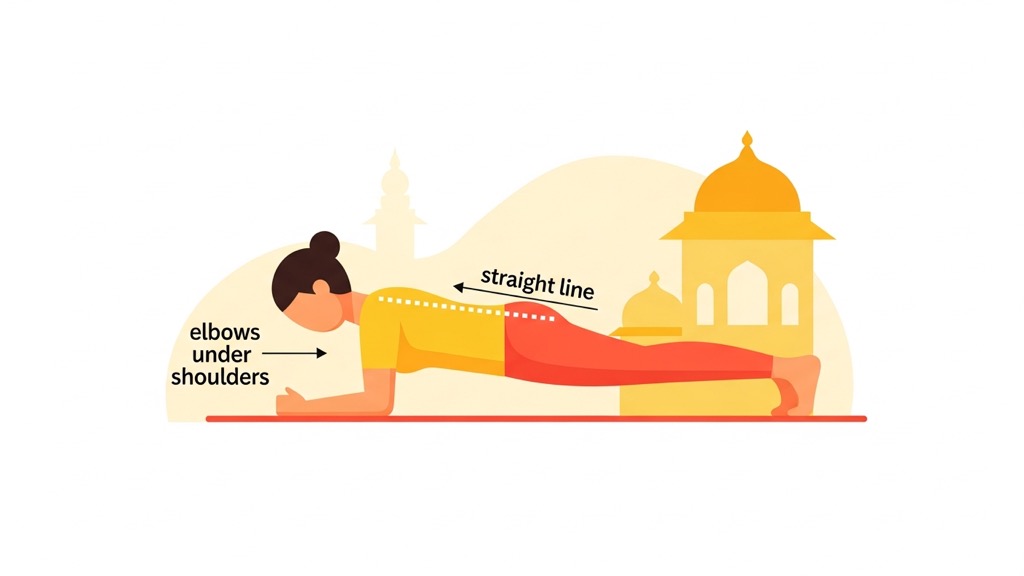
How to plank the right way — and how long to hold it
Planks look easy, but most people let their hips sag and then their back hurts. Here is the simple form that actually works your core, plus how long you really need to hold it.
You try a plank. Your arms shake. After ten seconds your back starts to ache, so you give up. Most people think the plank beat them. Usually it did not. The plank beat them because their shape was wrong. Fix the shape first and the seconds come on their own. This short read shows you the simple form that protects your back, and the honest hold time to aim for.
What good plank form looks like
A plank is a straight line from your head to your heels. You rest on your forearms and your toes, with your elbows bent to a right angle (90 degrees) and placed right under your shoulders. Your knees stay straight. One lab study wrote the rule this way: lie face down, bend your elbows to 90 degrees, keep your knees fully straight, and only your forearms and toes touch the floor. That same study found the front plank makes your side-stomach muscles work at about 77% of their max, and your front stomach muscles at about 48%. So the plank really does switch the core on hard.
Good plank vs the two mistakes that hurt your back
Holding a plank longer is always better for you.
mostly falsemostly false
A 30-second plank with a straight back beats a 90-second plank with a sagging middle. When real adults were asked to hold a plank for as long as they could, the average was only about 50 seconds. Men averaged around 62 seconds and women around 39 seconds. Form usually breaks down before the clock looks impressive. So three short, clean holds beat one long, messy one. Once your hips drop, the exercise is over, even if you are still up.
Build from 20 seconds to 60 seconds the safe way
The bottom line
The plank is a fine core move, but it works the front of your stomach much more than the back muscles. So pair it with walking and other moves for a balanced body. In Burnie, the maths is still the same: food calories minus (BMR plus active calories) equals your deficit. A plank burns very few calories on its own, but a strong core keeps you walking longer and standing taller, and that is where the real burn happens. Start at 20 seconds, hold a straight line, and let the time grow on its own.