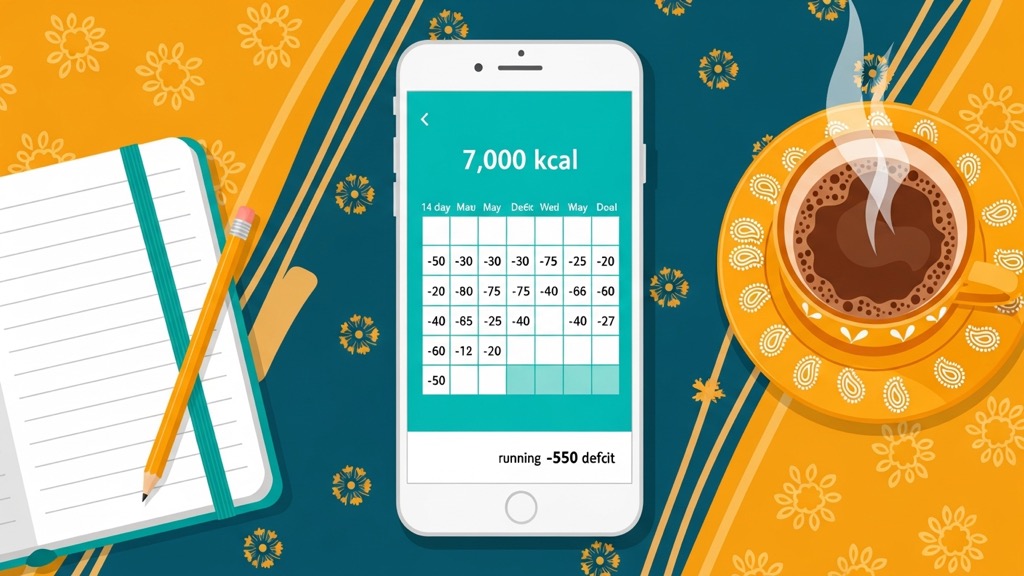
Two weeks in: how to read your deficit numbers
You have 14 daily deficit numbers sitting in Burnie. Here is the simple maths to turn them into one honest guess of the fat you lost, and how to read the gap when the scale says something different.
You finished two weeks on Burnie. Now you have 14 daily deficit numbers in a row. Each number alone means little. Put together, they tell one clear story. This read shows a simple five-minute check-up. You add the days. You divide. Then you read the gap. Do it once every fortnight (a fortnight means two weeks). Burnie is FREE, so this costs you nothing but a few minutes.
The two-step maths: sum it, then divide it
First, add all 14 daily deficits into one big number. Call this your cumulative deficit (cumulative means 'added up over time'). Example: say your average day was a 500 kcal deficit. Then 14 times 500 is 7,000 kcal for the fortnight. Now divide. Old research says about 7,700 kcal of deficit moves 1 kg of body weight. So 7,000 divided by 7,700 is about 0.9 kg. That is your maths prediction. Notice the word 'about'. The same paper calls this old rule inaccurate. Real bodies do not divide this neatly. Still, about 0.9 kg is your honest starting guess.
If the maths predicts 0.9 kg, the scale must show exactly 0.9 kg.
mostly falsemostly false
Over just two weeks, the scale hides more than it shows. One study looked at short, 1 to 3 kg weight swings in adults. It found each 1 kg change was 0.84 kg of water and lean tissue. Only 0.16 kg was fat. The energy in those short swings was about 2,380 kcal per kg, not 7,700. So most of what the scale does in a fortnight is water moving in and out. You may have lost the fat your maths predicted. The scale just hides it under water, salt and waste.
How to read the gap between your maths and your scale
Your fortnightly check-up in five small steps
The bottom line
Two weeks of deficit numbers are a compass, not a verdict. Do the sum. Divide by about 7,700. You get a rough guess of the fat you lost. Then expect the scale to disagree, because most of a fortnight's swing is just water. One study found short, 1 to 3 kg swings were 84 percent water and lean tissue. So read the gap honestly. Adjust one thing if needed. Then go run your next two weeks.