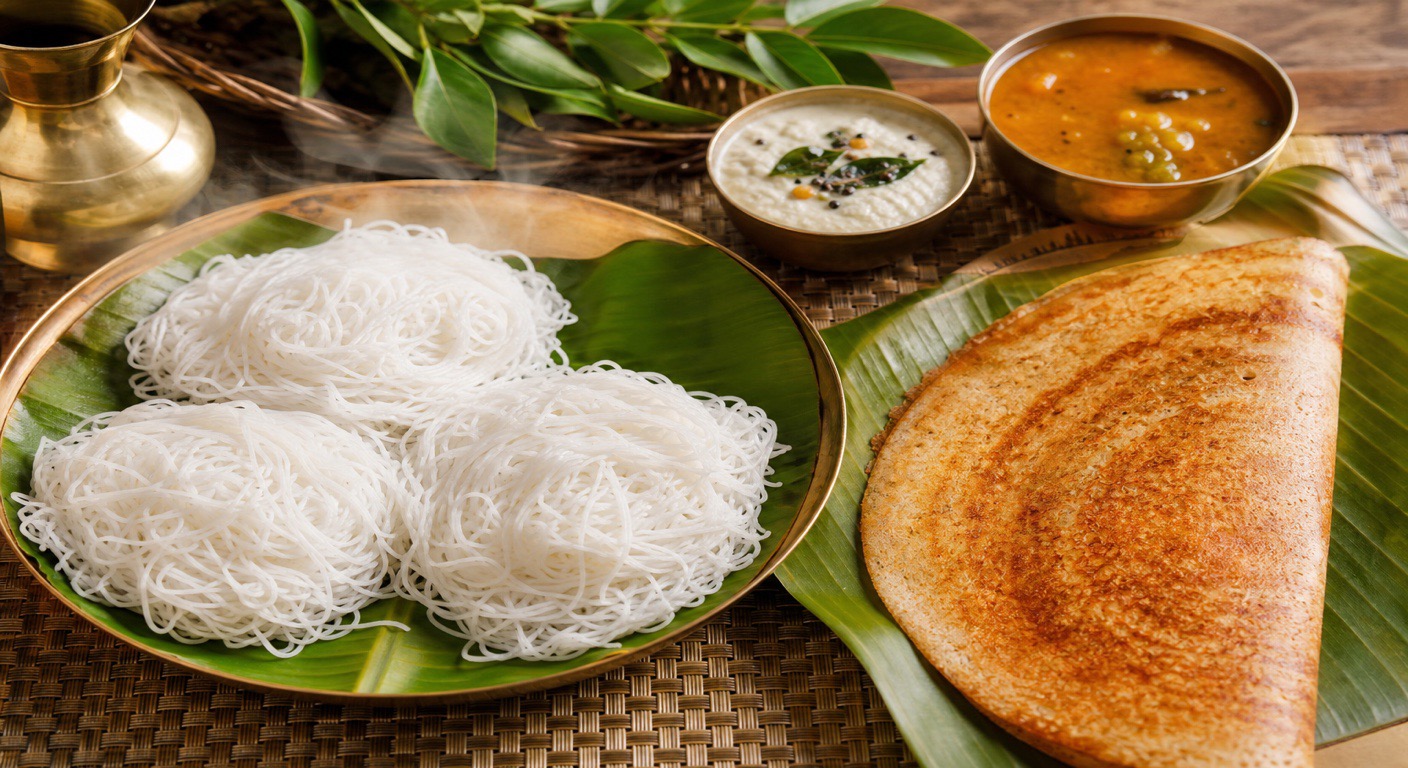
Idiyappam vs dosa - does steaming really win?
Idiyappam is steamed with no oil, so one piece is about 69 kcal against 133 for a plain dosa. Steaming wins on fat, but the coconut milk you pour on top can quietly close the gap.
Idiyappam and dosa are both rice-based, but they are cooked in totally different ways. Idiyappam is pressed into thin noodles and steamed, with no oil at all. A dosa is spread on a hot tava and cooked with ghee or oil. That one difference is where most of the calorie gap comes from.
One idiyappam vs one plain dosa
Idiyappam is steamed, so it has almost no fat and is always the lighter pick.
mostly trueMostly true per piece. One idiyappam has about 2.3 g fat versus about 5.2 g in a plain dosa, because the dosa is cooked in ghee or oil and the idiyappam is not. The catch is that one idiyappam is smaller than one dosa, so you usually eat two or three. And the curry you pour on top, especially rich coconut milk, can add back more calories than the steaming saved. Steaming wins on the oil, but the side dish decides your real total.
Your typical plate: 3 idiyappam with a small katori of coconut milk
A normal Kerala-style breakfast is not one idiyappam. It is three, with a small katori of sweet coconut milk poured on top. The idiyappams themselves are light and steamed, but the coconut milk is mostly fat, and it carries most of the calories on this plate.
Assumptions: 3 idiyappams at 69 kcal each = 207 kcal (Tarla Dalal per-piece figure). 1 small katori of regular canned coconut milk taken as ~100 ml at 197 kcal/100 ml = ~197 kcal. Total = 207 + 197 = 404 kcal, rounded to 400. The range allows for slightly larger or smaller katori sizes.
Use half the coconut milk, or thin it with water
The biggest lever on this plate is the coconut milk, not the idiyappam. Pour half the usual amount, or thin it with warm water so it still tastes coconutty but carries half the fat. Your steamed idiyappams stay exactly the same.
Assumptions: Same 3 idiyappams (207 kcal). Coconut milk cut from ~100 ml to ~50 ml at 197 kcal/100 ml = ~99 kcal. Total = 207 + 99 = 306 kcal. Saving versus baseline = 404 - 306 = 98 kcal. Thinning with water gives the same saving because you eat less actual coconut milk.
Small things that keep this breakfast light
- Idiyappam stays light only while it is steamed. Do not fry the leftovers in oil, or you turn it into a dosa by accident.
- A veg stew or sambar on the side has far less fat than sweet coconut milk, and adds protein and fibre to fill you up.
- Plain dosa is not the villain either. One plain dosa is about 133 kcal. It is the extra ghee, butter, and the potato filling in a masala dosa that push the number up.
- Pair either one with sambar or a dal. The rice alone is low in protein, so a protein side keeps you full longer.
The bottom line
Steaming really does win on the oil. One idiyappam is about 69 kcal with almost no cooking fat, against about 133 kcal for a plain dosa cooked in ghee. But you usually eat two or three idiyappams, and the coconut milk on top is where the calories hide. Keep the steamed idiyappam, go easy on the coconut milk, and add a veg stew or sambar. That is how the lighter choice actually stays light.