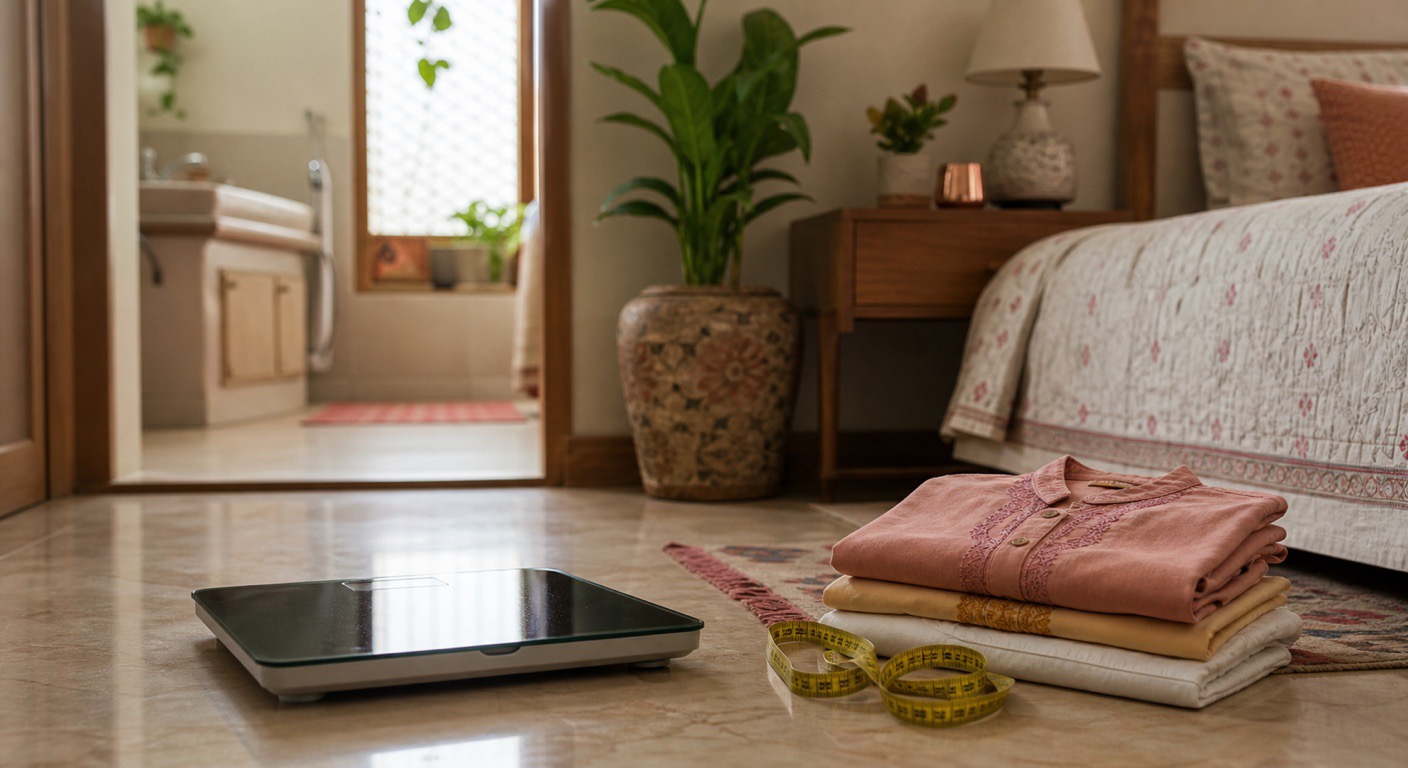
Losing inches but not kilos - is that okay?
Yes - and it is often better than watching the kilos drop. Your scale adds up water, muscle and glycogen too, so a shrinking waist can mean real fat loss even when your weight stays flat.
If the scale shows the same weight, my diet and workouts are not working.
mostly falseMostly false. The scale adds up your fat, your muscle, your water, your glycogen and even your last meal - then shows one number. All that water and glycogen can hide real fat loss for weeks. A looser waist or baggier jeans is usually a better sign that fat is going, even when the kilos refuse to budge.
Muscle weighs more than fat, so that is why the scale will not drop.
it dependsIt depends - a kilo of muscle and a kilo of fat both weigh one kilo. But muscle is denser than fat. One kilo of fat fills about 1.11 litres of space, while one kilo of muscle fills only about 0.94 litres. So when you lose fat and gain a little muscle, your weight can stay almost the same while your body shrinks. That is exactly why inches fall even when kilos do not.
Assumptions: 1 kg fat at 0.9 g/mL = 1000 / 0.9 = ~1111 mL (~1.11 L). 1 kg muscle at 1.06 g/mL = 1000 / 1.06 = ~943 mL (~0.94 L). So 1 kg of fat takes up roughly 18% more space than 1 kg of muscle for the same weight.
Real fat loss shows up slowly on the scale
Body fat packs a lot of stored energy. One kilo of fat holds about 7700 kcal. So even a solid 500 kcal daily deficit melts only about half a kilo of fat in a whole week. That tiny drop is easy to miss - one salty dinner or a couple of glasses of water can move the scale more than that. This is why the scale often looks stuck even when fat is leaving.
Assumptions: A 500 kcal/day deficit x 7 days = 3500 kcal/week. At ~7700 kcal per kg of body fat, that is ~0.45 kg of real fat lost per week - a move small enough to be hidden by daily water and waste changes on the scale.
I gained a kilo overnight, so I gained fat.
mostly falseMostly false. Your body stores carbohydrate as glycogen, and each gram of glycogen holds 3 to 4 grams of water along with it. A full glycogen store - roughly 500 g of glycogen across your liver and muscles - can swing about 2 to 2.5 kg on the scale, almost all water. Eat fewer carbs for a day and that water leaves too. You did not gain a kilo of fat overnight; you are mostly holding water.
Track what actually shows fat loss
- Measure your waist once a week - same morning, same tape, relaxed belly. It tracks fat better than the scale.
- Use one old pair of jeans as a fit-test. A looser waistband means fat is leaving, even if kilos stay the same.
- Weigh only once a week, after the toilet and before breakfast or water. Daily jumps are mostly water and waste.
- Salty food pulls extra water onto the scale for a day or two - wait it out before you judge a gain.
- Take a monthly photo in the same light and pose. You will see changes the numbers completely miss.
The bottom line
If your waist is shrinking but your weight is not, you are probably losing fat - and that is the kind of weight loss that really matters. The scale counts water, muscle and glycogen too, so it often lags behind the real change. Trust the tape and the jeans first. The kilos will catch up later.