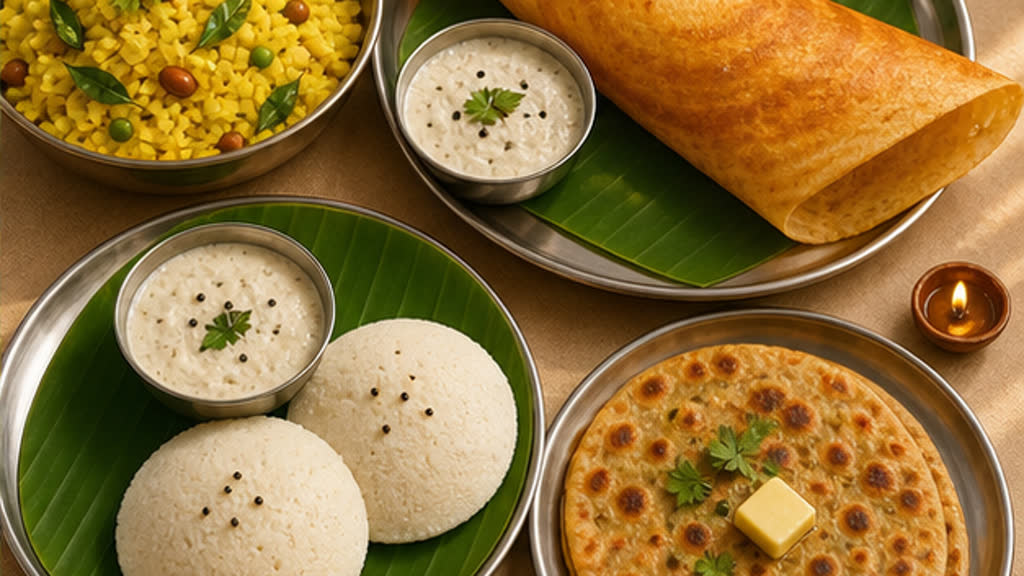
Indian breakfast calories: poha, idli, dosa, paratha swaps
A plate of poha, two idli, two dosa, two paratha, one bowl upma or two puri with bhaji can land anywhere from about 150 to 750 kcal. The big swing is not the rice or wheat, it is the oil and ghee you add, and the coconut chutney on the side. This guide gives honest per-plate ranges for the most common Indian breakfasts and the simplest swaps to keep your deficit without giving up the food you love.
Breakfast is the meal most Indians get either very right or very wrong for a calorie deficit. The same dish can be light or heavy depending on one thing: the oil and ghee. Two plain idli with a small spoon of chutney is under 200 kcal. Two paratha cooked in a big spoon of ghee can cross 600 kcal. The rice, the wheat, the dal, the potato are not the problem, they are just fuel. The added fat is what silently pushes the number up. This guide gives you honest per-plate calorie ranges for six common Indian breakfasts: poha, idli with chutney, plain dosa, paratha, upma and puri with bhaji. The ranges are wide because the oil varies, and that is the whole point. Once you see where the calories hide, the lightest swap is easy.
The baseline: each Indian breakfast is mostly carbs plus added fat
Most Indian breakfasts are built on rice (idli, dosa, poha) or wheat (paratha, puri) with some dal (urad dal in idli and dosa) and vegetables (potato in upma and bhaji). The grains and dal give you about 340-370 kcal per 100 g dry, but they are cooked with water, so the cooked weight is much lighter in calories than the dry weight. The real swing is the added fat. One teaspoon of oil or ghee is about 45 kcal, and a big restaurant-style pour can add 3-4 spoons without you noticing. A single idli is about 40 kcal because it is steamed with no oil. A single paratha can be 300-390 kcal per 100 g because it is folded with oil or ghee and often cooked in more ghee. So the honest baseline is: count the grain, then count the fat. That is almost the whole job.
Assumptions: Home-style portions for one adult: 1 plate poha (~60 g dry beaten rice), 2 idli (~30 g each) with 2 tbsp coconut chutney, 2 plain dosa (no potato, no ghee), 2 paratha (~80-100 g each with oil/ghee), 1 bowl upma (~150 g), 2 puri (~40 g each) with aloo bhaji. Ranges widen with extra oil, ghee, peanuts or potato.
Idli is a free food for weight loss, you can eat as many as you want.
mostly falseMostly false. A single idli is genuinely light, about 40 kcal per 30 g piece because it is steamed with no oil, and that makes it one of the best breakfast choices for a deficit. But idli is not free. Two to three idli is about 120-180 kcal before any chutney, and the coconut chutney that goes with it is mostly coconut fat at about 350 kcal per 100 g of coconut, so even a small 2-tablespoon serving adds 50-80 kcal. Eat four or five idli with a big bowl of chutney and you are at 300-400 kcal, the same as a plate of poha. Portion still matters. The honest version: idli is the lightest cooked Indian breakfast, not an unlimited one.
Lightest breakfast combos for north and south India
- South India light combo: 2 idli (steamed, ~80 kcal) with 1 tbsp coconut chutney (~40 kcal) and a small cup of filter coffee with a little milk, no sugar. About 150-180 kcal and it keeps you full for 2-3 hours.
- South India with more protein: 2 plain dosa without potato or ghee (~220 kcal) with a bowl of sambar (dal, so it has protein) and chutney. About 300-350 kcal. Skip the ghee pour on top.
- North India light combo: 1 bowl poha with measured oil (1 tsp) and a hard-boiled egg on the side for protein. About 300-350 kcal for the plate plus 70 kcal for the egg. The egg is what keeps you full.
- North India with protein: 1 paratha (not two) cooked with a measured 1 tsp ghee, plus a bowl of dal or a cup of curd and an egg. About 350-450 kcal, and the protein does the satiety work the second paratha was doing.
- Measure the fat, do not pour it. One teaspoon of oil or ghee is about 45 kcal. A free pour from the bottle is usually 3-4 spoons. Use a small spoon and the calorie number stays honest.
- Add protein to every breakfast. An egg, a bowl of dal, a cup of curd, or a handful of roasted chana with poha. Protein keeps you full so you do not snack before lunch, and that does more for your deficit than cutting 50 kcal.
- Puri is a sometimes food. Deep-frying pushes each puri to 110-135 kcal and the bhaji adds more. Save puri-bhaji for a weekend, and on weekdays pick idli, poha or plain dosa.
The bottom line
The lightest Indian breakfasts are the steamed and roasted ones with the fat measured: two idli with a little chutney (~130-200 kcal), a plate of poha with one spoon of oil (~250-350 kcal), and two plain dosa without potato or ghee (~220-300 kcal). The heaviest are the ones loaded with oil and ghee: two paratha can hit 500-750 kcal, and puri with aloo bhaji is 380-480 kcal because of the deep-frying oil. The single lever that moves the number most is the added fat, not the grain. So keep the steamed and roasted breakfasts, measure the oil and ghee with a small spoon, and add an egg, a bowl of dal or a cup of curd for protein so you stay full until lunch. Idli is the lightest, not a free food, two to three idli with chutney is about 120-200 kcal and portions still count. Log your breakfast in Burnie, see the number, and let the honest plate do the work.