Calories in Indian sweets: a sane festival guide
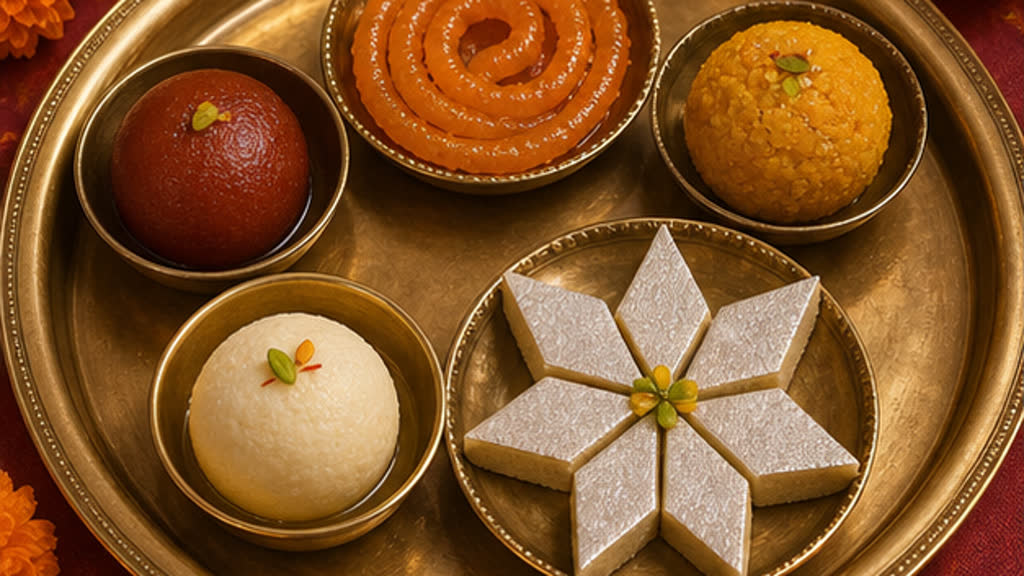
Indian mithai is dense because it is built from sugar (about 3.9 kcal per gram) and ghee (about 876 kcal per 100g), then soaked in sugar syrup. One gulab jamun is about 150 kcal, a jalebi piece about 150-180 kcal, and a rasgulla about 120-150 kcal. This guide gives honest per-piece estimates and a festival plan that does not break your deficit.
Diwali, Eid, a wedding, a visit to nani's house. Indian festivals are built around mithai, and most of it is a calorie bomb. A single gulab jamun can hold as many calories as a small meal. This is not a reason to feel guilty. It is a reason to know the numbers, so you can pick one favourite, enjoy it, and keep your deficit on track. This guide gives honest per-piece calorie estimates for the most common Indian sweets, explains why they are so dense, and ends with a simple festival plan that does not ask you to skip meals.
Why mithai is so calorie-dense: sugar + ghee + syrup
Almost every Indian sweet rests on three things: sugar, ghee or khoya (milk solids), and sugar syrup (chashni). Sugar gives about 3.9 kcal per gram. Ghee gives about 876 kcal per 100g, nearly 9 kcal per gram. Khoya, the milk-solid base of gulab jamun and barfi, is also dense because it is concentrated milk. The real trap is the syrup. Gulab jamun, jalebi, and rasgulla are soaked in chashni, and that syrup seeps deep into the sweet. So even a small piece carries a lot of sugar water. This is why two pieces of the same sweet can differ by 50 kcal or more: a shop that uses more syrup or more ghee makes a heavier piece. The per-piece numbers below are honest estimates, built from these ingredient densities, because most sweets do not have a single fixed published value.
Assumptions: Typical Indian sweet-shop portion sizes. Per-piece kcal are estimates built from sugar (~3.9 kcal/g), ghee (~8.76 kcal/g), and khoya, because per-piece published values are not available for most sweets. Rasgulla has a published per-100g value (186 kcal) and is scaled to a typical piece weight.
Rasgulla is a diet sweet, so you can eat a few without worry.
partly truePartly true, partly false. Rasgulla is genuinely lower in fat than most fried or ghee-heavy sweets. The published value shows about 1.85g of fat per 100g, compared with ghee-laden gulab jamun or laddoo. So if you must pick a mithai, rasgulla and sandesh (both chenna-based) are the lighter fat choice. But it is still soaked in sugar syrup. One rasgulla is about 120-150 kcal, and three of them is a small meal's worth of sugar. Lower fat does not mean free. Pick one, enjoy it, do not stack four.
A festival plan that keeps your deficit alive
- Pick one small favourite, not a sampling plate. One gulab jamun is about 150 kcal. A tasting plate of five sweets can easily top 600 kcal, which is a full meal.
- Lean towards chenna-based sweets. Rasgulla and sandesh carry less ghee and fat than deep-fried gulab jamun, jalebi, or ghee-rich laddoo. They are not free, but they are the lighter pick.
- Share. Cut one jalebi in half and give the rest away. You get the taste, your deficit keeps half the calories.
- Do not skip meals to 'save up' for sweets. Arriving hungry at a mithai plate means you eat three pieces instead of one. Eat your normal meals, then have one sweet.
- Drink water or chai alongside. The syrup in mithai is concentrated sugar. Water does not cancel calories, but it slows you down between pieces.
- Log the sweet in Burnie the same day. Seeing the 150 kcal on your log helps you balance the rest of the day instead of giving up the whole week.
The bottom line
Indian mithai is dense because it is built from sugar (about 3.9 kcal per gram) and ghee (about 876 kcal per 100g), then soaked in sugar syrup. One gulab jamun is about 150 kcal, a jalebi piece about 150-180 kcal, a motichoor laddoo 150-300 kcal, a rasgulla about 120-150 kcal, a small kaju katli about 60-80 kcal, and a barfi piece 100-150 kcal. These are honest estimates, because the real number depends on the shop's syrup and ghee. The festival plan is simple: pick one small favourite, lean towards rasgulla or sandesh, share, and never skip meals to save up. Log it in Burnie, keep your deficit, and enjoy the sweet you actually chose.