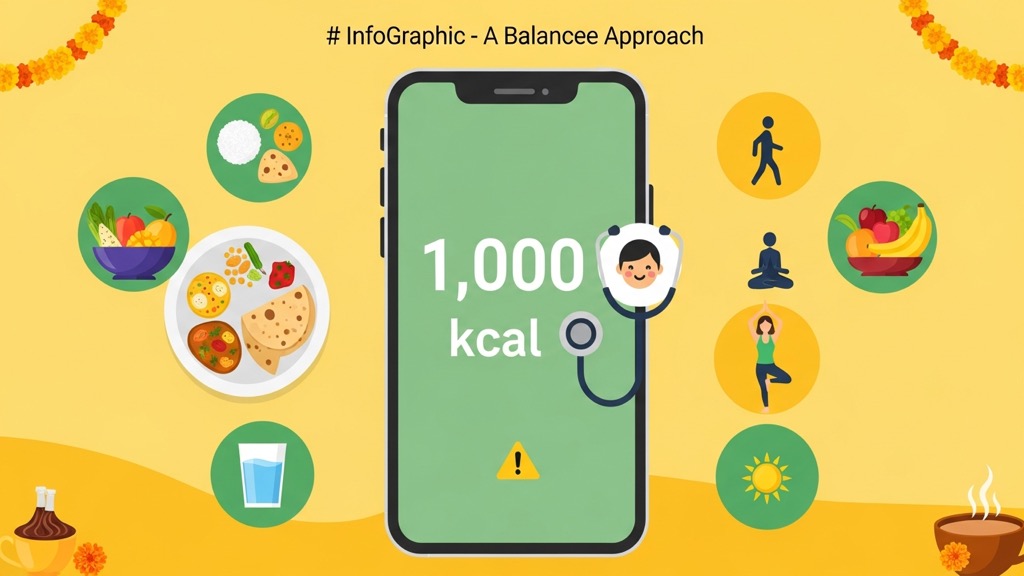
Is a 1,000-calorie deficit ever safe
A 1,000-calorie deficit sounds like a fast track to slim. For most people it is too big, and only a doctor should ever put you on one. Here is how to tell if that number fits you.
You saw it online. Someone lost weight fast on a 1,000-calorie deficit. Now you wonder, 'Should I do that too?' It sounds like a shortcut. But a number that big is not a normal deficit. It is a medical tool, used with care. This short read tells you when a 1,000-calorie gap is safe, and when it can quietly hurt you.
What guidelines actually call a safe deficit
Big health groups do not tell people to cut 1,000 calories a day on their own. Mayo Clinic says to lose 1 to 2 pounds a week (about 0.5 to 1 kilo), you burn about 500 to 750 calories more than you eat each day. So the tested, safe range for most adults is 500 to 750. A 1,000 gap sits above that range. That does not always mean danger. But it does mean 'slow down and check' before you try it.
A 1,000-calorie deficit is just a bigger, faster version of a normal one.
it dependsit depends
It depends on your size, and on what the gap leaves you to eat. Your deficit is food calories minus your BMR and active calories. A big, active person who burns 3,000 a day could cut 1,000 and still eat 2,000. That can be fine. A smaller person who burns only 1,600 would be left eating just 600. That is not a diet any more. That is a very-low-calorie diet, or VLCD. VLCDs are not self-serve. They are a medical tool a doctor watches closely. The line 'is it safe?' is really the line 'how much food is left for you?'
The danger zone: when eating gets very low
Doctors use the term VLCD for a diet under about 800 calories a day. In one study, people on a VLCD of about 500 calories a day had gallstones about three and a half times more often than people on a gentler low-calorie diet. Gallstones are hard bits in your gallbladder. They can cause sharp pain and may need surgery. This is the clearest reason a 1,000-calorie gap can turn unsafe: it can push your food so low that your gallbladder stops working right. The same study said the risk rose with faster weight loss. So speed itself is part of the harm.
Your size decides if 1,000 is safe
A very big deficit only attacks fat.
mostly falsemostly false
A very big gap hits more than fat. Long, deep calorie cuts lower your body's hormones too. One study of men on long-term calorie restriction found their total testosterone was about 12 units, while similar men who exercised had about 19. That is roughly a third less. Low testosterone can drain your drive, your mood, and your strength. A very large deficit can also break down muscle for fuel, not just fat. That is why a doctor adds enough protein and watches you on a VLCD. Your body is not a simple machine. Starve it fast, and it cuts muscle and hormones along with the fat.
What to do instead of chasing 1,000
The bottom line
A 1,000-calorie deficit is safe for some big, active people, and risky for most others. The real test is what the gap leaves you to eat. Drop under about 800 calories and you enter VLCD land, where gallstone risk jumped over three-fold in one study. The safe path is plain: stay near 500 to 750, let Burnie do the maths, and bring your doctor in before you ever go bigger.