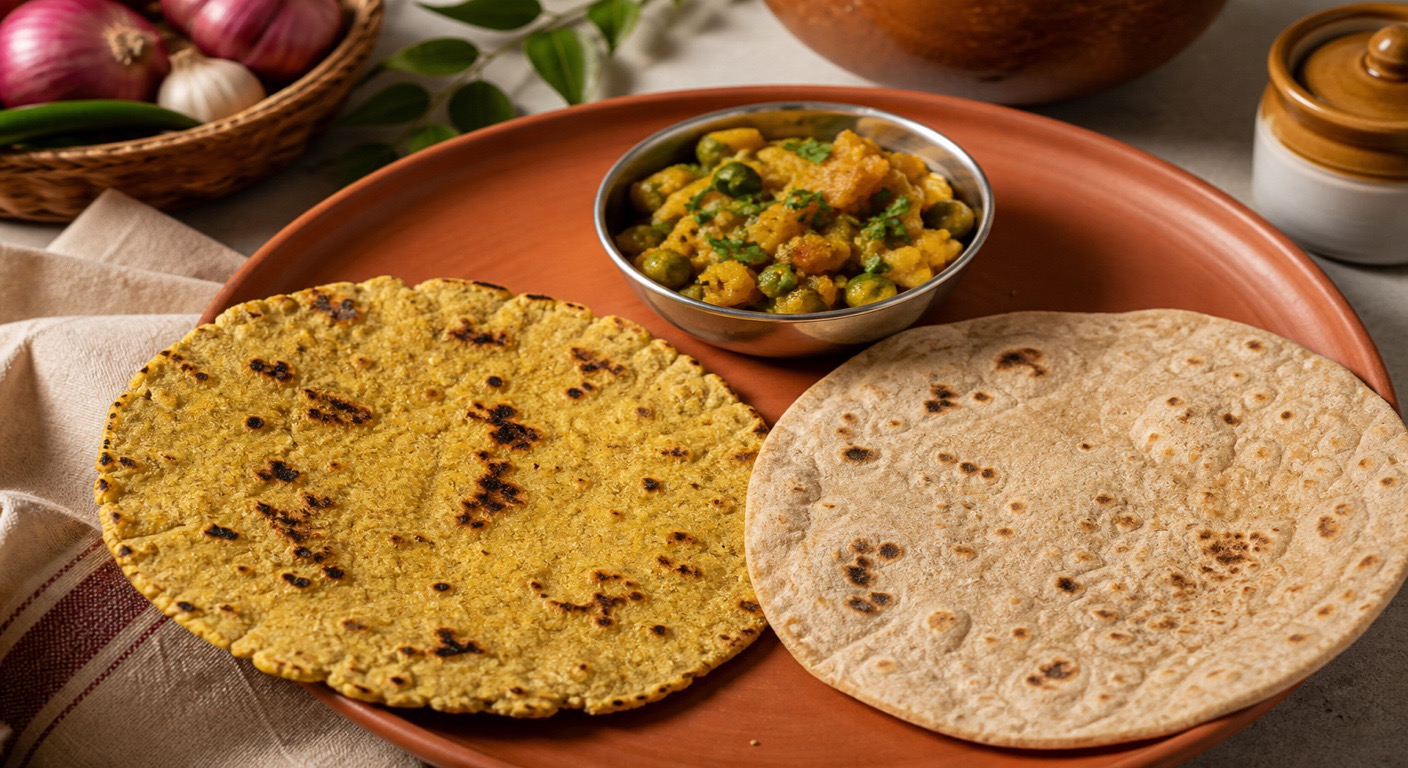
Jowar bhakri - the lighter roti swap?
A jowar bhakri and a wheat roti are almost the same calories per piece - about 100-110 kcal each, dry. The real win is eating one thick, chewy bhakri instead of two rotis, so you stay full longer on fewer total calories.
Jowar bhakri is a thick, golden flatbread from Maharashtra. People call it the lighter roti. Is that really true? Let us check the real numbers. Spoiler: per piece, a bhakri and a roti are almost the same. The smart swap is about how many you eat - not magic low-calorie flour.
Jowar bhakri has far fewer calories than a wheat roti.
mostly falseMostly false. Per same-size piece, jowar flour is only about 6% lighter than whole-wheat flour. One 30 g bhakri is about 104 kcal. One 30 g roti is about 111 kcal. That is only a 7 kcal difference. The big calorie cut comes from eating one filling bhakri instead of two rotis - not from jowar flour being magically lighter. Also, jowar is a whole grain, just like whole-wheat atta. Both beat maida (refined flour).
One bhakri vs one roti - same size, dry tava
A normal dinner: 2 wheat rotis
Most Indian dinners come with two rotis. Two medium rotis from 30 g atta each come to about 220 kcal. That is just the bread - before any ghee, sabzi or dal. This is your starting point for the swap.
Assumptions: 2 rotis x 30 g whole-wheat atta = 60 g. At 370 kcal/100 g = 222 kcal. Size varies: a smaller 25 g roti gives ~93 kcal each (~185 for two), a bigger 35 g roti gives ~130 kcal each (~259 for two). No ghee or oil included.
Swap two rotis for one thick jowar bhakri
Make one filling jowar bhakri (about 40 g flour) instead of two rotis. It is dense and chewy, so you eat it slowly. One bhakri fills the spot two rotis would, for fewer total calories. And jowar is a whole grain - a real upgrade over a maida (refined) roti.
Assumptions: 1 bhakri from 40 g jowar flour = 40 x 348/100 = ~139 kcal, dry tava. Versus the 222 kcal baseline of two rotis = -83 kcal. Bhakri is often made thicker than a roti, so a real piece can run 35-45 g (~120-160 kcal). The fullness claim is about dense texture and slower eating, not a verified satiety score.
Keep your bhakri light
- Go easy on the ghee. One teaspoon of ghee adds about 40 kcal - and ghee is almost pure fat.
- Eat it hot and chewy. The dense texture makes you eat slowly, so you feel full sooner.
- If your roti is already whole-wheat atta, jowar is not a big calorie cut - both are whole grains. The real upgrade is jowar over maida (refined) rotis.
- Pair one bhakri with a bowl of dal or sabzi. Protein and fibre do the real fullness work.
The bottom line
Jowar bhakri is not a magic low-calorie roti. Per piece, it is about the same as a wheat roti - roughly 100-110 kcal each, dry. The smart move is one thick, chewy bhakri instead of two rotis. You eat fewer calories, you eat slower, and you stay full longer. That is the real swap.