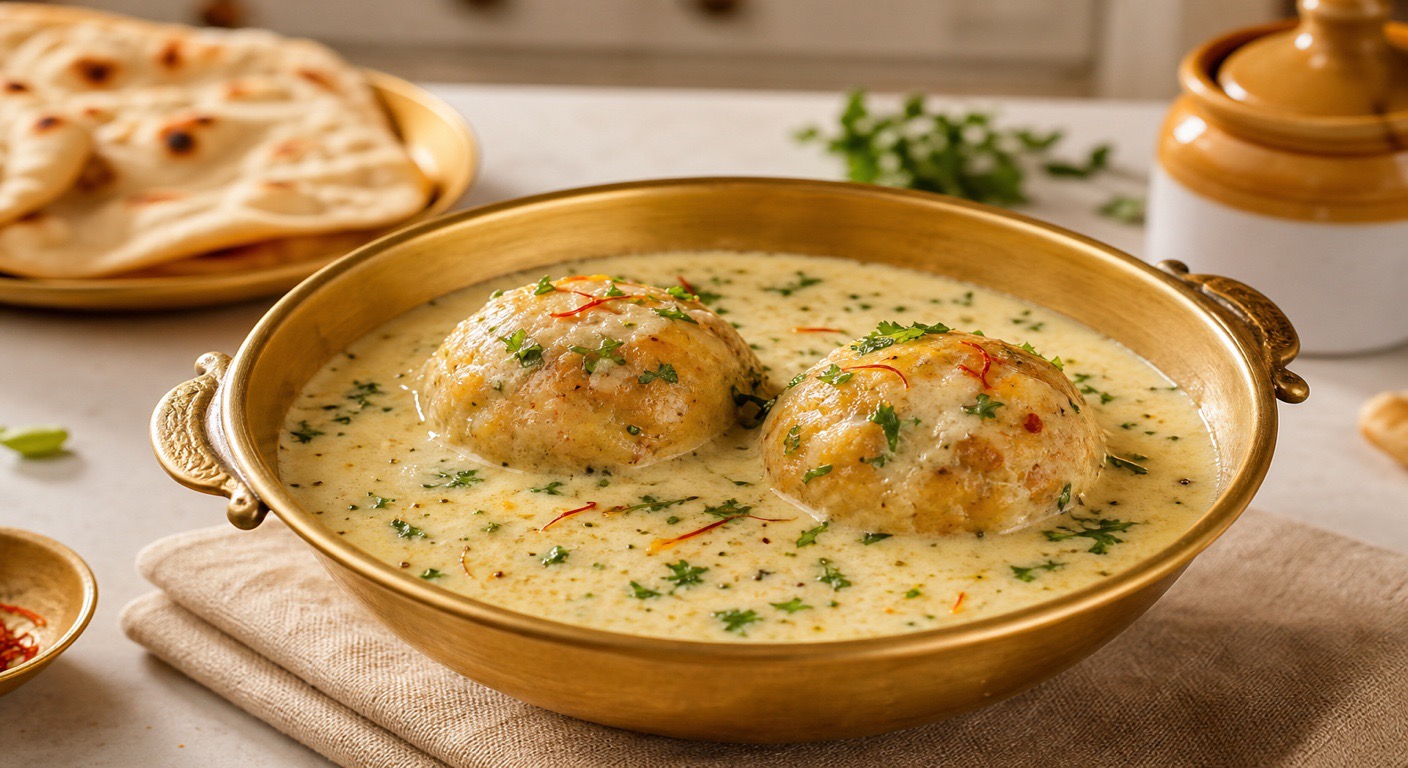
Malai kofta - the dessert of gravies?
Malai kofta curry is one of the richest curries on a Punjabi thali - a single home-style katori carries about 332 kcal, and nearly three-quarters of that comes from fat. Bake the koftas, use half the cream, and the same katori drops to around 245 kcal without losing the festive feel.
Malai kofta is basically a dessert hiding inside a gravy - fried cheese-potato balls floating in sweet cream.
mostly trueMostly true. The balls are deep-fried, the gravy is built from cream, butter and cashews, and about 243 of every 332 kcal in a home-style serving comes from fat - that is roughly 73% of the calories from fat alone. So yes, it eats more like a rich dessert than a regular dal. The good news: you can keep the flavour and lose a lot of that fat by baking the koftas and going easy on the cream.
One katori of home-style malai kofta curry: about 332 kcal
A normal home recipe splits into four katori servings, and each one lands near 332 kcal. Of that, about 243 kcal - almost three-quarters - is fat from the frying oil, the cream, the butter and the cashews. The paneer and potato inside the koftas add some protein, but the rich gravy is what really pushes the number up. A restaurant order is usually a bigger portion with extra cream and butter, so it sits higher than this home figure.
Assumptions: Baseline taken from a real published home recipe (Tarla Dalal Creamy Kofta Curry, recipe 255) at 332 kcal per serving with the recipe yielding 4 servings and 27.18 g fat per serving. The upper end of the range (365) brackets the related restaurant-style malai kofta figure of 362 kcal per serving from the same site (recipe 2174). Restaurant single orders are typically larger than one home katori and use more cream and butter, so they sit above this range; no single verified restaurant figure is cited here.
How a katori of malai kofta stacks up next to other curries
Bake the koftas and use half the cream
This is the biggest lever. Instead of deep-frying the paneer-potato koftas, brush them with a little oil and bake or air-fry them until golden. Then build the gravy with half the cream, topping it up with a splash of low-fat milk to keep it creamy. The koftas stay crisp on the outside and soft inside, and the gravy still tastes festive.
Assumptions: Kitchen estimate, not a lab measurement of a named recipe. Starting from the verified 332 kcal/serving baseline (27.18 g fat). Two savings are modelled from staples: (1) deep-frying the koftas absorbs roughly 8 g oil per serving across the koftas (~71 kcal at 884 kcal/100 g); baking with about 2 g brushed oil (~18 kcal) saves roughly 53 kcal. (2) A home serving uses about 2 tablespoons (30 g) of heavy cream (~102 kcal at 340 kcal/100 g); halving to 15 g and making up the volume with low-fat milk saves about 51 kcal. Combined saving ~104 kcal, rounded down to a working figure of about 87 kcal to stay conservative, giving ~245 kcal per katori. Real savings depend on your exact oil and cream amounts.
Small moves that lighten the katori
- Grate a little lauki (bottle gourd) or carrot into the kofta mix - it adds bulk and moisture, so you can use less potato and the kofta fries lighter.
- Swap some of the paneer for low-fat paneer or chenna - you keep the soft bite but drop a chunk of the fat.
- Thicken the gravy with a cashew-melon-seed paste and a splash of milk instead of pouring in heavy cream - same silky texture, much less fat.
- Pair it with one roti or a small portion of rice, not a butter naan - a butter naan can add another 250-300 kcal to the plate.
- Treat malai kofta as the star of the meal, not one of three rich curries - pick it, skip the paneer butter masala on the same thali.
The bottom line
Malai kofta curry really is one of the richest curries around - a home-style katori is about 332 kcal and nearly three-quarters of that is fat, mostly from the deep-fried koftas and the cream gravy. Bake the koftas, halve the cream, and the same katori comes down to around 245 kcal. You don't have to skip it at a wedding or a Sunday lunch - just let it be the one rich thing on your plate.