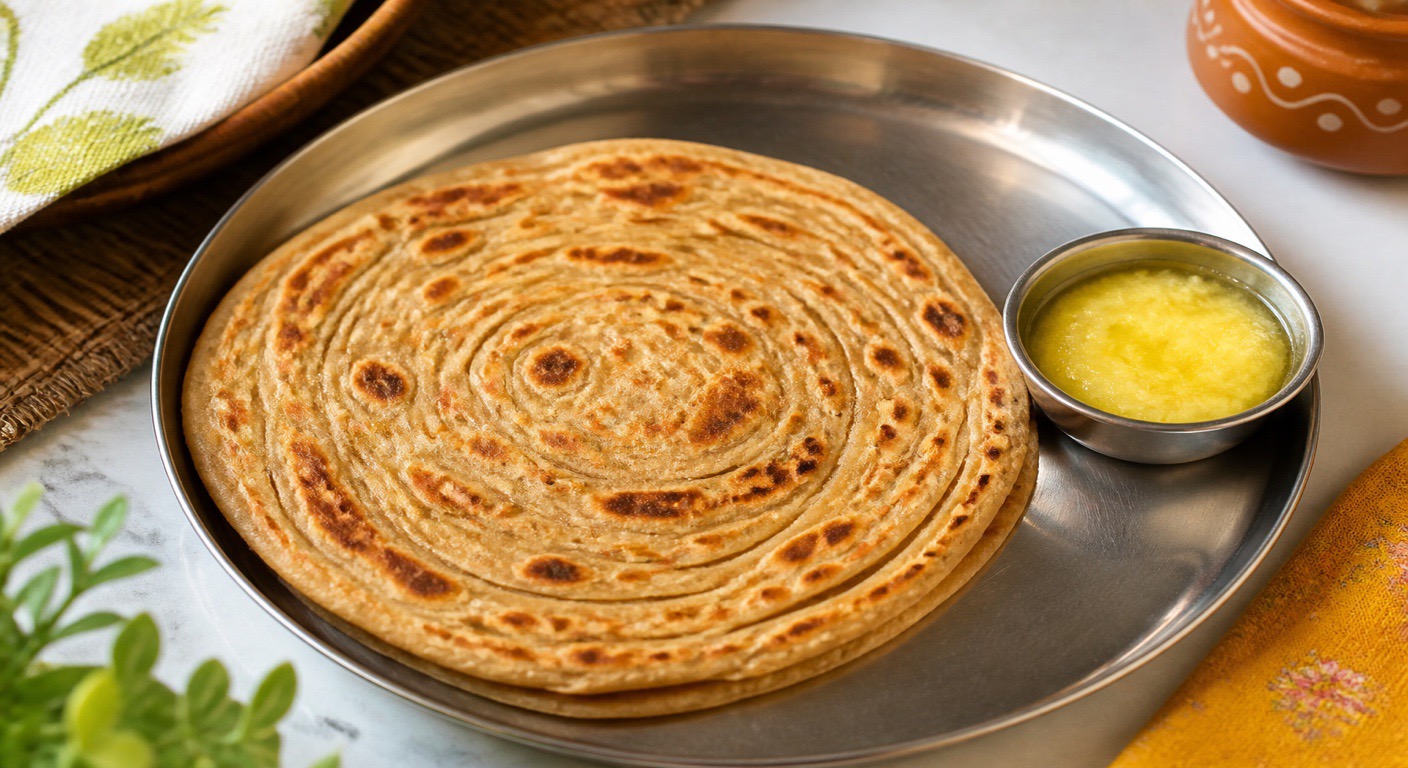
Lachha paratha - do the layers add calories?
A lachha paratha looks like a fancy roti, but each flaky layer is folded with ghee or oil. One whole-wheat lachha paratha is about 250 kcal - roughly 100 kcal more than a plain roti, and almost all of that extra is the fat tucked between the layers.
Look at a lachha paratha and it seems like a posh roti. Those flaky spirals look light and airy. But every layer is folded with ghee or oil so the dough can separate. That fat is where the extra calories hide. Let's count it honestly.
A lachha paratha is just a roti with a fancy shape, so it has the same calories.
mostly falseMostly false. The shape is not the point - the ghee or oil between the folds is. A whole-wheat lachha paratha runs about 250 kcal, while a plain roti of similar size is about 150 kcal. Nearly all of that 100 kcal gap is the fat folded into the layers and brushed on top.
A plain home roti: your starting point
One normal phulka made from about 40 g of whole-wheat atta, with no ghee on top, comes to roughly 150 kcal. That is just the flour - no added fat. This is the fair thing to compare a lachha paratha against.
Assumptions: 40 g whole-wheat atta x 370 kcal/100 g = 148 kcal, rounded to 150. No ghee or oil added - a plain dry phulka straight off the tava.
Plain roti vs lachha paratha
Halve the ghee between the layers
You don't need ghee on every fold. Brush a thin layer on just half the folds, and go light on the top brush too. The paratha still flakes, but with about half the fat.
Assumptions: A whole-wheat lachha paratha carries about 14 g fat, of which roughly 13 g is added ghee/oil (the atta itself brings about 1 g). That added fat is about 117 kcal at 9 kcal/g. Halving the between-layer ghee cuts about 6-7 g fat, or about 55-60 kcal: 250 - 60 = about 190 kcal. The dough portion (about 148 kcal from 40 g atta) stays the same.
Smart ways to eat your lachha paratha
- The dough is not the problem - atta and maida are close in calories per 100 g. The fat folded in is.
- Whole-wheat lachha has about 4.5 g fibre; the maida dhaba version has almost none. Same calories, but the whole-wheat one fills you up more.
- If you're at a dhaba, one lachha paratha instead of two is the single biggest save - about 250 kcal gone.
- Pair it with a light sabzi or dal, not paneer butter masala - the paratha already brings the fat for that meal.
The bottom line
A lachha paratha is a roti plus about 100 kcal of ghee or oil folded into the layers. One whole-wheat lachha paratha is about 250 kcal versus about 150 for a plain roti. You don't have to drop it - just go easy on the between-layer ghee, pick the whole-wheat one, and have one, not two.