Late dinner - does the clock really make you fat?
Eating late does not turn food into extra fat by magic - the same dinner has the same calories at 8 pm or 11 pm. But late eating does lower how much you burn and push you to eat more, so timing has a small real effect.
Eating after 8 pm turns your food straight into fat.
mostly falseMostly false. The clock does not change the calories in your roti or paneer - that food is the same energy at 8 pm or 11 pm. But timing is not nothing. In one careful study, late eating made people burn about 60 fewer kcal a day and made them hungrier. In another, late lunch eaters lost less weight than early eaters. So it is not magic fat - but late eating has a small real cost.
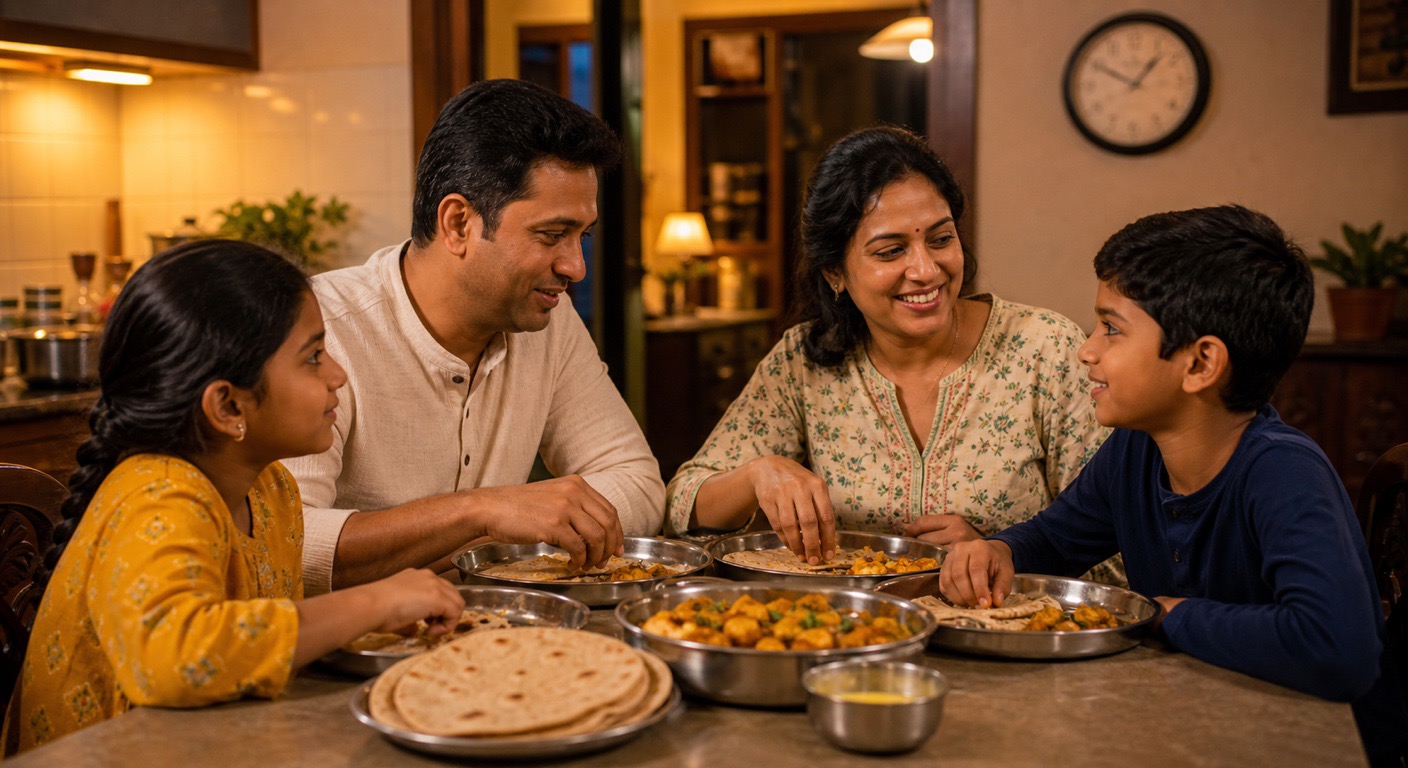
A normal late dinner: 3 rotis, paneer sabzi, a spoon of ghee
Picture a real late dinner at 10:30 pm. Three rotis, a katori of paneer sabzi, and a spoon of ghee on the rotis. It comes to about 790 kcal. This is not a huge feast. It is a regular Indian dinner - just eaten late.
Assumptions: 3 home rotis = 90 g whole-wheat atta at 370 kcal/100 g = 333 kcal. Paneer sabzi: 100 g paneer (299 kcal) cooked in 13 g (about 1 tbsp) sunflower oil (115 kcal) = 414 kcal; the onion-tomato base is mostly vegetables and adds only a little. 1 tsp (5 g) ghee on the rotis = 45 kcal. Total = 333 + 414 + 45 = 792 kcal, rounded to 790.
Same dinner, two clocks: 8 pm vs 11 pm
Eat the same dinner 2-3 hours earlier
You do not change the food at all - just the clock. The dinner stays about 790 kcal. But eating earlier dodges the small late-eating penalty: in the study, people burned about 60 fewer kcal a day and felt hungrier when they ate late. Same food, slightly better outcome.
Shrink the late dinner instead
If late is the only time you can eat, make the plate lighter. Drop one roti and skip the ghee - keep the paneer sabzi. You still get a real dinner, about 150 kcal lighter, and you sleep easier without a stuffed stomach.
Assumptions: 2 home rotis = 60 g whole-wheat atta at 370 kcal/100 g = 222 kcal. Paneer sabzi unchanged = 414 kcal (100 g paneer at 299 kcal + 13 g oil at 115 kcal). Ghee skipped (0). Total = 222 + 414 = 636 kcal, rounded to 635. Saving = 790 - 636 = 154 kcal.
If late dinner is your life
- Late eaters often skip breakfast and arrive at dinner starving - eat a real lunch so the 10 pm plate does not double in size.
- Cook the sabzi with 1 tablespoon of oil, not three. One tbsp is about 115 kcal; three is about 345 kcal - that swap alone saves about 230 kcal.
- Skip the second dinner. If you already ate at 8 pm, the 11 pm namkeen-and-chai round is extra calories, not your dinner.
- Leave 2-3 hours between dinner and bed - it helps you sleep comfortably on a lighter stomach.
- Pick one change, not all of them. The best lever is the one you can actually keep doing.
The bottom line
The clock does not add calories - the same dinner is about 790 kcal at 8 pm or 11 pm. But late eating has a small real cost: you burn about 60 fewer kcal a day and you feel hungrier. So timing matters a little. What matters far more is how much you eat, and whether late-night you adds a second dinner. Move the meal earlier, make it a bit smaller, and skip the extra snack.