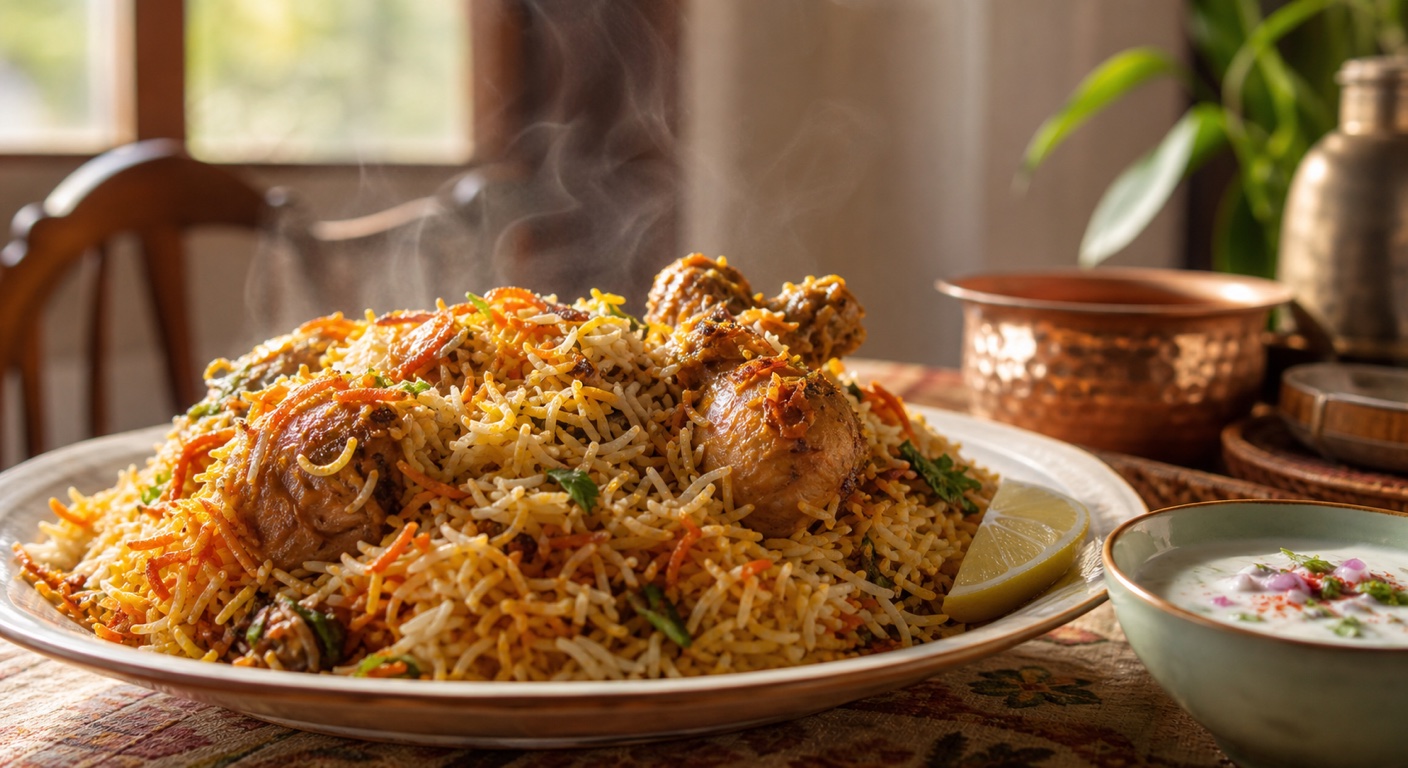
I love biryani - how do I make it lighter?
You don't have to give up biryani. A regular home-style plate is about 580-650 kcal, and most of the extra calories come from the ghee in the dum layering, the oil the fried onions soak up, and going back for a second plate - not from the chicken. A few small swaps - less ghee, lighter-fried onions, and one plate with dahi instead of two - can bring a typical biryani meal down by half or more, and it still tastes like biryani.
Biryani is a celebration dish, and nobody wants to hear 'don't make it'. The good news: the rice and chicken aren't the problem - it's the ghee in the layering, the oil the onions soak up, and how easy it is to go back for seconds. See where the calories actually come from, and you can keep making biryani while quietly bringing the number down. Every figure here comes from real recipe math and real food data (IFCT 2017 and USDA), given as an honest range where cooking style makes it wobble.
Your regular plate of biryani
One full plate of home-style chicken biryani - rice, chicken and the works, not paired with extra sides - comes to roughly 610 kcal. The chicken and rice together are about two-thirds of that; the rest is the ghee in the dum layering and the oil soaked up by the fried onions. Neither the rice nor the chicken is the villain here - the ghee and the frying oil are the biggest single levers.
Assumptions: One plate (~300 g mixed rice + chicken): 180 g cooked basmati rice (~234 kcal) + 90 g skinless chicken thigh (~180 kcal) + 14 g / 1 tbsp ghee in the dum layering (~126 kcal) + fried-onion garnish, 15 g onion + 5 g absorbed oil (~52 kcal) + 20 g yogurt marinade (~12 kcal) + whole spices/saffron (~5 kcal) = ~609 kcal, rounded to ~610. Honest range 580-650 kcal: lower with less ghee/fewer fried onions, higher with a heavier hand on ghee or restaurant-style extra oil.
Halve the ghee in the dum layering
Use about half a tablespoon of ghee instead of a full one when layering and finishing the dum. Let the rice and chicken's own moisture and the whole spices carry the aroma - a heavy hand with ghee at the end is the easiest thing to cut without losing the dish.
Fry the onions in less oil
Fry the birista (crispy onions) in a shallow pan with just enough hot oil to coat them, not a deep pool - hot oil crisps them fast and they absorb less. Cutting the absorbed oil from about 5 g to 2 g across the batch saves calories without losing the crunch.
Keep it skinless
Most home biryani is already made with skinless, bone-in chicken - if that's you, this box is already ticked. If you ever use skin-on pieces (like whole leg cuts), pull the skin off before marinating; it adds real fat for not much extra flavour once it's buried under the spice.
Same honesty as the skinless choice in the chicken curry article - real if you're starting from skin-on, already done for most home cooks.
A bit more chicken, a bit less rice
Shift the ratio on the same plate - a little more chicken, a little less rice. It's not really a calorie-cutter (chicken is denser in calories than rice, so this can even add a few), but it raises the protein and keeps you fuller for longer, which is what actually stops the second helping.
Like whole wheat over maida in the paratha article - the calorie change here is small, and even slightly up. The real win is protein and fullness, not a lower number.
Stop after one plate - add a bowl of dahi, skip the second helping
This is the biggest lever of all, and it's about the plate, not the biryani itself. Two plates of biryani is close to 1,220 kcal. Swap the second plate for a bowl of plain dahi (150 g, ~90 kcal) - you stay full from the volume and the protein, and the meal lands under 700 kcal instead of over 1,200.
Delta is measured against a typical TWO-PLATE meal (1220 kcal), because that's what this swap replaces - not against the single-plate baseline. Against one plate, the dahi actually adds ~90 kcal; it's a swap for the second helping, not the first.
Small tips that add up
- The two changes that matter most are the ghee in the dum and stopping at one plate - fix those first, the rest is fine-tuning.
- Fried onions add up fast because of the oil, not the onion - garnish smart, and don't feel you need a restaurant-sized pile.
- More chicken/less rice is about protein and fullness, not fewer calories - don't expect a calorie win from this swap alone.
- Skinless bone-in chicken keeps this dish honest - most home biryani has already ticked that box.
- A second plate is where the real damage happens. If you're going to have more, make it a bowl of dahi, not another full plate.
The bottom line
A regular plate of home-style chicken biryani is ~580-650 kcal, and most of that is the ghee in the dum and the oil in the fried onions - not the chicken. Halve the ghee, go lighter on the onion-frying oil, and lean toward more chicken and less rice for fullness, and a best-case plate lands around 540-560 kcal. The single biggest lever, though, is portion: stick to one plate with a bowl of dahi instead of going back for seconds - that takes a typical two-plate biryani meal from ~1,220 kcal down to around 640. You're not giving up biryani - just being honest about the ghee, the fry oil, and the seconds.
Best-case recipe, computed independently: One plate made light, computed independently (not a sum of the deltas above): 140 g cooked rice (~182 kcal) + 130 g skinless chicken thigh (~260 kcal) + 7 g ghee in the dum (~63 kcal) + a light fried-onion garnish, 15 g onion + 2 g oil (~25 kcal) + 20 g yogurt marinade (~12 kcal) + spices (~5 kcal) = ~547 kcal. Paired with a 150 g bowl of plain dahi (~90 kcal) instead of a second plate, for a full meal at ~637 kcal.