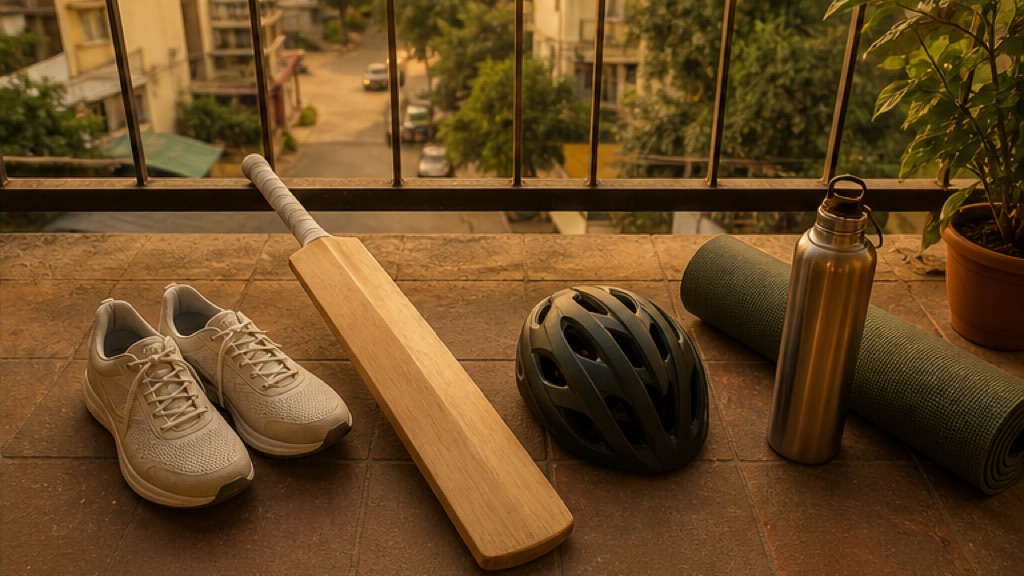
Middle-class Indian workouts: honest calories burned
Most middle-class Indians do not need a fancy gym to burn calories. The evening colony walk, the apartment stairs, cycling on weekends, cricket in the park, yoga at home, and a little gym work all count. Here is the honest calorie burn for each one, based on MET values, for a 70 kg person doing 30 minutes. The best workout is the one you will actually do every day, not the one that burns the most in a lab.
When you live in an Indian city or town, your exercise is usually not what a Western gym guide imagines. It is the evening walk round the colony, the four flights of stairs in your building, a weekend cycle on the ring road, cricket with the neighbours in the park, and a yoga mat rolled out in the bedroom. Sometimes a society gym visit, sometimes the swimming pool at the club. This article tells you honestly how many calories each of these actually burns for a 70 kg person in 30 minutes, where the numbers come from, and which one is worth your time. The short answer: the one you will do daily. The rest is fine-tuning.
The baseline: MET values and a 70 kg, 30-minute burn
A MET, or metabolic equivalent, is how exercise scientists compare the energy cost of activities. One MET is the energy you burn just sitting quietly. The rule is simple: 1 MET is about 1 kcal for each kilogram you weigh, per hour. So for any activity, calories burned in 30 minutes = MET value x your weight in kg x 0.5. For a 70 kg person, that is MET x 35 kcal. So a 3 MET activity burns about 105 kcal in 30 minutes, and a 7 MET activity burns about 245 kcal. These are gross numbers, they include the resting energy you would burn anyway during that half hour. The net extra burn above sitting is a little lower, but the gross number is what most apps and trackers show you, so we use it here for easy comparison. The numbers come from the Compendium of Physical Activities, an open-access list of MET values for hundreds of activities.
Assumptions: 70 kg adult, 30 minutes of continuous activity, gross energy including resting metabolism. Lighter people burn proportionally less, heavier people burn more, because the formula scales with body weight.
You only burn real calories if you sweat a lot, and only a gym workout counts.
mostly falseMostly false. Sweat is your body cooling itself, not a measure of calories burned. You can sweat buckets in a hot auto-rickshaw and burn almost nothing, and you can burn 100 kcal on a calm evening walk without a drop of sweat. What drives the burn is muscle work, measured in METs. A brisk 30-minute walk at 4.8 MET burns about 168 kcal for a 70 kg person with no sweat at all. And the gym is not the only place muscles work. Stairs, cycling, cricket, even a fast Surya Namaskar all count. The gym's real advantage is resistance training, which builds muscle and raises your resting burn over time. But for pure calorie deficit, the daily walk you actually do beats the gym membership you never use. The honest rule: consistency beats intensity. A 105-kcal walk you do 300 days a year is worth far more than a 300-kcal jog you do 12 times and quit.
Fit movement into real Indian middle-class life
- Walk the commute you already have. Get off one metro stop early, or park the two-wheeler 1 km away. Two short walks a day is about 150 extra kcal for a 70 kg person, with no extra time carved out.
- Take the apartment stairs. Start with one flight up, build to four. Stairs burn about 9 MET, so even 10 minutes is roughly 100 kcal, and it is free and always available.
- Make the evening walk non-negotiable. A 30-minute colony round at a brisk pace is about 168 kcal. Do it 6 days a week and that is 1,000 kcal a week without a gym.
- Add resistance twice a week. Society gym, home dumbbells, or bodyweight squats and push-ups on the balcony. This builds muscle, which raises your BMR so you burn more even at rest.
- Use weekend cricket and cycling as bonus, not the base. They are fun and social, which keeps you consistent, but they are not daily, so they do not carry your deficit.
- Do not chase sweat or soreness. A calm walk that you repeat for a year beats a brutal workout you do twice. Log your food in Burnie, see the deficit, and let daily movement widen it.
The bottom line
The honest verdict: the best workout is the one you will actually do every day, not the one with the highest MET number. For most middle-class Indians, that is a brisk 30-minute evening walk, about 168 kcal for a 70 kg person, done six days a week. Add apartment stairs when you can, a weekend cycle or cricket match for fun, and two short resistance sessions a week to build muscle and protect your BMR. Walking plus twice-a-week resistance is the high-leverage combo, it is cheap, gentle, sustainable, and it works. Jogging and stairs burn more per minute, but only if you keep doing them, and most people do not. Do not chase sweat, do not chase the hardest workout, chase the one you can repeat. Log your food in Burnie, see your deficit, and let daily movement widen it slowly and steadily. That is the whole plan.