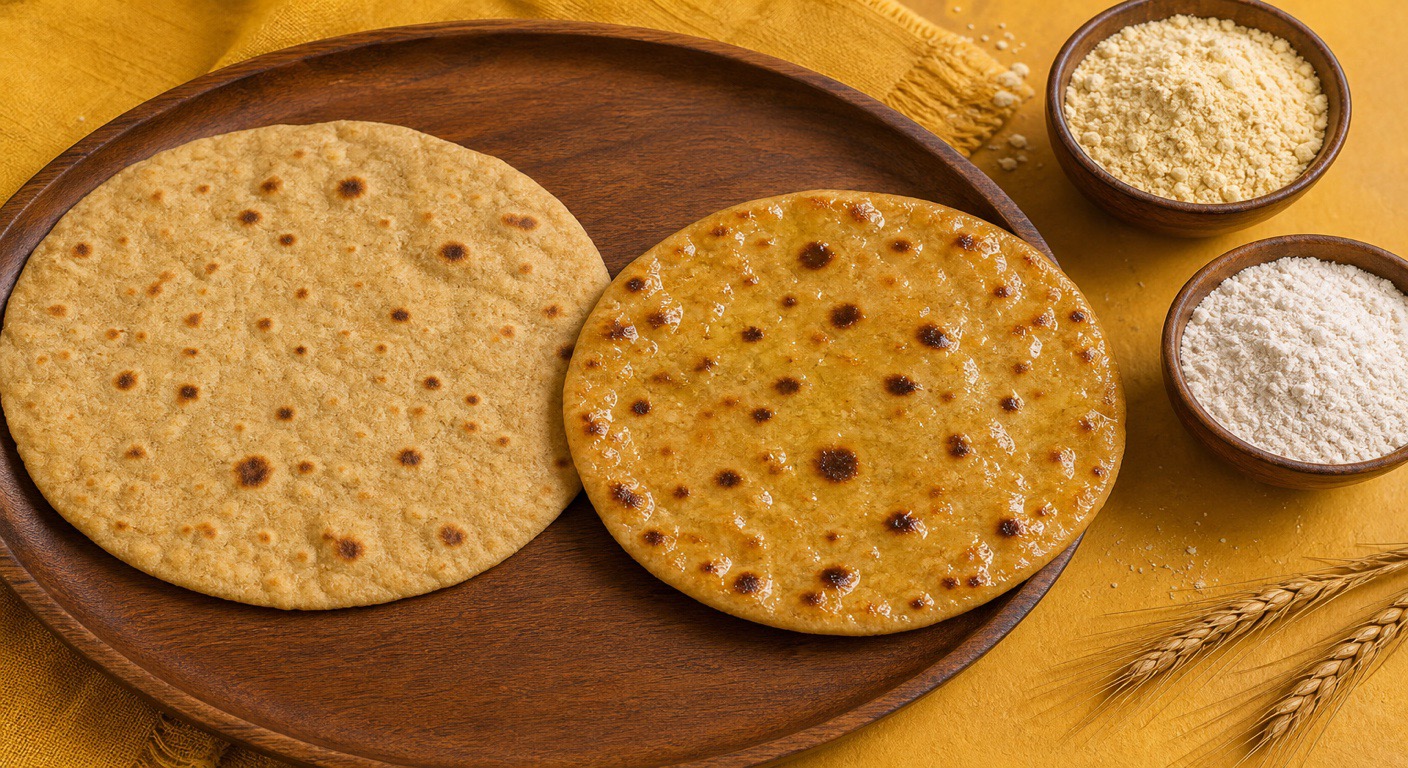
Is missi roti a healthy roti?
Missi roti mixes besan with wheat, so it packs more protein and fibre than a plain roti - but the ghee or oil you cook it in decides the calories. A dry-cooked missi roti is about 77-103 kcal, while a dhaba-style one brushed with a tablespoon of ghee jumps to nearly 200.
Missi roti sounds like the smart cousin of plain wheat roti. It mixes besan (gram flour) with atta, so people call it high-protein and healthy. That part is partly true. But the real calorie story is not in the flour. It is in the ghee or oil that touches the tava. Let's see what one missi roti really costs you.
Missi roti is a diet roti, because besan has more protein and fibre than wheat.
mostly trueMostly true for the flour, but it depends on the ghee. Per 100 g, besan has about 22 g protein and 11 g fibre, while whole wheat flour has less of both. So the besan in missi roti genuinely adds protein and fibre. The catch: the flour is only half the story. A dry missi roti is light, but the same roti brushed with ghee can more than double in calories. Besan does not cancel out ghee.
A typical home missi roti: about 103 kcal
A normal Punjabi-style missi roti, made with atta and besan and cooked with a small spoon of oil, lands around 103 kcal for one medium roti (about 35 g). It has about 4.5 g of fat - most of that is the cooking oil, not the besan. This is your everyday starting point.
Assumptions: Anchored on the published Punjabi missi roti recipe figure of 103 kcal per 35 g roti (recipe yields 10 rotis, ~4.5 g fat each). The upper end of the range is the ghee-cooked Rajasthani version at 115 kcal with 5.2 g fat. These are real published per-recipe numbers, not kitchen guesses.
Same roti, different fat: the calorie ladder
See how the fat you add changes the number. Each row is one missi roti (about 35 g), only the cooking fat differs. A plain home wheat roti sits in the middle for context.
Cook it nearly dry to save about 26 kcal
Use just a quarter-teaspoon of oil per roti on the tava, and skip oil in the dough. The besan binds well on its own with a little water. You keep all the protein and fibre and drop the extra fat.
Assumptions: Anchored on the published low-fat Rajasthani missi roti figure of 77 kcal with 1.30 g fat (about a quarter-teaspoon oil per roti). Saving vs the typical 103 kcal baseline is ~26 kcal per roti - small for one roti, but over two rotis a day that is ~52 kcal, about 5 kg of body fat over a year (at ~7700 kcal/kg).
Skip the dhaba-style ghee brushing
A dhaba missi roti is glossy because it gets a generous tablespoon of ghee brushed on both sides. That single spoon adds about 117 kcal - more than the whole dry roti. Enjoy the ghee flavour sometimes, but know it is not a free upgrade.
Assumptions: Start from the dry low-fat missi roti base (~77 kcal) and brush about 1 tablespoon (13 g) of ghee on both sides, the way a dhaba would. 13 g ghee x 897 kcal/100 g = ~117 kcal of ghee alone. Total ~194 kcal, rounded to 195. This is a transparent kitchen estimate of a generous brushing, not a lab measurement of one specific dhaba roti.
Smart ways to eat your missi roti
- Pair one missi roti with a bowl of dal or sabzi, not three rotis - the besan already adds protein, so you need fewer rotis to feel full.
- If you love the ghee flavour, brush half a teaspoon instead of a tablespoon - that is about 22 kcal instead of 117.
- Add finely chopped onion, methi or coriander to the dough - it adds bulk and fibre for almost no calories, so each roti feels bigger.
- Watch what you eat with it: a missi roti with butter paneer gravy can turn a 100 kcal roti into a 700 kcal meal.
- Two dry missi rotis (~154 kcal) is lighter than one ghee-cooked one (~195 kcal) - and you get to eat twice as much bread.
The bottom line
Yes, missi roti is a healthy roti - the besan gives it more protein and fibre than plain wheat. But it is healthy only when you cook it light. A dry missi roti is about 77-103 kcal. The same roti brushed with a tablespoon of ghee jumps to nearly 200. The flour is smart; the ghee is what decides the calories. So pick your roti by how it is cooked, not just by its name.