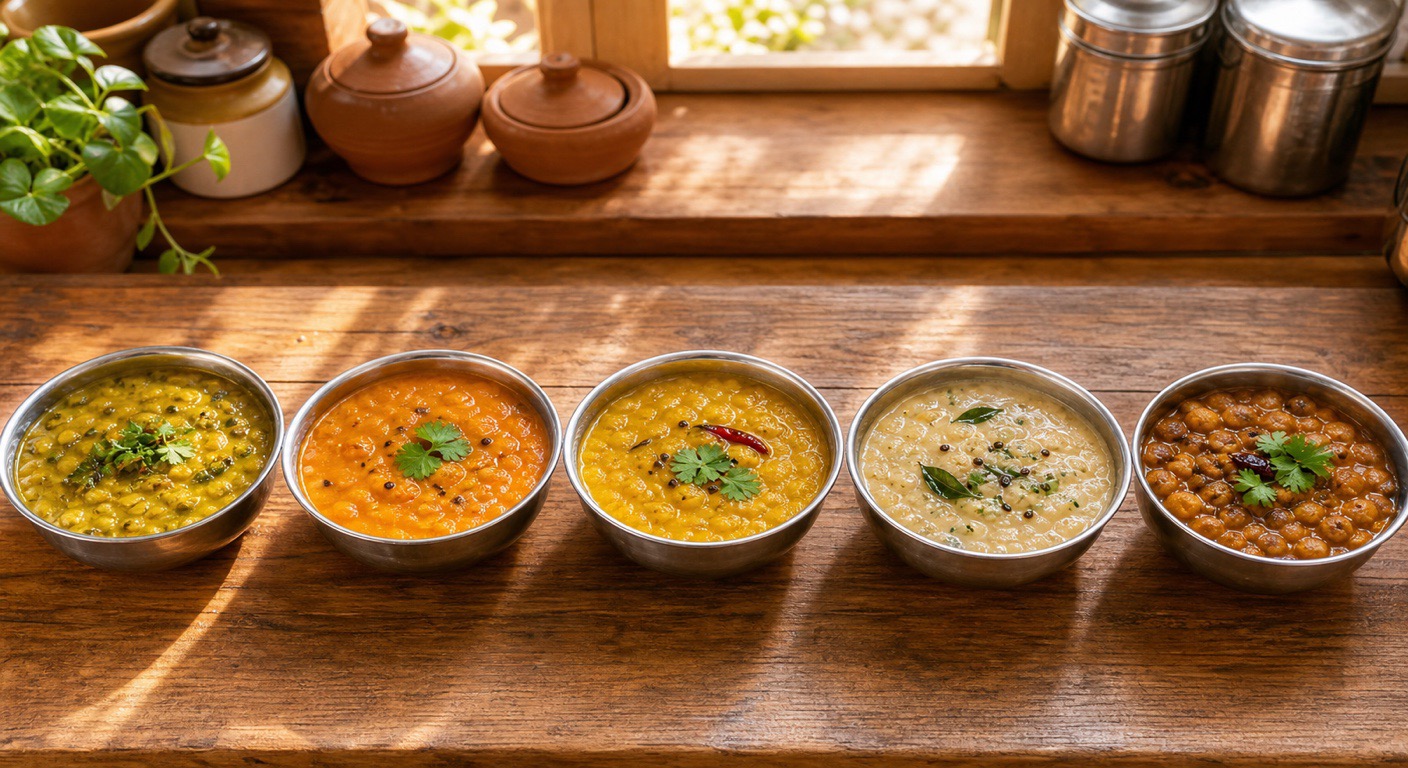
Which dal is the lightest? Moong wins, and the tadka decides
Cooked plain, moong and urad dal tie as the lightest at about 135 kcal per katori, while chana dal is the densest at about 210. The dal you pick moves the number by roughly 75 kcal per katori, but a heavy dhaba tadka can add far more than that on its own.
Ask any Indian kitchen which dal is the lightest, and most hands point to moong. They are mostly right. But the dal in your katori is only half the story. The other half is the tadka, the sizzle of oil or ghee on top. That spoon can change your katori more than the dal you chose. Let us look at the real numbers, plain and honest.
One katori of dal, plain boiled, no tadka
Your usual katori: home moong dal tadka
One small home katori of moong dal with a normal tadka lands near 180 kcal. The dal itself is only about 135 kcal. The single teaspoon of ghee on top adds about 45 kcal more. So the tadka is already a quarter of the bowl. Keep that in mind before the second spoon.
Assumptions: 1 small katori = ~130 g cooked moong dal. Cooked moong = 105 kcal/100 g, so 130 g = ~136 kcal, rounded to 135. Tadka = 1 teaspoon ghee (~5 g) at 897 kcal/100 g = ~45 kcal. Total ~180 kcal. A bigger katori (~150 g) or a heavier tadka pushes it toward 230.
Moong dal is the lightest and the gentlest dal.
mostly trueMostly true. Per katori cooked plain, moong and urad tie as the lightest, at about 135 kcal. Chana dal is the densest, at about 210 kcal. Moong is also the gentlest on the stomach, because split yellow moong has the least fibre and is the dal given to babies and on sick days. But remember: the tadka can swing your katori more than the dal you pick. One teaspoon of ghee adds about 45 kcal, and a dhaba-style pour can add far more.
Keep the tadka to one teaspoon, not two
A second spoon of ghee on top feels small, but it adds another 45 kcal to the same katori. That is more than the gap between moong and chana dal. Measure the ghee with a teaspoon, pour straight from the bottle, and you will usually pour double. One teaspoon for the tadka, then stop.
Assumptions: Same 130 g cooked moong dal (~135 kcal) with only a half teaspoon ghee (~2.5 g = ~22 kcal) swirled in, instead of one full teaspoon. A truly no-oil dal (zero-oil moong dal) sits even lower, near 135 kcal for the dal alone.
Small things that lighten your dal bowl
- Eat one katori, not two. The second katori is the easiest 180 kcal you can skip.
- If you love chana dal, have it, but count it as the rich one. A katori of chana dal is about 75 kcal heavier than moong, before the tadka.
- A dhaba dal tadka can mean two or three tablespoons of oil or ghee. That is 175 to 270 kcal of fat on top of the dal. At home, one teaspoon is plenty.
- Urad dal ties moong on calories but is heavier to digest. Save dal makhani for lunch, and pick moong or masoor for dinner.
- Sprouted whole moong is mostly water and fibre. A katori of sprouts is even lighter than cooked dal, and great in a chaat.
The bottom line
Moong and urad are the lightest dals, about 135 kcal per katori cooked plain. Chana dal is the densest, about 210 kcal. But the dal you pick moves the bowl by about 75 kcal, while the tadka can move it by far more. Keep the ghee to one teaspoon, pick moong or masoor for dinner, and your dal stays the gentle, light friend it always was.