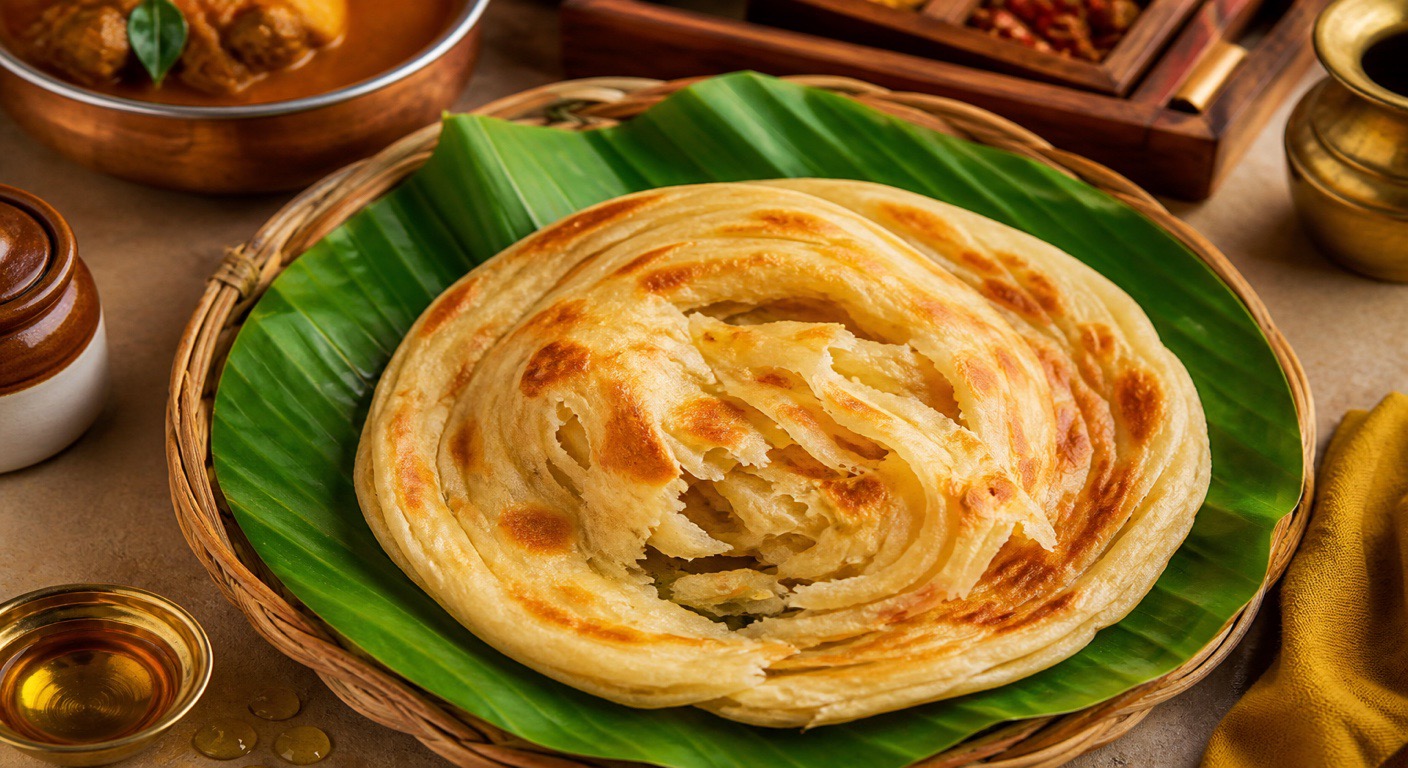
Kerala parotta - the flaky layered trap
A Kerala parotta looks like one flatbread, but oil or ghee is folded into every layer, so one parotta carries about 320 calories - close to three wheat rotis. Eat two plain rotis instead and you keep your South Indian meal while dropping calories and a lot of fat.
Kerala parotta is the flaky, layered flatbread you tear into at a Chettinadu mess or a roadside thattu kada. Those flaky layers do not come from the flour. They come from oil or ghee folded and rolled into the dough again and again. That is the real reason a parotta is heavier than it looks.
Maida (refined flour) is what makes a parotta heavier than a roti.
mostly falseMostly false. Maida and whole-wheat atta hold almost the same calories per 100 grams - maida about 364, atta about 370. So the flour type is not the trap. The real heavy part is the oil or ghee folded into every layer. A plain roti is cooked dry on a tava. A parotta is layered with fat. That fat, not the maida, is where the extra calories hide.
One Kerala parotta: about 320 calories
A standard Kerala parotta (about 100 grams) carries roughly 320 calories. A generous dhaba version cooked with plenty of ghee and oil can run much higher - close to 480. The layers look thin and light, but each one is brushed with fat.
Assumptions: Standard figure: 1 parotta (~100 g) = 320 kcal per the Calorique entry for malabar parotta (serving 1 parotta / 100 g). Upper bound from Tarla Dalal's Malabar Paratha recipe = 482 kcal per parotta, which uses about 3 tbsp ghee plus oil for rolling and cooking - a generous home or dhaba version. Most of the gap between the two figures is oil and ghee, not flour.
One parotta vs two wheat rotis
Have two wheat rotis instead of one parotta
The simplest swap on a South Indian plate. Two plain rotis give you more to scoop your curry with, similar carbs, and far less fat - and you save about 80 calories. Against a ghee-heavy parotta, the saving is even bigger, about 240 calories.
Assumptions: Baseline parotta ~320 kcal (1 parotta / 100 g, Calorique). Two medium wheat rotis at ~40 g each and ~120 kcal each = ~240 kcal (NutriScan). Delta = -80 kcal. Versus a ghee-heavy parotta (~482 kcal, Tarla), two rotis save about 242 kcal. Flour check: ~60 g atta in two rotis x 370 kcal/100 g = ~222 kcal raw, close to the cooked figure once a little oil or water is counted.
Small tips that add up
- Parotta is a sometimes food, not a daily one - the oil in the layers is the reason, not the maida.
- If you love the flaky texture, ask for a wheat parotta or share one parotta between two people and fill the rest of the plate with roti.
- Watch the side: a parotta with a rich kurma or a blob of butter piles on the oil load all over again.
- At home, brush just a teaspoon of oil between the layers instead of pouring - you keep the flake and lose most of the calories.
The bottom line
One Kerala parotta is worth close to three wheat rotis in calories, and almost all the extra comes from the oil folded into its layers, not from the maida. Eat two plain rotis instead and you keep the curry, keep the South Indian meal, and quietly drop about 80 calories - far more if your parotta was the ghee-heavy kind.