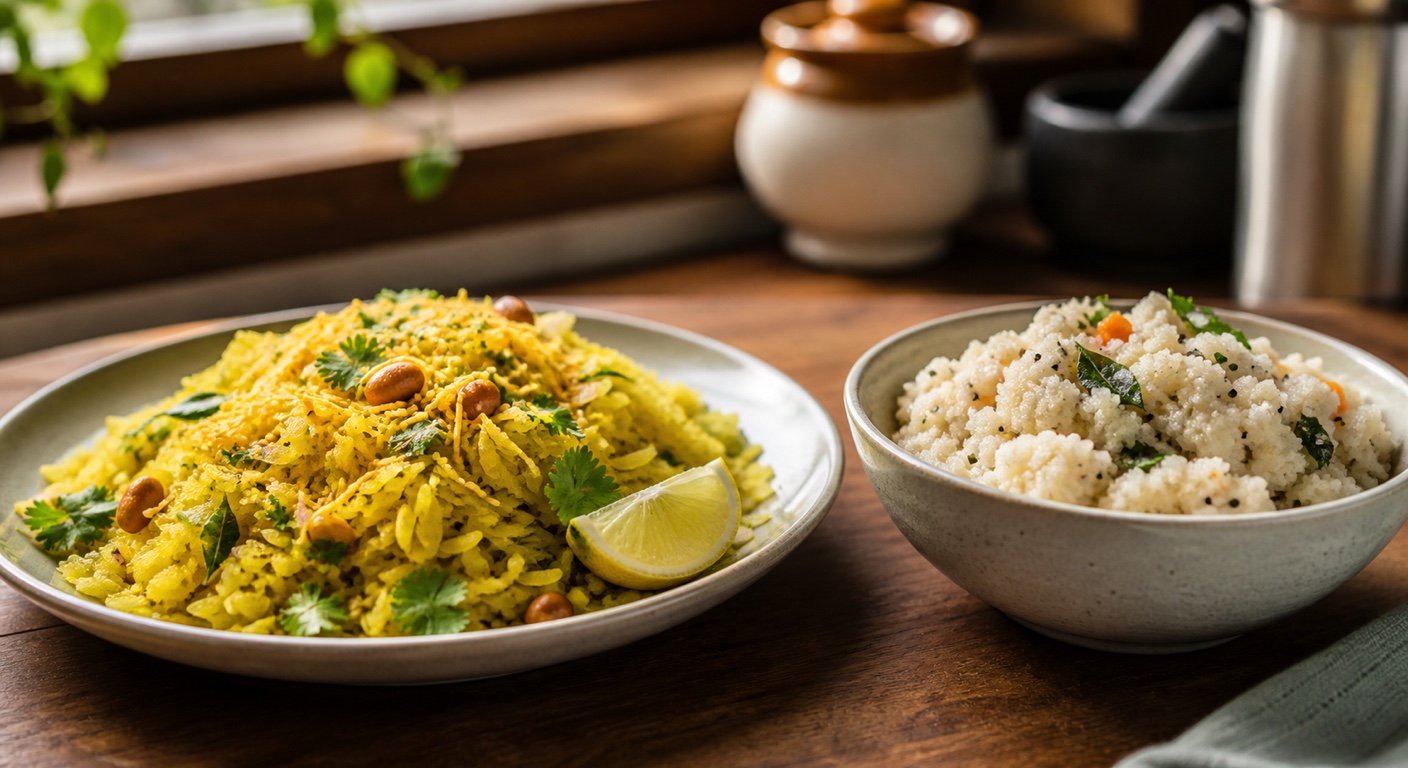
I eat poha and upma because they're 'light' - are they really?
Poha and upma are genuinely fine breakfasts - but they're not automatically diet food regardless of how they're made. A home bowl of kanda poha (flattened rice, onion, peanuts, a proper tempering) runs close to 400 kcal, and a rava upma made with a generous ghee tempering can land in the same range. The tempering oil, any ghee garnish, and the peanuts are the real levers here - not which of the two dishes you pick.
Poha and upma get treated as automatically 'safe' breakfasts because they sound light - flattened rice, semolina, a quick tempering. But the tempering oil, any ghee finish, and a generous hand with the peanuts can push either dish well past what most people assume. See where the calories actually sit, and you can keep both in your breakfast rotation with a clearer sense of what's adding up.
Your typical bowl: kanda (onion) poha
A home-cooked bowl of kanda poha - 60 g dry flattened rice, a proper 2 tsp tempering of oil with mustard seeds and curry leaves, onions, and a spoon and a half of roasted peanuts - comes to roughly 395 kcal. The poha itself is a moderate-calorie base; it's the oil and the peanuts that decide how light or heavy the bowl actually is.
Assumptions: 60 g dry poha at a real IFCT 2017 rate of 346 kcal/100 g = ~208 kcal. 2 tsp (~10 g) cooking oil at 884 kcal/100 g = ~88 kcal. 1.5 tbsp (~15 g) roasted peanuts at a real rate of ~599 kcal/100 g = ~90 kcal. Onion, curry leaves, mustard seeds, turmeric: negligible, ~10 kcal. Total ~396 kcal.
Go easy on the tempering oil
The tadka is doing more work than you'd think - cutting from 2 tsp to 1 tsp of oil (the mustard seeds and curry leaves still crackle just fine) is the single easiest change here.
Keep peanuts to a modest tablespoon, not a generous fistful
Roasted peanuts are a genuinely good add - protein, crunch, healthy fats - but they're calorie-dense at nearly 600 kcal/100 g. A levelled tablespoon, not a fistful and a half, keeps the crunch without quietly doubling the peanut calories.
Assumptions: Cutting from ~15 g (1.5 tbsp, ~90 kcal) to ~10 g (1 tbsp, ~60 kcal) of roasted peanuts saves ~30 kcal.
The same logic applies to upma - a ghee-loaded version isn't automatically lighter
A rava upma made with the same tempering oil plus a generous finishing spoon of ghee lands close to the same number as this poha bowl - the dish name doesn't decide the calories, the oil and ghee do.
This compares a full alternative bowl (upma) against the poha baseline, the way choosing idli over dosa works in the sibling article - it isn't a modification of the poha bowl's own ingredients.
Assumptions: 50 g dry rava/semolina at a real IFCT 2017 rate of 360 kcal/100 g = ~180 kcal, plus the same 2 tsp (~10 g) tempering oil (~88 kcal) and a generous 1.5 tsp (~7 g) finishing ghee at ~900 kcal/100 g (~63 kcal), plus negligible vegetables (~10 kcal) = ~341 kcal - close to the poha baseline of 396 kcal, not automatically lower.
A slightly smaller bowl, bulked out with extra vegetables
Dropping the dry poha from 60 g to 45 g and making up the volume with extra peas, carrots or beans keeps the bowl just as full without the extra flattened rice.
Assumptions: 45 g dry poha at 346 kcal/100 g = ~156 kcal, in place of 60 g (~208 kcal); vegetables added to bulk the bowl are close to calorie-free at this scale. Oil and peanuts unchanged from the baseline.
Small tips that add up
- Poha and upma are not automatically 'diet food' just because they sound light - a version loaded with tempering oil, a ghee finish and a heavy hand with peanuts can land close to a paratha. A version made with modest oil genuinely is a good light breakfast.
- A crunchy nylon sev garnish on kanda poha is a common addition that adds real deep-fried calories - roughly 60-80 kcal per serving by one real recipe estimate - on top of everything else. Skip it or swap it for a few extra peanuts.
- The tempering oil and any ghee garnish are the biggest single lever on either dish - not the poha or rava itself.
- Restaurant or hotel-style upma often uses noticeably more oil per 100 g than a home-cooked one - if you're ordering out, this is where most of the extra calories are hiding, not in the semolina.
The bottom line
Poha and upma both start from a moderate-calorie base - flattened rice or semolina. What actually decides whether the bowl is light or heavy is the tempering oil, any ghee finish, and how generous the peanuts are. A typical home bowl of kanda poha is around 395 kcal; going easier on the oil, keeping peanuts to a level tablespoon, and using a slightly smaller poha portion bulked with vegetables can bring it down to roughly 260 kcal - and the same logic, not the dish you pick, is what keeps upma light too.
Best-case recipe, computed independently: 45 g dry poha (~156 kcal) with 1 tsp tempering oil (~44 kcal) and a level tablespoon of roasted peanuts kept in for protein (~60 kcal), no sev garnish, bulked out with extra vegetables, comes to about 260 kcal, computed independently (not a sum of the deltas above).