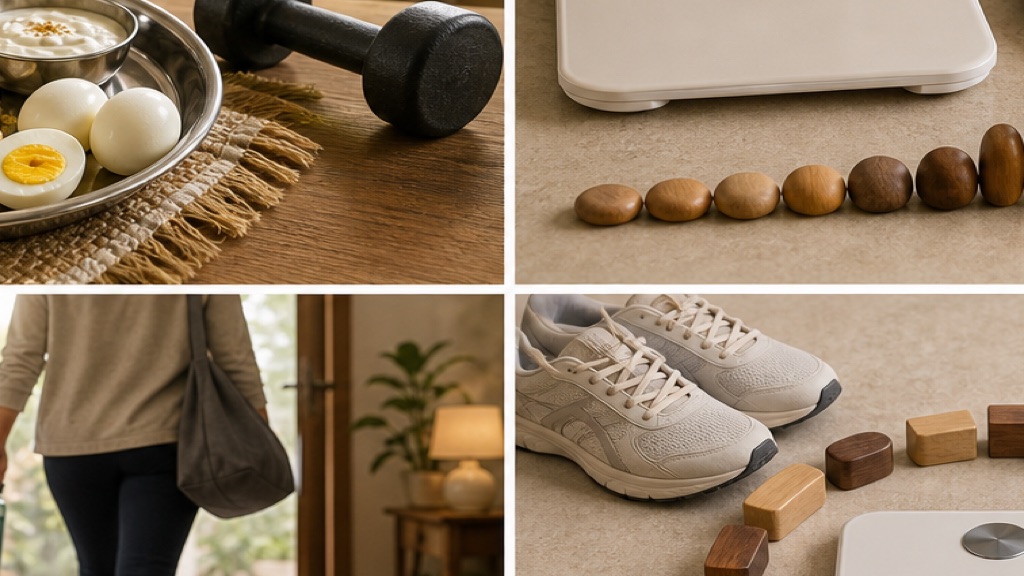
Protein and lifting - keeping the muscle that keeps your BMR
Muscle needs lifting plus protein - about 1.2-1.6 g/kg/day, above the 0.8 RDA. In a deficit, higher protein keeps your muscle, and your muscle keeps your BMR.
When you lose weight, your BMR drops for two reasons: you weigh less, and you often lose muscle along with the fat. Less muscle means a lower resting burn, and that can stick around long after the diet ends. The fix is not a hack. It is the boring combo every coach agrees on: lift something heavy a few times a week, and eat enough protein. Together they tell your body to keep the muscle while you lose the fat. Protein also burns a few extra calories just being digested, more than carbs or fat do. So a bit more protein does three small jobs at once: it builds muscle, keeps muscle, and quietly raises your calorie burn a little.
The RDA of 0.8 g per kg of body weight is all the protein anyone needs.
VerdictThat number is the minimum to avoid a deficiency, not the target for someone who lifts weights or is losing fat. A big meta-analysis of 49 studies found the break point for building muscle with training was about 1.62 g/kg/day, roughly double the RDA. People in a calorie deficit often need more protein, not less, because the body is tempted to break down muscle for energy when food is scarce.
The BMR you protect when you keep your muscle
For a typical 70 kg Indian adult, resting burn is about 1,650 kcal/day for a man and 1,350 for a woman. Muscle itself burns only about 13 kcal per kg per day at rest, so it is not a huge calorie furnace, but when you diet you risk losing it, and that lowers your BMR for as long as the muscle is gone. To keep it, lift twice a week and eat about 1.2 to 1.6 g of protein per kg per day. For a 70 kg person that is roughly 85 to 110 g a day. The upper end, near 1.6 g/kg, is where a large meta-analysis found extra protein stops adding more muscle from training. The old 0.8 g/kg RDA is the floor to avoid deficiency, not the target when you are training and cutting calories.
Assumptions: 70 kg adult, about 30 years old, average height, sedentary office job; women and older adults sit lower in the range.
How to hit your protein in a normal Indian day
Spread protein across the day, not all at one meal. Your body uses it better in doses of about 20-30 g per meal. Here is one 70 kg day that lands near 100 g: breakfast two eggs plus a bowl of curd (about 20 g); lunch two roti with a thick bowl of dal and a small paneer piece (about 30 g); evening a glass of buttermilk and a handful of roasted chana (about 10 g); dinner chicken or soya chunks with roti and sabzi (about 35 g). You do not need powders or imported foods. Dal, curd, paneer, eggs, chicken and soya do the job, and pairing dal with roti or rice makes their proteins complement each other. Log the day in Burnie and you will see the protein add up and the deficit hold steady, which is the part that actually drives the fat loss.
Assumptions: 70 kg adult eating about 100 g protein/day; protein TEF of 20-30% adds roughly 80-120 kcal on top of the resting burn shown in the baseline.
Protein vs carb vs fat: the thermic effect, and what a deficit study showed
Small habits that keep your muscle and your BMR
- Aim for 1.2-1.6 g of protein per kg per day if you lift and cut. For 70 kg that is about 85-110 g.
- Spread protein across 3-4 meals, roughly 20-30 g each, instead of one big dinner.
- Pick cheap Indian sources: dal, curd, paneer, eggs, soya, chicken and milk do the job.
- Pair dal with roti or rice. Together their proteins complement each other better than either alone.
- Lift twice a week: squats, push-ups and rows at home for 20 minutes. Protein without lifting does not build muscle.
- Log your food in Burnie so you actually see whether you hit your protein, instead of guessing.
The bottom line
Lifting plus enough protein is how you keep the muscle that keeps your BMR. Aim for about 1.2 to 1.6 g per kg per day, spread across your meals, with two strength sessions a week. You will burn a few extra calories digesting it and protect your resting burn from dropping. But remember, the calorie deficit still does the real fat-loss work. Log your food, watch the deficit, and let protein and lifting be the sturdy scaffolding around it. Burnie keeps that whole loop simple.