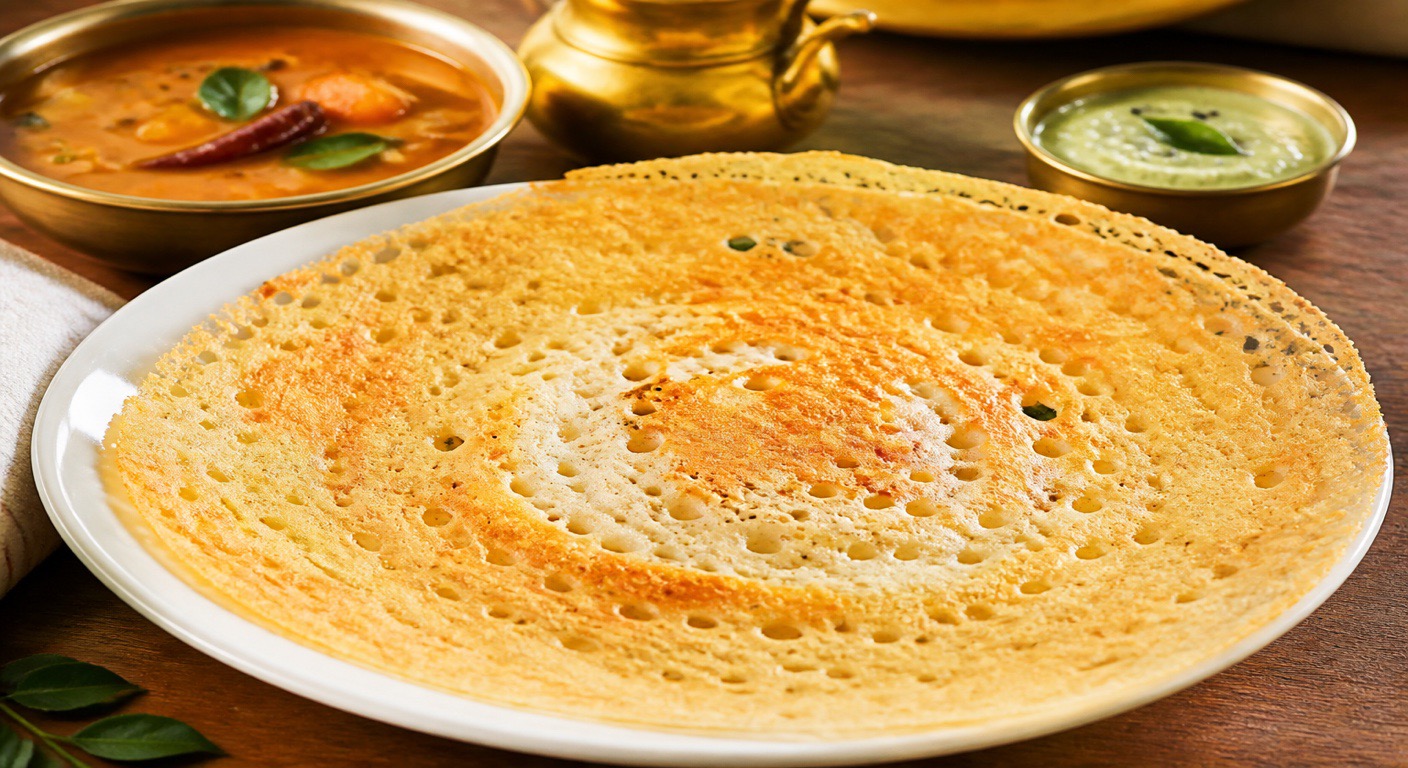
Rava dosa's crisp - is it just lots of oil?
That lacy, crispy rava dosa looks light, but most of its calories come from the oil poured into the holes. A restaurant rava dosa can run about 350-450 kcal, while a plain dosa is closer to 168 kcal.
You order a rava dosa. It arrives thin, golden, and full of lacy holes. It looks lighter than a normal dosa. That look is a trick. Those pretty holes are little pools of oil. The crisp you love is mostly oil, not magic.
Rava dosa is light and healthy because it looks so thin and lacy.
mostly falseMostly false. The lacy holes are where oil sits and fries the batter crisp. Oil packs about 884 kcal per 100 g, far more than the flour at about 360 kcal per 100 g. A thin-looking rava dosa can hide a lot of oil.
Your restaurant rava dosa: about 370 kcal
A lacy restaurant rava dosa uses a lot of oil on the tawa. The cook pours oil around the edges and into every hole. That oil is most of the calories. The rava and rice flour add only a little.
Assumptions: Per dosa: 18 g rava (~65 kcal at 360 kcal/100 g) + 8 g rice flour (~29 kcal at 366 kcal/100 g) + 3 g maida (~11 kcal at 364 kcal/100 g) + ~30 g oil poured for the lacy crisp (~265 kcal at 884 kcal/100 g) = ~370 kcal. Oil is about 70% of the total. Restaurant oil ranges about 25-40 g per dosa, so the honest range is ~350-450 kcal.
Rava dosa vs plain dosa
Make it at home with just 2 teaspoons of oil
Use a measured 2 tsp (about 9 g) of oil on a hot tawa. Pour the batter thin. You still get a crisp dosa, but the oil stays small.
Assumptions: Per dosa: 18 g rava (~65 kcal) + 8 g rice flour (~29 kcal) + 3 g maida (~11 kcal) + 9 g oil (~80 kcal) = ~185 kcal. Oil is now about 40% of the total instead of 70%.
Use a non-stick tawa and brush just 1 teaspoon of oil
A good non-stick tawa needs far less oil. Brush 1 tsp (about 4.5 g) instead of pouring. A hot tawa still gives a nice crisp.
Assumptions: Per dosa: same flours (~105 kcal) + 4.5 g oil (~40 kcal) = ~145 kcal. Oil is now about 28% of the total.
Smart rava dosa habits
- The lacy holes in a rava dosa are tiny pools of oil. That is why they are crispy. A plain dosa has no holes, so it needs less oil.
- The flours are not the problem. Rava, rice flour, and maida are all about 360 kcal per 100 g, close to atta at 370. The oil is what piles up.
- A plain dosa uses fermented rice and urad dal, so it has a little more protein and is gentler on blood sugar than a rava-maida batter.
- Order one rava dosa, not two or three. Fill up on sambar and chutney instead. They are tasty and low in calories.
- Ask for a 'dry' rava dosa with less oil. Many darshinis and restaurants will make it if you ask.
The bottom line
A restaurant rava dosa can run about 350-450 kcal, and most of that is the oil sitting in the lacy holes. A plain dosa is closer to 168 kcal. Make rava dosa at home with 1-2 measured teaspoons of oil and it drops to about 145-185 kcal. The crisp is not free. You pay for it in oil.