Resistance band home workout for Indians: cheap full-body burn
A set of loop resistance bands and a door anchor costs less than one month of a gym, packs flat in a drawer, and trains your whole body at home. A band circuit burns about 105-175 kcal in 30 minutes for a 70 kg person, but the real win is muscle and BMR (the calories you burn just sitting). This article gives you the kit, a full-body circuit, honest burn numbers, and a myth-bust on whether bands build real strength.
You do not need a gym, iron weights, or a big room to get stronger. A few rubber resistance bands and a door anchor can train your legs, back, chest, shoulders, arms and core on the floor of your bedroom. Bands are cheap, they fold into a side bag for travel, and they are gentle on your knees and elbows because the resistance builds up smoothly instead of slamming your joints. For many Indian starters, bands beat dumbbells: no floor space, no noise, no fear of dropping a weight on your toe. This article tells you honestly what a band workout burns, how to build a full-body routine, and why the big win is not the session calories but the muscle and BMR you keep.
The honest burn: about 105-175 kcal per 30 minutes for a 70 kg person
Resistance training is a lower session-burn activity than running or cycling. The Compendium of Physical Activities lists resistance training at 3.0-5.0 MET depending on how hard and how fast you work. One MET is the energy you burn just sitting, about 1 kcal per kg per hour. So a 70 kg person doing a moderate band circuit at about 3.5 MET burns about 3.5 x 70 x 0.5 = 123 extra kcal in 30 minutes. A gentle session is about 3 MET (105 kcal). A brisk circuit with short rest can reach 5 MET (175 kcal). That is honest: a 30-minute band workout burns less than a 30-minute jog. The win is not the session. The win is that resistance training keeps and builds muscle, and muscle raises your resting metabolism, the BMR you burn all day. You trade a small session burn for a bigger all-day burn. Burnie logs your food and shows your deficit; the band session widens that deficit a little and protects the muscle that keeps your BMR up.
Assumptions: 70 kg adult, full-body band circuit, 30 minutes, 8-15 reps per exercise with short rest. Heavier people burn proportionally more because they move more mass. MET values from the Compendium of Physical Activities resistance-training codes.
The full-body band circuit: 8 moves, muscle group and band setup
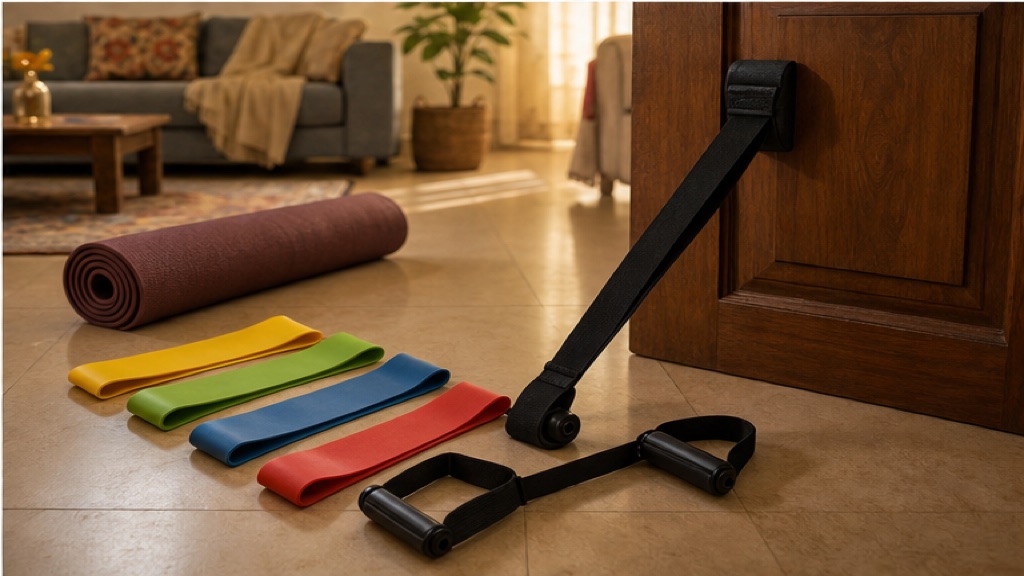
Run these as a circuit: one move after the other, 8-15 reps each, 30-60 seconds rest between moves, 2-3 rounds. Start light. A loop band or a flat band with handles works for every move. A door anchor (a small strap that wedges in a door frame) opens up rows and presses without a gym. Do the whole circuit 2-3 times a week, not every day, so your muscles can recover and grow.
Resistance bands are too easy to build real muscle.
falseFalse. A meta-analysis of eight trials comparing elastic (band and tube) training to conventional weight training found that elastic resistance promotes similar strength gains to conventional resistance training, in different population profiles and using diverse protocols. The catch is not that bands cannot build strength, it is that you must add tension over time: stack a second band, step wider, slow your tempo, or add reps. Bands do cap out lower than a heavy barbell for advanced lifters chasing huge loads, but for a home starter and even an intermediate, bands build real, usable strength. The push-up with a band has even shown strength gains similar to the bench press at similar stress levels.
Make the band workout actually work
- Do the full-body circuit 2-3 times a week, not daily. Muscle grows on rest days, not on training days.
- Progress by adding tension, not by guessing. Stack a second band, step wider on the band, or slow each rep to 3 seconds up and 3 seconds down. Slow tempo is brutal and builds real strength.
- Aim for 8-15 reps per set. If you can do 15 easily, add tension. If you cannot reach 8, use a lighter band or step narrower.
- Check the door anchor every time. Wedge it firmly in a fully closed door before you pull, and pull in a direction that keeps the door shut, not one that yanks it open.
- Pair bands with walking. Bands build muscle and protect BMR; walking widens the calorie deficit. Two band days plus a daily 30-minute walk is a strong, cheap, joint-friendly plan.
- Inspect bands for cracks before each session. A snapped band can sting; replace a band that looks dry or cracked. Keep them away from direct sun.
The bottom line
A set of resistance bands and a door anchor gives you a full-body strength workout at home for very little money and zero floor space. The honest burn is about 105-175 kcal in 30 minutes for a 70 kg person, lower than cardio, but the real win is the muscle you keep and the BMR it protects. Run the 8-move circuit 2-3 times a week, add tension over time by stacking bands or slowing your tempo, and pair it with a daily walk. Bands are not too easy, a meta-analysis shows elastic training matches conventional weights for strength gains, they just cap out lower for advanced barbell loads. Log your food in Burnie, see your deficit, and let bands and walking widen it slowly and steadily. That is the whole plan.