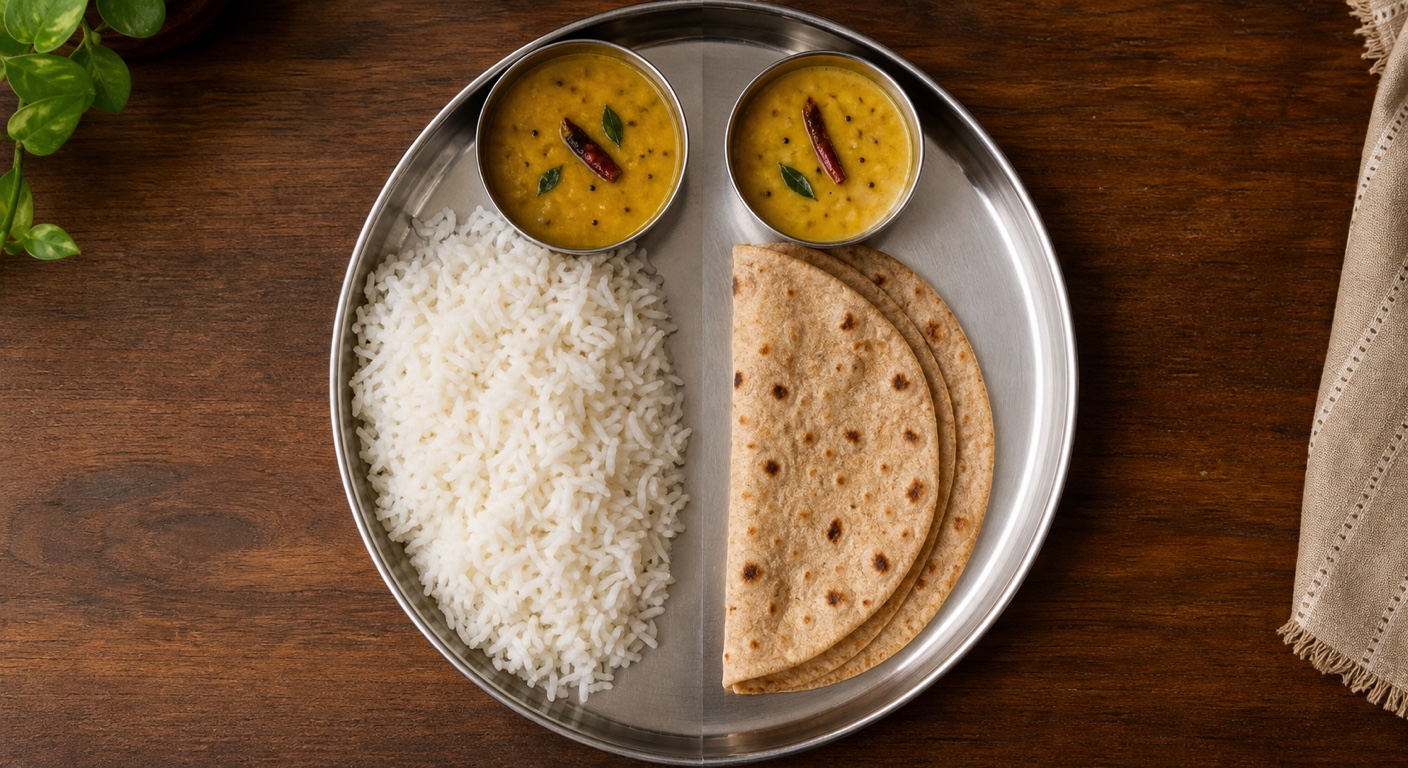
Rice vs roti: which one actually helps you lose weight?
Rice families and roti families have argued about this for generations. Here's what glycemic-index and weight-loss studies run on real Indian meals actually found - and it's less dramatic than either side expects.
Rice households and roti households can argue about this for generations - 'rice makes you fat', 'no, roti is heavier', 'switch to brown rice and the weight falls off'. The actual research, run in Indian populations eating Indian meals, gives a clearer and considerably less dramatic answer than either camp expects.
"Rice makes you fat; roti (wheat) doesn't."
mythMyth as a blanket statement - the strongest Indian evidence says grain choice alone isn't a reliable weight-loss lever.
Malik, Sudha, Mohan and colleagues ran a 3-month randomised controlled trial (2019, British Journal of Nutrition) with 166 overweight or obese adults in Chennai, giving one group parboiled brown rice and the other white rice as their staple, eaten ad libitum six days a week. Simply changing the grain did not significantly improve glycaemic control or lipid markers in the group overall - the only significant benefit appeared in a subgroup who already had metabolic syndrome. If switching grains alone reliably drove fat loss, a 3-month controlled trial in exactly this population would have shown it clearly across the board; it didn't.
"Roti has a much lower glycemic index, so it's obviously the better choice for blood sugar and weight."
partly truePartly true in isolation, but the gap mostly disappears in a real Indian mixed meal.
Standalone glycemic-index tables do rank wheat roti lower than white rice. But Nayar and Madhu (2020, Indian Journal of Endocrinology and Metabolism) tested this the way people actually eat - as part of a mixed North Indian meal with dal and vegetable, each providing 50g of available carbohydrate - and found the glycaemic index of the wheat-based meal (85.53 ± 11.75) was not significantly different from the rice-based meal (83.57 ± 11.40, p = 0.7095). Add fat, protein and fibre from dal and sabzi to either staple, and the isolated-food GI advantage of roti mostly washes out.
"Roti's extra fibre means you'll naturally eat less and lose weight."
partly truePartly true - fibre genuinely improves fullness signals, but that doesn't reliably translate into eating fewer total calories.
Sanders, Zhu, Wilcox, Koecher and Maki (2021, Advances in Nutrition) pooled 32 randomised controlled trials comparing whole-grain to refined-grain intake and found whole grains significantly reduced hunger and significantly increased fullness and satiety ratings. But when they looked at what people actually ate afterward, the reduction in measured energy intake was small and not statistically significant (SMD -0.11, p = 0.070). Roti's extra fibre from whole wheat genuinely helps you feel more satisfied - it just isn't a guaranteed calorie-cutting mechanism on its own, especially if you eat more rotis to compensate or add generous ghee to each one.
Small tips that add up
- Compare portions, not staples: one bowl of rice and 2-3 rotis, with equivalent dal/sabzi/ghee, land in a similar calorie range - plate composition matters more than which grain is on it.
- If you want roti's fibre and fullness benefit, choose whole-wheat (atta) roti over refined/maida versions, and don't cancel it out with extra ghee or butter per piece.
- For blood sugar specifically, what you eat rice or roti WITH (dal, vegetables, protein) affects the glycaemic response as much as the grain itself, per the mixed-meal study above.
- If you're testing a grain swap for weight or metabolic reasons, watch the plate size and total meal, not just the grain - the Chennai brown-vs-white rice trial found no overall benefit from the swap alone.
- Both rice and roti are complete-enough traditional staples - the sustainable choice is whichever one you can portion-control and enjoy for years, not the one that wins a family argument.
The bottom line
The honest bottom line: neither rice nor roti is secretly making you fat or thin - portion size, what's on the rest of the plate, and how much ghee or oil goes on top matter far more than which staple you choose.
Best-case recipe, computed independently: Not a literal recipe - the practical best case is picking the staple you enjoy and can portion-control consistently, pairing it with dal/vegetables/protein, and measuring the ghee or oil added, rather than switching staples and expecting that alone to change the outcome.