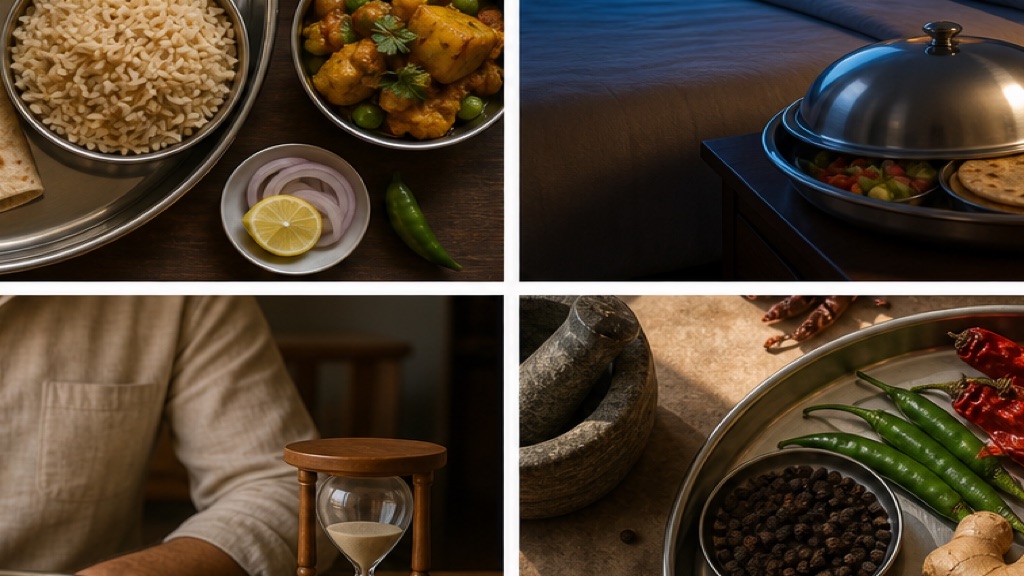
Roti vs rice: calories, satiety and the deficit verdict
One medium whole-wheat roti gives about 100 kcal, a 150 g katori of cooked white rice about 195 kcal, and brown rice about 185 kcal. Brown and white rice are nearly equal in calories; the real difference is fibre and glycaemic index. Roti is more filling because it has far more fibre and protein. In a calorie deficit, portion size matters more than which grain you pick.
Roti or rice? It is the oldest food fight on the Indian plate, and most people pick a side believing one is magically lighter. The honest truth: all three grains (whole-wheat roti, white rice, brown rice) can fit a calorie deficit. The numbers are close enough that portion size beats grain choice almost every time. This article compares one medium roti with one katori (~150 g) of cooked white or brown rice, shows the calories per piece and per 100 g cooked, explains why roti fills you up more (fibre and protein), and gives you a simple plate rule you can use today. Spoiler: the lever is the sabzi and dal on the side, not the grain.
The baseline: roti ~100 kcal, rice katori ~185-195 kcal
Here are the numbers from USDA-backed nutrition tables. Whole-wheat roti (chapati, commercially prepared) gives about 298 kcal per 100 g cooked. A medium homemade roti from about 30 g of whole-wheat flour, cooked with no ghee, weighs roughly 33 g, so it lands near 100 kcal. Bigger rotis or a teaspoon of ghee push that to 120-150 kcal. Cooked white rice (medium-grain, unenriched) is about 130 kcal per 100 g; one Indian katori of about 150 g cooked rice gives about 195 kcal. Cooked long-grain brown rice is about 123 kcal per 100 g, so the same 150 g katori gives about 185 kcal. Notice the brown-vs-white gap is only about 10 kcal per katori, almost nothing. The roti looks lighter only because a single roti is a smaller mass of food than a full katori of rice. Compare them per 100 g cooked and roti is actually the densest of the three, because roti keeps its fibre and protein while rice puffs up with water.
Assumptions: 1 medium whole-wheat roti ~33 g cooked (from ~30 g flour, no ghee or oil). 1 katori cooked rice ~150 g. Values are cooked-weight, no added fat. Add ~45 kcal for each teaspoon of ghee or oil.
Brown rice has way fewer calories than white rice.
mostly falseMostly false. Per 100 g cooked, brown rice is about 123 kcal and white rice about 130 kcal, a gap of only about 7 kcal. A full 150 g katori differs by only about 10 kcal. The real difference between brown and white rice is not calories, it is fibre (1.6 g vs almost none) and glycaemic index. The international GI tables (Foster-Powell, Atkinson 2008) list boiled white rice at GI 73 plus or minus 4 and boiled brown rice at GI 68 plus or minus 4, so brown is only slightly lower, while chapati is clearly lower at GI 52 plus or minus 4. So brown rice is a small upgrade on blood sugar, not a calorie cheat. If you want fewer calories, eat less rice, not a different colour of rice.
The real lever: half-rice-double-sabzi or 2 roti plus dal
Pick the grain you actually enjoy, then fix the portion. Two plate patterns work well in a deficit. Plate A (rice lover): half the rice you usually eat, double the sabzi, and a small katori of dal. So instead of 2 katori rice (~390 kcal), eat 1 katori rice (~195 kcal), extra sabzi (~50-80 kcal), and dal (~100 kcal) - you save roughly 100-150 kcal and feel just as full because the sabzi and dal add fibre and protein. Plate B (roti lover): 2 medium roti (~200 kcal) with a generous bowl of dal (~150 kcal) and sabzi - the roti's own fibre (4.9 g per 100 g) and protein (11.25 g per 100 g) keep you full longer than the same calories of white rice. The reason roti wins on satiety is simple: per 100 g, roti has about five times the fibre and about four times the protein of cooked white rice. Same calories, more fullness. But neither grain saves you if you pile it high. The single biggest move in an Indian deficit is shrinking the grain and growing the sabzi-dal. Log the plate in Burnie and let the deficit show you the result.
Assumptions: One-roti baseline ~100 kcal. Plate A example: 1 katori rice (195) + extra sabzi (60) + dal (100) = about 355 kcal vs a 2-katori-rice habit of about 390 kcal, a saving of roughly 95 kcal. Dal and sabzi calorie estimates are typical home-style, no heavy oil.
Make the grain work for your deficit
- Measure the grain, eyeball the rest. One katori of cooked rice is about 185-195 kcal; two is a full meal's worth. Use one small katori, not the serving spoon you usually heap.
- Pair rice with protein. Dal, kadhi, chana, rajma, or soya with rice slows the blood-sugar spike and keeps you full. Plain rice alone is the easy-to-overeat trap.
- Pick roti when you want fullness per calorie. Its fibre (4.9 g per 100 g) and protein (11.25 g per 100 g) beat cooked rice, so two roti with dal often feels more filling than one katori of rice at similar calories.
- Skip the ghee teaspoon if you can. One teaspoon of ghee adds about 45 kcal. Tasty, but on a deficit, the roti is fine without it.
- Brown rice is a fine choice if you like the taste and chew, but do not expect a big calorie drop. The win is fibre (1.6 g per 100 g) and a slightly lower glycaemic index (GI about 68 vs 73 for white).
- If you eat rice daily, simply eat less of it. Dropping from 2 katori to 1 katori saves about 195 kcal with zero change of grain. That is the honest, boring, effective move.
The bottom line
One medium whole-wheat roti is about 100 kcal, a 150 g katori of cooked white rice about 195 kcal, and the same katori of brown rice about 185 kcal. Brown and white rice are nearly the same in calories; the small win from brown is fibre and a slightly lower glycaemic index, not a calorie cut. Roti fills you more per calorie because per 100 g it has about five times the fibre and about four times the protein of cooked white rice. But none of that saves you if the portion is large. The honest verdict: pick the grain you like, shrink it, and grow the sabzi and dal around it. Half-rice-double-sabzi, or 2 roti plus dal, is the real lever of an Indian calorie deficit. Log the plate in Burnie, watch the deficit, and let the grain be a small, enjoyable detail, not the whole fight.