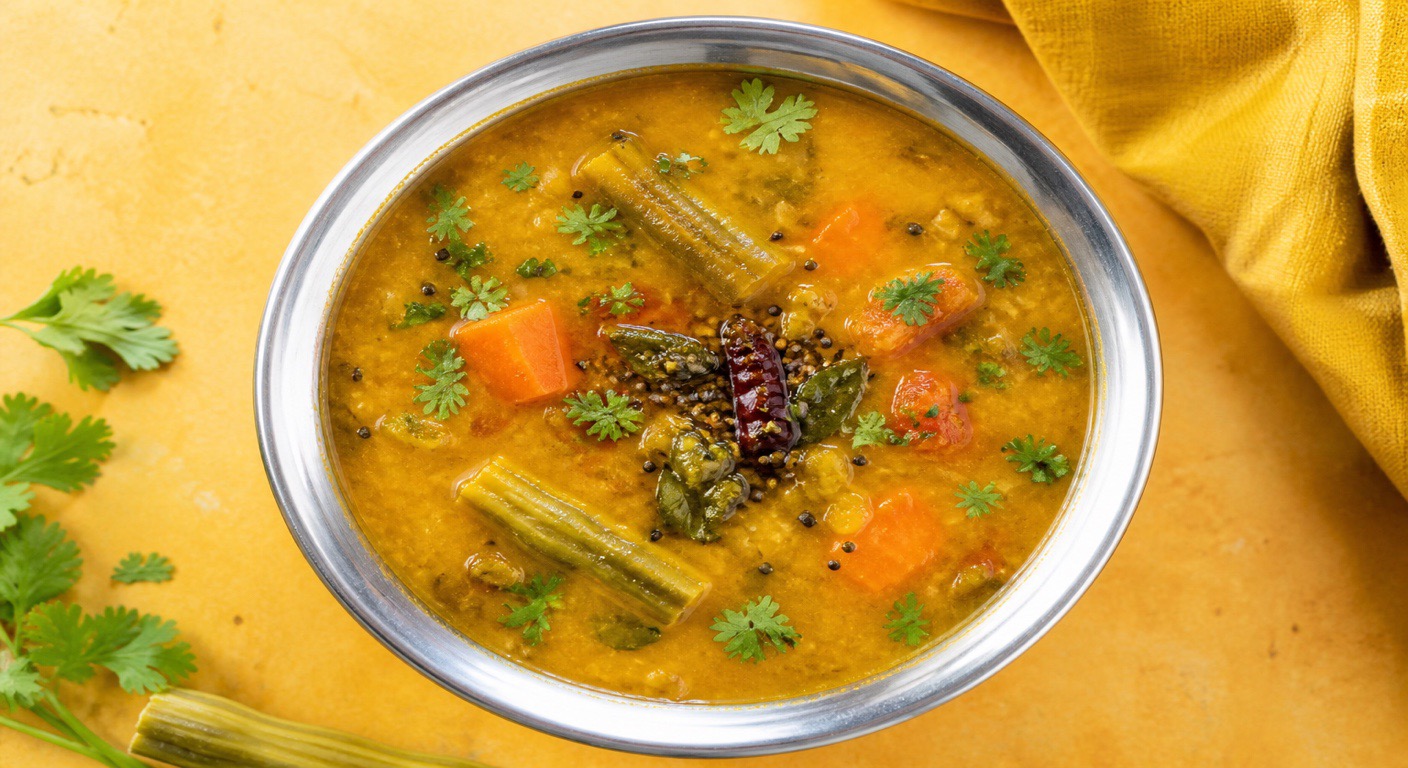
Is sambhar one of the lighter Indian gravies?
A home katori of sambhar is only about 120-150 kcal, mostly cooked dal and vegetables with very little oil. The tadka is the one small part that can quietly change the number.
Sambhar is the South Indian stew you eat with idli, dosa, or rice. It is made from toor dal, mixed vegetables, and tangy tamarind. Next to creamy north Indian gravies, it is genuinely one of the lighter bowls on your thali. But the little spoon of hot oil poured on top, the tadka, is where the calories can quietly change.
A home katori of sambhar
One normal home katori, about 230-240 g, comes to roughly 120-150 kcal. Most of that is the cooked dal and the vegetables. The fat is small, usually only 2-5 g per katori, because sambhar uses far less oil than a butter curry.
Assumptions: Built from three real Tarla Dalal home recipes. The idli-and-dosa sambhar (recipe #1663) is 122 kcal per 234 g serving, 3.4 g fat, made with 1 tbsp oil across 5 servings. The homemade sambhar (recipe #1557) is 143 kcal per serving, 5.4 g fat, made with 2 tbsp oil across 6 servings. The higher-dal healthy sambhar (recipe #3578) is 151 kcal per serving but only 1.6 g fat, because it uses 1 cup toor dal with just 1 tsp oil. A normal katori sits in the middle, around 135 kcal.
Sambhar next to a rich gravy
See how big the gap is. One katori of sambhar is a small number. One serving of paneer butter masala, a loved north Indian gravy, is more than four times higher, because it is built from paneer, butter and cream.
Sambhar is a diet food, so you can eat unlimited bowls.
mostly falseMostly false. Sambhar is light, around 120-150 kcal a katori, but it is not calorie-free. The rice, idli or dosa you eat with it carry the real bulk of the meal. And extra oil in the tadka can push each bowl higher, so the bowls are not free even when the restaurant refills them.
Keep the tadka light
The tadka is hot oil with mustard seeds and curry leaves, poured on top at the end. Each extra tablespoon of oil in the pot adds about 133 kcal, which is roughly 22 kcal per katori across six servings. Use one teaspoon, not two tablespoons, and you keep the flavour without the oil cost.
Assumptions: Baseline katori (~135 kcal) sits near the 1-tbsp-oil recipe (#1663). Each tablespoon (15 g) of oil is ~133 kcal at 884 kcal/100 g. Cutting one tablespoon out of a 6-serving pot removes about 22 kcal per katori, giving ~113 kcal, close to the low-fat healthy recipe (#3578) at 1.6 g fat. This is a transparent kitchen estimate from the oil value, not a lab test of one brand.
Small habits that keep sambhar light
- Sambhar's vegetables, drumstick, pumpkin, carrot and tomato, add bulk and fibre for almost no calories, so a fuller bowl is still a light bowl.
- The calories climb with what you eat alongside, the rice, idli or dosa carries more than the sambhar, so watch those portions.
- At a restaurant, sambhar is often refilled free, but it can carry more oil than the home version, so one bowl is enough to enjoy the flavour.
- For more protein with the same lightness, add a little extra toor dal and keep the oil to one teaspoon.
The bottom line
A home katori of sambhar is about 120-150 kcal, one of the lightest gravies on an Indian thali. The vegetables and dal fill you up for very few calories, and only the tadka's oil can quietly push it higher. Keep the oil to a teaspoon, watch the rice, and sambhar stays a smart pick.