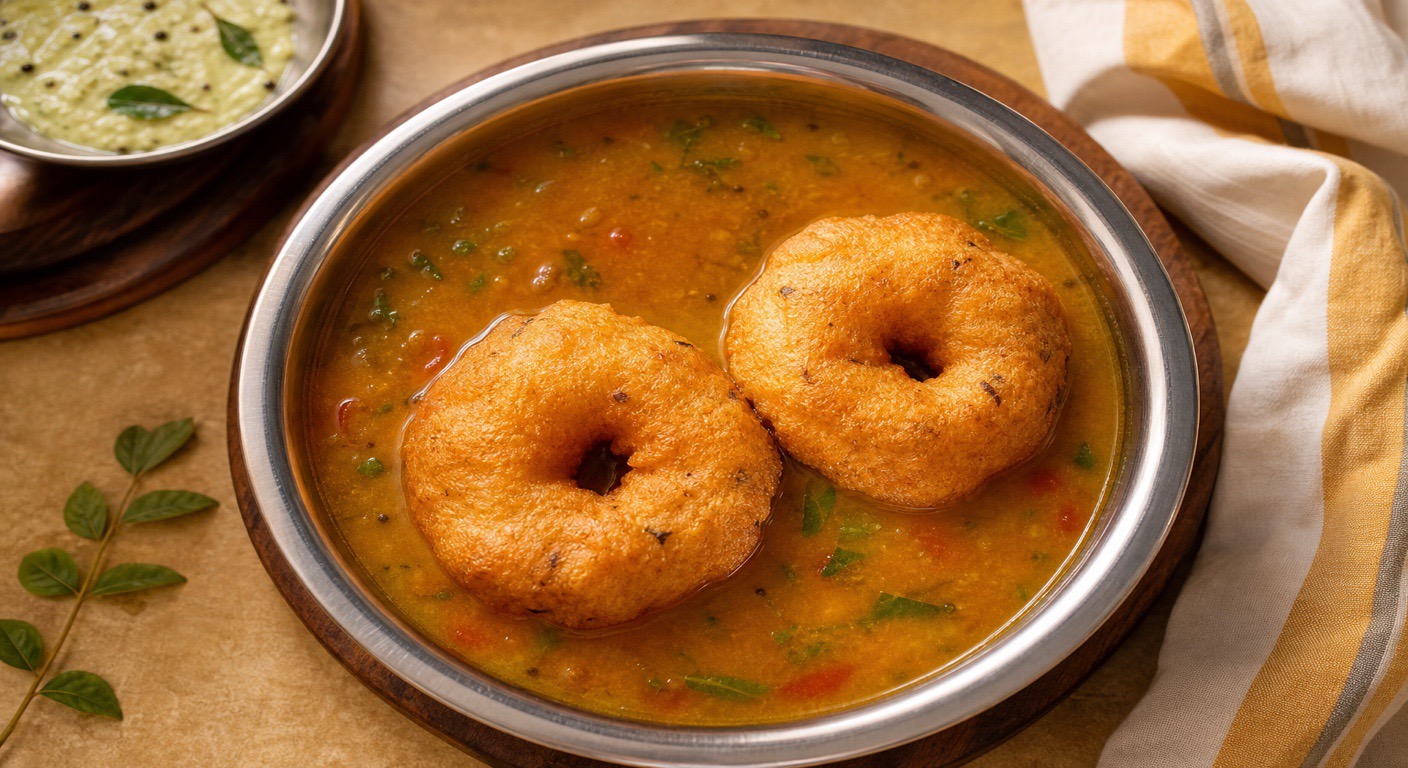
Sambhar vada: why the little vada is the heavy part
A sambhar vada order of two vadas with a katori of sambhar is about 315 kcal, and most of the fat comes from the deep-fried vada, not the light dal soup. Swap to idli-sambhar or an appe-pan vada and the same bowl drops to roughly 185 kcal.
You order sambhar vada and a big bowl of sambhar arrives. It looks like the main event. But the sambhar is actually the light part. The small fried vada soaking in it is where the calories hide. See the real numbers and you can keep the flavours you love for a lot fewer calories.
Sambhar vada is healthy because sambhar is a light dal soup.
it dependsIt depends - the sambhar part really is light, but the vada is deep-fried. In one medu vada, fat is the biggest single chunk: 47 of the 97 kcal come from frying oil. So the combo's calories come mostly from the vada, not the soup.
Your typical order: 2 vadas with a katori of sambhar
A normal sambhar vada plate - two medu vadas and one katori of sambhar - comes to about 315 kcal. The sambhar is mostly dal and vegetables with very little fat. The two fried vadas carry almost all the oil on the plate.
Assumptions: 2 medu vadas at 97 kcal each = 194 kcal. 1 serving (234 g) of sambar made for idlis and dosas = 122 kcal, with only 3.42 g fat. Total = 316 kcal, rounded to about 315.
Per piece: vada vs idli vs sambhar
Swap the vadas for idli - keep the sambhar
The easiest lighter order. Two soft idlis with the same katori of sambhar keep the south-Indian breakfast feel and cut the fried oil entirely. Idli is steamed, so almost all its calories come from rice and dal - not fat.
Assumptions: 2 idlis at 33 kcal each = 66 kcal. Same 1 serving (234 g) sambar = 122 kcal. Total = 188 kcal, versus 316 kcal baseline. Savings = 128 kcal.
Love the vada? Cook it in an appe pan, not a kadai
If you really want vada, make it at home in an appe (paniyaram) mould with just a brush of oil. You get the same urad-dal crispiness without the deep-fry soak. Tarla Dalal's low-calorie medu vada comes to about 31 kcal per vada this way.
Assumptions: 2 appe-pan medu vadas at about 31 kcal each (155 kcal per 5-vada serving) = 62 kcal. Same 1 serving (234 g) sambar = 122 kcal. Total = 184 kcal. Savings = 132 kcal versus the 316 kcal baseline.
Small moves for your sambhar vada order
- Order one vada instead of two - you still get the fried treat, just half of it.
- Ask for extra sambhar on the side - it is the light, filling part of the plate.
- At home, an appe pan with a brush of oil gives you vada texture without the deep fry.
- Pick idli-sambhar on days you want to go light - it is the same south-Indian flavour, steamed not fried.
The bottom line
The sambhar in your sambhar vada is genuinely light - mostly dal and vegetables with little fat. The small fried vada is the heavy part: almost half its calories come from frying oil. A typical two-vada order lands near 315 kcal. Swap to idli-sambhar, or cook your vada in an appe pan, and the same bowl drops to about 185 kcal. Keep the sambhar - go easy on the fry.