Why your metabolism drops with age - and how to fight it
Your metabolism dips as you get older mostly because you slowly lose muscle and move less, not because your cells mysteriously slow down. From your 30s you shed muscle every decade unless you actively use it, and that lost muscle quietly lowers your BMR. Lifting weights and eating enough protein fights it at any age.
Your aunt turned 50 and swears she eats half of what she did at 30, but the weight still creeps on. She blames 'slow metabolism with age.' It feels true. But the real story is more hopeful: aging itself is not the fate. The quiet thing happening is that you slowly lose muscle from your 30s onward unless you actively use it, and muscle burns calories even at rest. Less muscle means a lower BMR. The good news is you can fight it, and it works in your 40s, 50s, and 60s-plus.
Your baseline: a 75 kg man in his 30s
Picture a 75 kg man, 175 cm tall, age 35, who moves around a fair bit. Using the Mifflin-St Jeor formula, his BMR is about 1,674 kcal/day. A big chunk of that resting burn comes from his organs, and a meaningful slice from his muscle. Muscle burns roughly 13 kcal per kilogram per day at rest. So if he carries about 28 kg of skeletal muscle, that is around 360 kcal/day just from muscle sitting idle. Keep that number in mind. It is the lever age pulls on.
Assumptions: 75 kg, 175 cm, male, age 35, ~28 kg skeletal muscle; Mifflin-St Jeor formula. Muscle metabolic rate ~13 kcal/kg/day from Wang 2010.
What happens at 30, 45, and 60 if you don't train
Muscle quietly leaves you decade by decade if you sit at a desk and do nothing about it. Reviews put the cross-sectional loss at about 0.47% per year in men and 0.37% per year in women, and past 50 the leg muscles alone thin by 1-2% per year. Add in less daily movement (fewer stairs, more two-wheeler and chair time) and BMR slips. Here is how the trend looks for the same 75 kg man if he stays sedentary.
Myth: your metabolism slows down with age because your cells just get lazy.
partly truePartly true but mostly misread. Yes BMR falls with age, but a large share of that fall is because you carry less muscle and move less, not because every cell mysteriously slows. Muscle is metabolically active tissue (~13 kcal/kg/day). When you lose 5 kg of it over 30 years, that is roughly 65 kcal/day gone from resting burn, before counting the daily activity you also dropped. Aging plays a role, but lost muscle is the part you can actually push back on.
The counter: lift weights 2-3 times a week and eat enough protein
Add 2-3 resistance sessions a week (squats, push-ups, rows, lunges - bodyweight or dumbbells) and keep protein high at every meal.
This works in your 40s, 50s, and 60s-plus, not just for the young. A meta-analysis of 47 studies and 1,079 adults aged 50 and up found resistance training added 25-33% strength on common lifts. More muscle kept means more resting burn kept. If you hold onto about 3 kg of muscle you would otherwise have lost, that is roughly 40 kcal/day of BMR preserved, plus the workout itself burns calories. Pair it with enough protein (roughly 1.2-1.6 g per kg body weight) and you give your body the bricks to rebuild. Burnie logs your food and shows your deficit, protein included, so you can see both halves at work.
Assumptions: 75 kg reference man; keeping ~3 kg muscle vs losing it (~3 x 13 = ~40 kcal/day BMR preserved) plus ~2 workouts/week averaging ~50-60 kcal/day extra burn; protein ~1.2-1.6 g/kg/day. Delta vs the age-60 sedentary decline path in the compare section.
Practical ways to keep your muscle as you age
- Start with two short strength sessions a week. Squats, push-ups against a wall, and lunges need no gym. Add dumbbells when it feels easy.
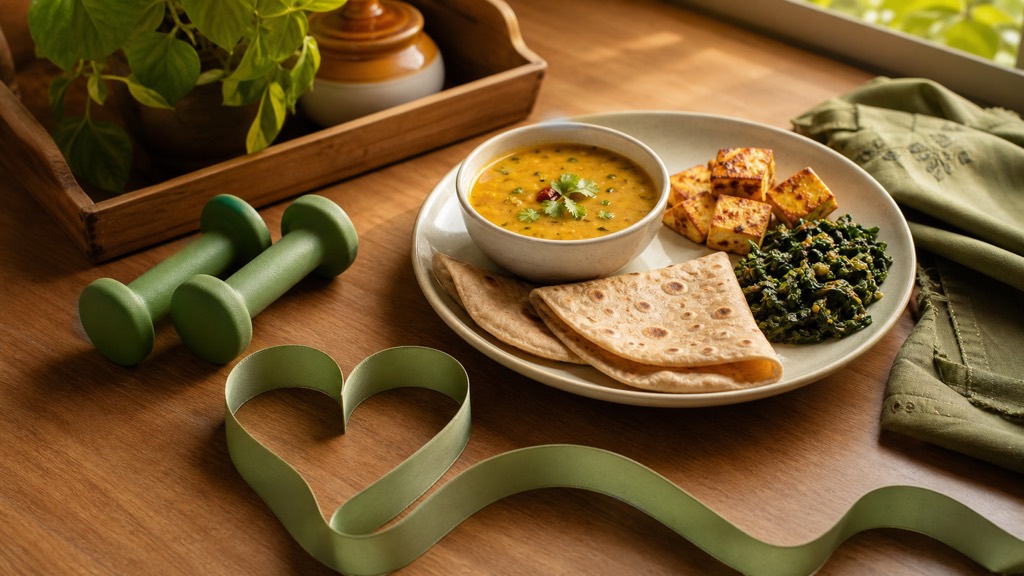
- Put protein in every meal. Eggs, paneer, curd, dal, chicken, fish, soya chunks - aim for a fist-sized portion. Roughly 1.2-1.6 g per kg body weight per day is the common range for older adults who train.
- Walk too. Walking is not muscle-building, but it keeps your legs working and your daily activity up, which protects against the 'move less' half of the slowdown.
- Don't crash diet. Hard calorie cuts without protein and strength work make you lose muscle, which is the exact tissue that keeps your BMR up.
- Sleep 7-8 hours. Muscle is built and repaired at night. Poor sleep chips away at the gains you worked for.
The bottom line
Aging is not the fate; lost muscle is. From your 30s you shed muscle every decade unless you actively use it, and that lost muscle quietly lowers your BMR. Lift something heavy twice a week, eat protein at every meal, and walk. That keeps the muscle that keeps your metabolism. Burnie logs your food and shows your deficit and protein - the simple engine that does the real work.