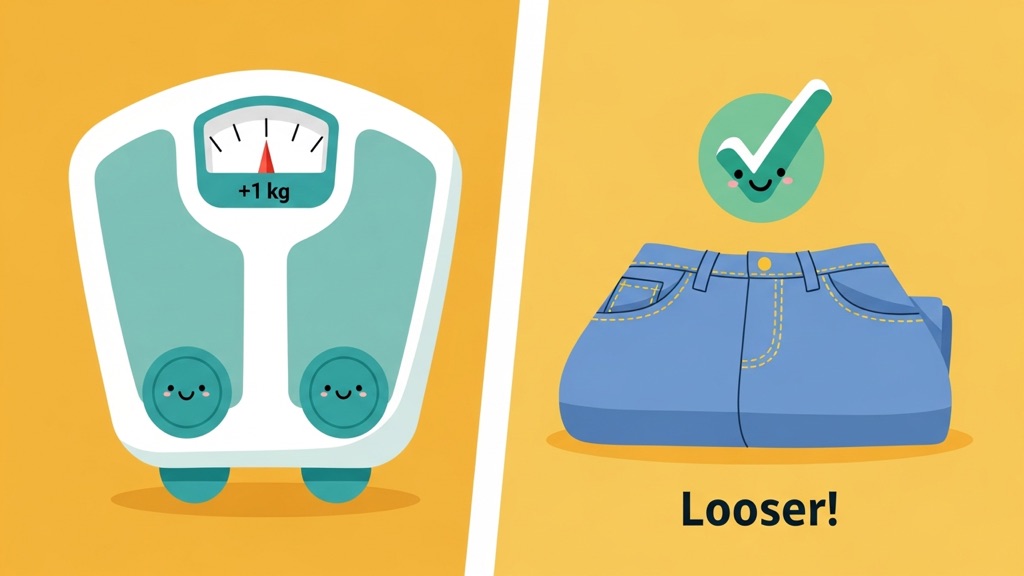
When the scale says up but your clothes say down
You step on, the scale is up a kilo, but the jeans that were tight last week now zip without a fight. The scale adds up water, muscle, glycogen and waste too, so two signals can disagree - and the jeans usually read the truth the scale is hiding.
Monday morning. You zip your jeans. They feel easy - looser than last Friday. You feel good. Then you step on the scale. It says you are 1 kilo heavier. Your heart sinks. "How? My clothes say I lost weight, but the number says I gained." This read is about that exact fight between two signals - and why the jeans are usually telling the truth.
If the scale went up, you must have gained fat.
mostly falsemostly false
The scale only measures one thing: the total weight of your body, all mixed together. It cannot tell fat from water from muscle. About 50 to 60% of your body weight is just water. So a small shift in water shows up as a big shift on the scale, even when your fat has not changed at all. A higher number does not mean higher fat. It often means more water, more waste in your gut, or more sugar stored in your muscles - not more fat.
What the scale is actually adding up
Think of the scale as a sum, not a single thing. Your weight = fat + muscle + water + stored sugar (called glycogen) + waste in your gut. Water alone is more than half of that sum. And your body stores sugar in your muscles and liver with about 3 to 4 grams of water stuck to every gram of sugar. So when you eat a few extra rotis or a plate of rice, your muscles fill up with sugar and water - and the scale jumps. None of that jump is fat. It is sugar plus water, sitting there until you use it.
What the scale sees vs what your clothes see
Why your deficit still counts when the scale is loud
Here is the honest maths of fat loss. Fat is stored energy - lots of energy packed into a small space. So a steady daily deficit, added up over two or three weeks, pulls real fat out of your body. That is how a caloric deficit works: eat a little less energy than you burn, and your body fills the gap from its fat store. The scale may hide that fat loss on any one morning under extra water, sugar, or waste. But the maths still happened. If your Burnie log shows a steady deficit, fat is leaving your body - even when the scale is noisy and wrong. Trust the maths over the morning number.
How to read the two signals without panic
The bottom line
When the scale says up but your clothes say down, your clothes are almost always right. The scale sums up fat, muscle, water, sugar and waste all jumbled together - and water alone is more than half your weight. Your jeans read the one thing you actually want to change: the shape and size of your body. So log your food, watch your weekly deficit in Burnie, and let the jeans settle the argument. Burnie is FREE, so the maths is not a bill - it is just maths.