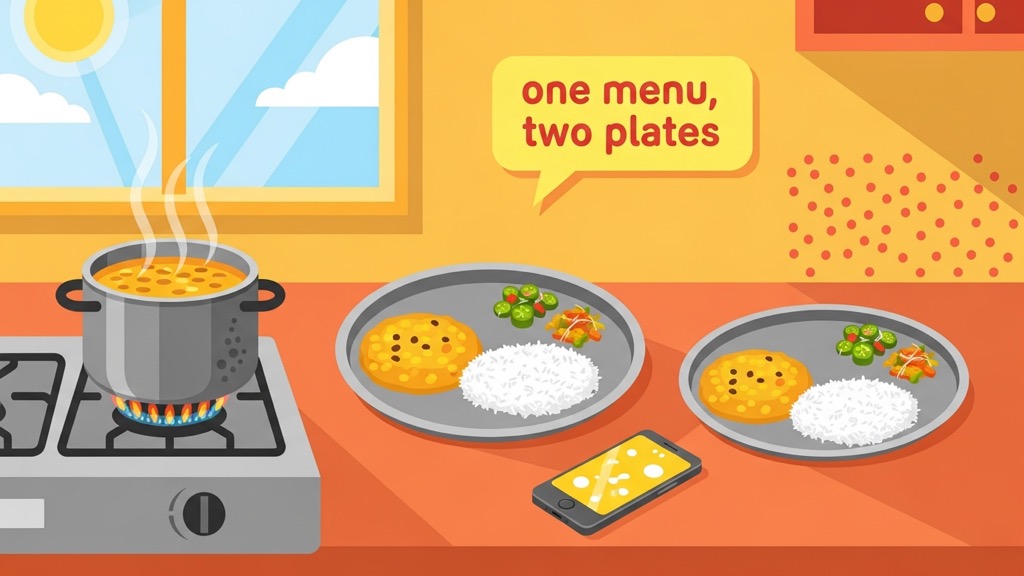
How two people share a kitchen but keep different deficits
Two people in one home rarely need the same calories, because a bigger or more active body burns more fuel each day. You can cook one pot of dal and still serve two honest plates, each logged in Burnie before the first bite.
You both come home hungry. One pot of dal is on the stove. The sabzi smells lovely. Two rotis sit hot on the tava. You serve two plates from the same food. But your bodies are not the same size. So your plates should not be the same either. This short read is about sharing a kitchen without sharing a deficit.
Your body is not their body
Two people in one home often need different calories. A heavier body burns more fuel, even at rest. Men often burn more than women at the same weight. And a person who moves more burns more than a person who sits all day. A top food science report gives each adult their own energy number. It is worked out from their sex, their body size, their age, and their activity. So one shared kitchen must hold two different maths, not one.
If we cook one pot, we both have to eat the same amount.
mostly falsemostly false
Same food, yes. Same amount, no. The smart move is to cook one menu, then plate it two ways. The bigger or more active person takes more rice, one extra roti, a bigger spoon of dal. The smaller person takes less of the same dishes. Nothing is wasted, and no one cooks twice. Take the roti as proof. India's food experts, ICMR-NIN, list wheat atta at about 320 kcal per 100g. One plain roti holds about 30g of atta, so it is about 100 kcal. Two rotis are about 200 kcal. That is a 100 kcal gap, made from the same tava, just by counting rotis.
One shared dinner, two honest plates
Cook once, plate two ways
The bottom line
One kitchen can hold two honest deficits. Cook one menu. Serve two sizes. Log each plate in Burnie before the first bite. The smaller body takes a little less from the same pot, and that is fair maths, not a smaller life. Burnie is free, so both of you can run your own numbers side by side.